<b>When a buyer's inspection turns up problems, they usually don't walk — they come back asking for money.</b> The cost of an inspection-contingency price renegotiation is whatever credit, price cut, or repair allowance you agree to just to keep the deal alive, on top of the commission and closing costs you were already paying. On a typical sale that can run from a few thousand dollars to several percent of your price, and you have little leverage to refuse once the house is off the market.
Step 1 of 5
Tell us about the property and we'll send a written cash offer within 24 hours, no inspection contingency, no repair credits sprung on you after you're under contract, no commissions.
You’ll talk to Trevor McAmis, Owner & Acquisitions Lead
(313) 710-6129
Takes about two minutes. Or call (313) 710-6129 — we answer.
Educational only. This explains how these situations generally work. It is not legal, tax or financial advice, and the rules differ by state — talk to an attorney or CPA about your own situation before you act on any of it.
A standard residential purchase contract gives the buyer an inspection contingency — a defined window, usually 7 to 14 days, to have the home professionally inspected and respond. The buyer has three options once the report comes back with anything notable, and nearly every inspection finds something: accept the home as-is and proceed, walk away and get their earnest money back, or come back and ask the seller to fix it.
That third option is the inspection-contingency renegotiation, and it almost always takes one of three forms: a price reduction (the sale price itself gets cut), a credit at closing (the sale price stays the same on paper but cash goes back to the buyer at the closing table), or a split (the seller makes some repairs directly and credits the rest). The Consumer Financial Protection Bureau's guidance on scheduling a home inspection describes exactly this dynamic: an inspection contingency lets a buyer cancel without penalty if they're not satisfied, but inspecting early “gives you time to identify any problems so you can negotiate with the seller to get them fixed or get a credit for needed repairs.” That's the buyer's playbook, in the government's own words.
This is the opposite problem from the one covered in our guide on the cost of lender-required repairs before closing. That situation is about a lender's appraiser mandating specific fixes — a missing handrail, exposed wiring, a leaking roof — before the bank will fund the loan, and there's no negotiating with an appraiser. An inspection-contingency renegotiation is a negotiation, full stop, which is exactly what makes it expensive: the buyer is asking for a concession, not reporting a requirement, and the seller is the one deciding how much to give up to keep the deal.
Here's an illustrative example — a generic $300,000 sale price, not tied to any specific house or any specific offer. The math scales up or down with any other price.
Start with the costs that apply whether or not a buyer ever asks for a renegotiation: a typical real estate commission (commonly cited in the 5–6% range nationally, 5.5% used here) and typical seller-side closing costs — title fees, transfer tax, attorney fees, prorations — commonly another 1–2% of sale price, 1.5% used here.
Scenario 1 — retail sale, no inspection renegotiation: sale price $300,000, minus commission at 5.5% (−$16,500), minus closing costs at 1.5% (−$4,500), for net proceeds of $279,000.
Scenario 2 — retail sale, with an inspection-contingency renegotiation: the buyer's inspector flags a roof section, an aging water heater, and a few electrical items. Rather than walk, the buyer asks for a credit. For illustration only — a hypothetical, not a verified industry average — say that credit lands at 2% of sale price, or $6,000. Net proceeds: $300,000 minus $16,500 commission, minus $4,500 closing costs, minus $6,000 renegotiation credit, equals $273,000. That credit sits on top of everything else, not instead of it — it comes off the $279,000 the seller expected to keep, not off the $300,000 sticker price.
Scenario 3 — cash, as-is sale, no post-inspection renegotiation risk by design: a cash buyer purchasing as-is isn't sending an inspector to generate a renegotiation request, because the home's condition is priced in before the offer is made, not discovered after the seller is already under contract. For illustration only, say that offer comes in at $258,000 — lower than the retail price because it reflects the home's condition and the certainty of a no-contingency close, not a promise of what any specific buyer would pay for any specific house. With no commission and typically little to no seller-paid closing costs, net proceeds land at roughly $258,000.
| Scenario | Sale price | Commission | Closing costs | Inspection credit | Net proceeds |
|---|---|---|---|---|---|
| Retail, no renegotiation | $300,000 | −$16,500 | −$4,500 | $0 | $279,000 |
| Retail, with renegotiation (illustrative 2%) | $300,000 | −$16,500 | −$4,500 | −$6,000 | $273,000 |
| Cash, as-is (illustrative, generic) | $258,000 | $0 | ~$0 | $0 (no risk by design) | ~$258,000 |
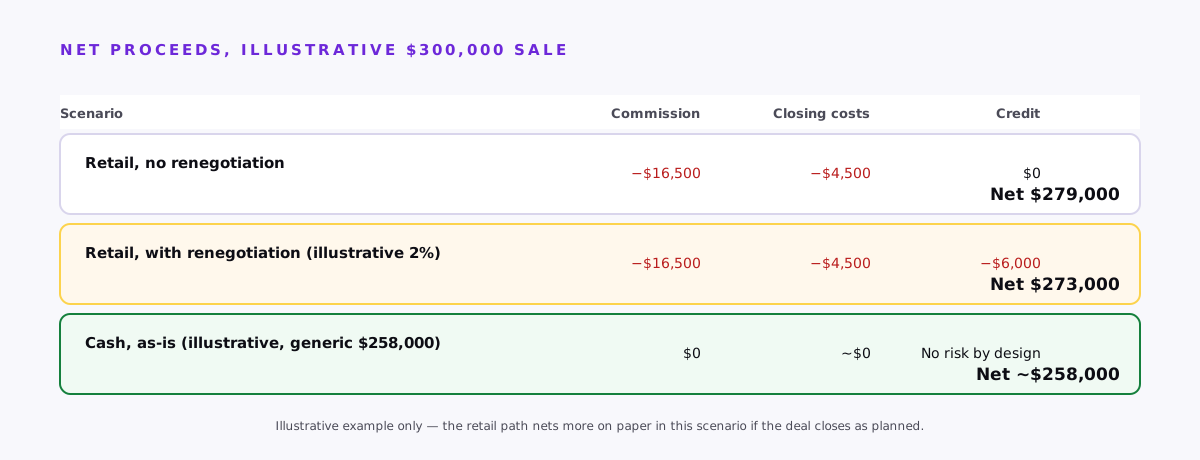
Read that table honestly: the cash number is the lowest of the three. A retail sale, even with a renegotiation hit, still nets more on paper in this illustration. The real tradeoff isn't that cash always wins — it's that the retail numbers assume the deal actually closes on schedule, at that price, with no further surprises. The cash row has no renegotiation line item because there's no inspection contingency to renegotiate against, not because the number is guaranteed to beat every retail outcome.
The uncomfortable part of an inspection-contingency renegotiation isn't the dollar amount — it's that the seller is negotiating from a worse position than before accepting the offer. Three things shift against the seller the moment a contract is signed.
The house is already off the market. Every day it sits “under contract” is a day it isn't being shown to anyone else. If this buyer walks over a renegotiation dispute, the seller isn't resuming a bidding war — they're starting over, and every week back on the market costs money in carrying costs and signals something to the next round of buyers.
The buyer's switching costs are now lower than the seller's. The buyer has paid for an inspection and maybe an appraisal, but can still walk away relatively cleanly inside the contingency window and get earnest money back. The seller has to re-list, re-market, and re-negotiate from scratch, losing whatever momentum and price anchoring the first offer provided.
A relisted house signals a problem to the next buyer. Agents and serious buyers both notice when a listing returns to the market after going “pending” or “under contract.” The natural question is what happened, and the honest answer — an inspection issue — is exactly the kind of thing the next buyer wants to know before making their own offer, handing that next round of negotiation to them too.
Put together, those three facts mean most sellers accept some version of the buyer's ask rather than risk the deal collapsing. It isn't that the repairs always justify the dollar amount requested — it's that the alternative, walking away from this buyer and starting the process over with someone else, usually costs more in time and uncertainty than the credit costs in cash.
A seller listing with an agent can shrink this risk before it ever shows up, rather than negotiating it away after the fact.
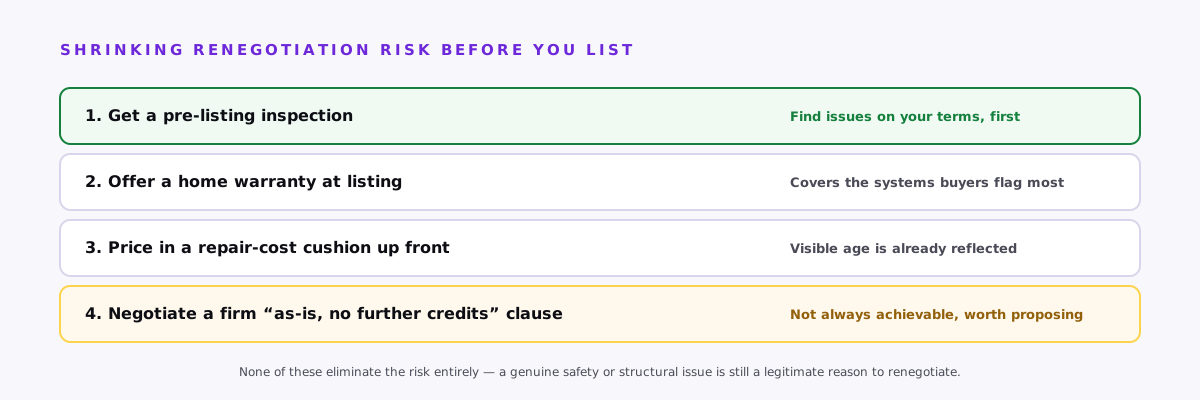
Get a pre-listing inspection. Paying for an inspector before listing surfaces the roof, water heater, or electrical panel issues before a buyer's inspector does. Our guide on the cost of a pre-listing home inspection walks through what that typically runs, and why finding problems first, on the seller's own terms, is usually cheaper than having a buyer find them during a live renegotiation.
Offer a home warranty at listing. A one-year home warranty covering major systems and appliances can take some categories of buyer concern off the table before an inspection ever happens, since many common post-inspection asks involve exactly the systems a warranty covers.
Price in a repair-cost cushion up front. If the roof or HVAC is visibly nearing the end of its life, pricing the home with that reality already built in makes a buyer less likely to treat an inspection finding as new leverage, since the price already reflects visible age.
Negotiate a firm “as-is, no further credits” clause. Some buyers will accept a clean as-is clause limiting further negotiation to safety and structural issues only, in exchange for a slightly lower asking price. It isn't always achievable in a competitive market, but it's worth proposing, particularly to a buyer who has already waived other contingencies.
None of these eliminate the risk entirely — a buyer can still ask, and a genuine structural or safety issue is a legitimate reason to renegotiate regardless of what the contract says. But each one narrows how much room a buyer has to use a routine inspection finding as a lever for a large concession.
Two verifiable data points are useful context, though neither hands over a precise “average renegotiation size” — that figure isn't something any major research publisher reports in a standardized way, so any specific percentage quoted elsewhere should be treated as an illustration, not a verified industry average.
The National Association of Realtors' Realtors Confidence Index, based on monthly surveys of its members, has reported that only around 20% of buyers waived the inspection contingency entirely in recent survey months — meaning roughly 80% of buyers kept the right to inspect and come back to the negotiating table. That's the scale of exposure: the large majority of sales carry this risk, not a small edge case.
Separately, Redfin's analysis of closed sales found that 44.4% of U.S. home-sale transactions included a seller concession of some kind in the first quarter of 2025, up from 39.3% a year earlier. Redfin's definition of “concession” there covers money toward repairs, closing costs, or mortgage-rate buydowns, and specifically excludes straight price reductions, so it understates total renegotiation activity rather than overstating it. Even on that narrower definition, concessions showed up in nearly half of all closed sales — a sign that asking for money back after going under contract is closer to normal than rare in the current market.
An inspection-contingency renegotiation isn't a scam or a sign of picking the wrong buyer — it's a built-in feature of how a standard purchase contract works, and it shows up on financed and cash-retail sales alike whenever a contingency gives the buyer room to inspect and come back. The real cost is twofold: the credit or price cut itself, layered on top of commission and closing costs already being paid, and the weak negotiating position a seller is in once the house is off the market and re-listing means starting the clock over.
A pre-listing inspection, a home warranty, a pricing cushion, or a firm as-is clause can all shrink that exposure in a retail sale. An as-is cash sale removes the inspection-renegotiation line item by design, in exchange for a price that reflects the home's condition up front instead of after going under contract — a real tradeoff worth running the numbers on for any specific situation, rather than assuming either path automatically wins.
A cash offer prices the home's condition in up front, so there's no inspection contingency and no renegotiation request waiting for you after you're already under contract and off the market.
You'll get a written offer within 24 hours, no repairs or commissions required, and you pick the closing date. This is general information, not financial or legal advice — run your own numbers before deciding what's right for your situation.
All guides · Cost of lender-required repairs before closing · Cost of a pre-listing home inspection · Cash offer vs. listing net proceeds
Step 1 of 5
No obligation, no fees, no repairs. We respond the same day.
You’ll talk to Trevor McAmis, Owner & Acquisitions Lead
(313) 710-6129
Takes about two minutes. Or call (313) 710-6129 — we answer.