An escrow shortage doesn't become a new bill when you sell. The 12-month repayment plan some borrowers get offered only applies if they keep the loan. Once you sell, the loan is paid off, and the unresolved shortage is handled in the final payoff accounting, either reducing your refund or changing the payoff figure sent to the servicer.

Step 1 of 5
Send the address and your approximate loan balance. We'll walk through your real payoff with you, including how your current escrow shortage gets settled, before you commit to a listing price or a closing date.
You’ll talk to Trevor McAmis, Owner & Acquisitions Lead
(313) 710-6129
Takes about two minutes. Your address is never shared.
Educational only. This explains how these situations generally work. It is not legal, tax or financial advice, and the rules differ by state. Talk to an attorney or CPA about your own situation before you act on any of it.
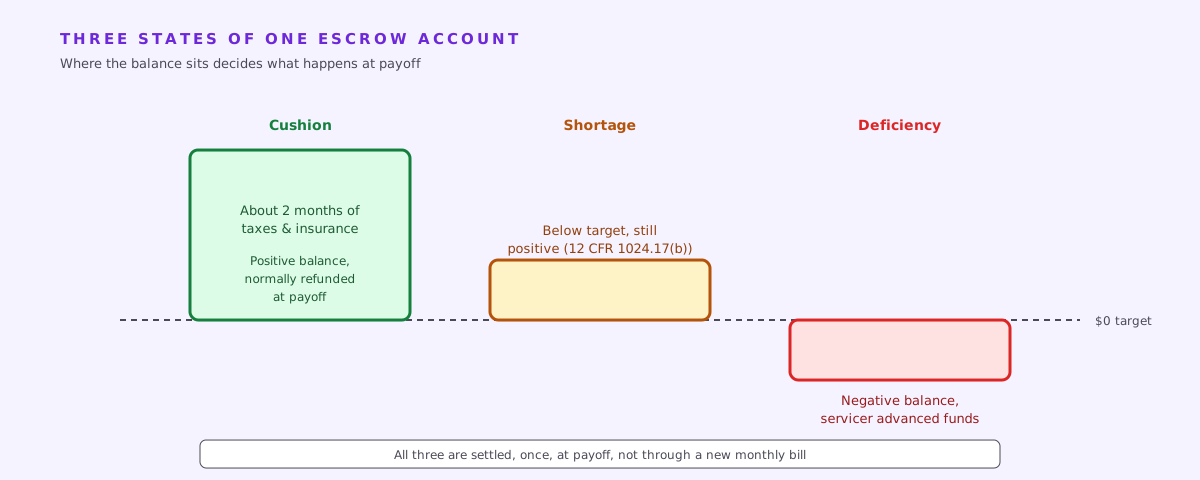
Your mortgage servicer collects extra every month into an escrow (impound) account to cover property tax and homeowners insurance bills on your behalf. Three different words describe three different states of that account, and mixing them up is where most of the confusion starts.
A cushion is the normal buffer, a reserve capped at about one-sixth of your estimated annual disbursements (roughly two months' worth) under federal escrow rules, 12 CFR 1024.17. It's intentional, and it's usually the balance that gets refunded to a seller after payoff.
A shortage is different. The account balance has fallen below that cushion target, but it's still positive. Under 12 CFR 1024.17(b), a shortage is defined as the amount by which the current escrow account balance falls short of the target balance for the account. It usually means a tax or insurance bill came in higher than the servicer projected, so future collections need to catch up.
A deficiency goes a step further. The balance actually went negative, because the servicer advanced its own money to pay a tax or insurance bill when the account didn't have enough to cover it. The same regulation defines a deficiency simply as the amount of a negative balance in an escrow account. A deficiency means the servicer already covered the bill out of pocket. A shortage means the account is thin but never actually ran empty.
Shortages and deficiencies trace back to a handful of common triggers. A county tax reassessment raises your annual bill after your servicer already set your monthly collection based on the old, lower number. A homeowners insurance premium jumps at renewal, sometimes sharply, after a claim in the area or a broader rate increase. You switch insurance companies mid-year and the new premium doesn't match what the servicer had budgeted. In every version, the account was sized for a bill that turned out bigger than projected, and the gap surfaces at the next annual escrow analysis, usually as a notice that your payment is about to go up.
If you keep the loan, your servicer has defined choices under 12 CFR 1024.17(f). For a shortage under one month's payment, it can leave it alone, bill a lump sum due within 30 days, or spread repayment in equal installments over at least 12 months, usually folded into a higher monthly payment going forward. For a shortage of a month's payment or more, that 12-month spread is the standard path. The whole plan assumes you'll keep making monthly payments long enough for the account to catch up.
Selling breaks that assumption. The loan is being paid off, not continued, so there's no future monthly payment left to spread anything across. The 12-month plan becomes moot the moment the loan is satisfied. What replaces it is the servicer's final accounting of the account. Under 12 CFR 1024.17(i)(4)(iii), if you pay off the loan during an escrow computation year, the servicer must send a short year statement within 60 days of receiving the payoff funds, closing the account out for good.
That statement settles the shortage, but it generally isn't a separate bill that lands in your mailbox weeks later. Servicers typically resolve an existing shortage against the loan at the point of payoff. Most sellers find it either raises the stated payoff figure their closing agent is told to wire the servicer, which comes straight out of sale proceeds, or it's netted against any cushion sitting on top of it, reducing what comes back as a refund instead of arriving as a separate charge. The exact mechanic can vary by servicer, which is exactly why a written, current payoff quote matters more than a guess from last year's annual statement. A deficiency is resolved the same way, since both are just variations on the account owing the loan, settled once, at the one moment the loan stops existing.
A shortage changes what nets to you. It doesn't change which selling path wins. Whichever way you sell, the shortage gets settled once, at payoff, the same way either time. What actually differs between listing and a cash sale is everything sitting next to it: repairs, commission, closing costs, and how long you carry the house.
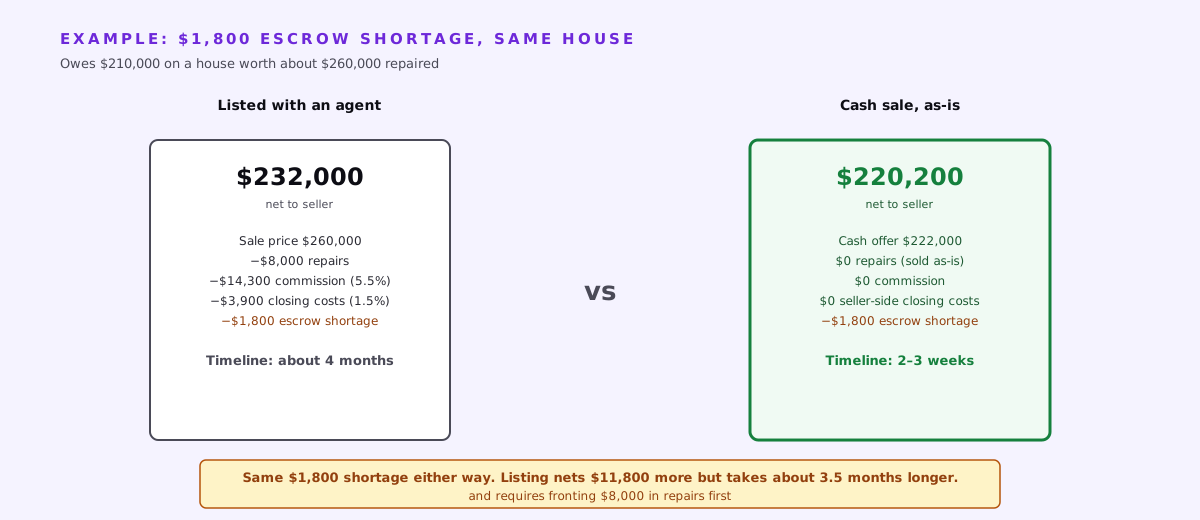
Example: a seller owes $210,000 on a house worth about $260,000 once repaired. A county tax reassessment pushed the bill up mid-year, and the servicer's latest statement shows a $1,800 escrow shortage on file.
| Line item | Listed with an agent | Cash sale, as-is |
|---|---|---|
| Sale price / offer | $260,000 | $222,000 |
| Repairs before sale | −$8,000 | $0 (sold as-is) |
| Agent commission (~5.5%) | −$14,300 | $0 |
| Closing costs (~1.5%) | −$3,900 | $0 |
| Escrow shortage settled at payoff | −$1,800 | −$1,800 |
| Net to seller | $232,000 | $220,200 |
| Typical timeline | About 4 months | 2–3 weeks |
In this example, listing nets about $11,800 more once repairs, commission, closing costs, and the shortage are all accounted for. The tradeoff is roughly three and a half additional months on the market, plus fronting $8,000 in repairs before any of that money shows up. A seller who can carry the mortgage, taxes, and insurance for four more months, and has $8,000 available upfront, comes out ahead listing. A seller who needs the account closed out now, can't front repair costs, or needs funds in weeks rather than months, is trading that $11,800 for roughly fourteen fewer weeks of carrying costs and zero repair spending. Neither path makes the shortage bigger or smaller. It's the same $1,800 either way, settled at the same moment: when the loan is paid off.
An escrow shortage gets settled at payoff whether you list or sell for cash, so it won't change which path we show you. What we can do is put a written cash offer in 24 hours next to a straight net-to-seller number, as-is, with no repairs and no commission, and let you pick the closing date.
All guides · Do you get your escrow refund back when you sell? · How a mortgage payoff statement works · Cash offer vs listing net proceeds
Step 1 of 5
No obligation, no fees, no repairs. We respond the same day.
You’ll talk to Trevor McAmis, Owner & Acquisitions Lead
(313) 710-6129
Takes about two minutes. Your address is never shared.
