The cost of a tenant buyout vs. eviction comes down to this: a buyout (cash for keys) typically runs a few hundred to a few thousand dollars and takes days to a few weeks, while a contested eviction can cost more in lost rent, filing fees, and attorney time, and take months. Waiting out the lease costs nothing upfront but delays your sale. The right choice depends on how much time you actually have.
Step 1 of 5
Tell us what's going on with the tenant and the lease. We'll build it into a written offer instead of asking you to resolve it first.
You’ll talk to Trevor McAmis, Owner & Acquisitions Lead
(313) 710-6129
Takes about two minutes. Your address is never shared.
Educational only. This explains how these situations generally work. It is not legal, tax or financial advice, and the rules differ by state. Talk to an attorney or CPA about your own situation before you act on any of it.
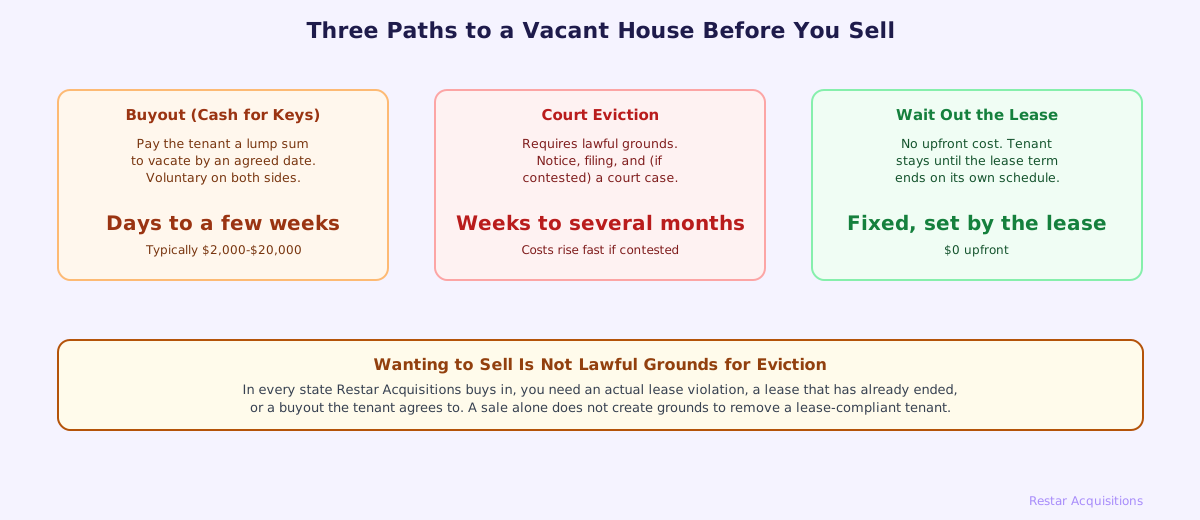
If you own a rental and want it vacant before you sell, you have three real paths: pay the tenant to leave early (a buyout, sometimes called cash for keys), file for eviction if you have lawful grounds and the tenant won't leave voluntarily, or simply wait until the lease term ends on its own.
Each path carries a different cost, a different timeline, and a different amount of risk that something drags it out longer than planned.
A buyout is a private agreement between you and the tenant, not a legal process, which is why it moves fast when it works. You offer a lump sum, the tenant signs an agreement to vacate by a specific date and return keys, and you pay on move-out. Cash-for-keys payments typically fall in the $2,000 to $20,000 range nationally, clustering around $3,000 to $8,000 for an ordinary single-family rental, and are sometimes structured as 2 to 6 months of rent instead of a flat number.
The number moves with how much notice you're giving, how good the tenant's alternative housing options are, and how badly you need the date certain.
A buyout is not an eviction and is not governed by eviction law. It only works because it's voluntary on both sides. If a tenant refuses your offer, you cannot use the threat of eviction to pressure them into taking it unless you actually have lawful grounds and intend to follow through. A buyout that reads as coercive can expose you to the same tenant-protection claims a wrongful eviction would.
Eviction has a real-dollar floor even in a clean, uncontested case: court filing fees and process-server or sheriff service typically run in the low hundreds of dollars. That floor rises fast the moment a tenant contests the case, requests a continuance, or raises a defense. Nationally, landlords filed roughly 1.26 million eviction cases in 2024, an overall filing rate near 8 percent of renter households, according to Princeton University's Eviction Lab, so a contested case eating months instead of weeks is a routine outcome, not a rare one.
Add to the filing and legal cost the rent you don't collect while the case is pending, and the make-ready cost once the unit is back, which tends to run higher after a contested move-out than a voluntary one. In many states, a landlord who wins also can't collect attorney's fees or back rent from a tenant with no money to pay it, which means winning the case in court doesn't always mean recovering the cost of getting there. The Eviction Lab at Princeton tracks filing volume and outcomes by state and county if you want to see how contested your local court actually runs.
Nothing upfront, and that's the appeal. If the lease has two months left and the tenant is paying and behaving, waiting costs you nothing extra beyond the opportunity cost of not selling sooner. The tradeoff is pure timing: you cannot force a lease-compliant, paying tenant out before the term ends just because you want to sell, in any state we operate in. If your sale timeline and the lease end date are close together, waiting is often the cheapest option on the table.
Sometimes, and this is where state and local law matters more than anything else here. California's Tenant Protection Act (AB 1482) requires landlords doing a no-fault, just-cause termination on a covered unit to pay relocation assistance equal to one month of the tenant's contract rent, and some local ordinances, including Los Angeles's rent stabilization rules, set relocation amounts well above that for long-term, senior, disabled, or low-income tenants.
A privately negotiated buyout agreement is a separate, voluntary contract and isn't itself required by AB 1482, but the law sets the floor a landlord would owe anyway for a lawful no-fault eviction, which is often the number both sides end up negotiating around.
None of the states we buy in (Alabama, Arizona, Florida, Georgia, Indiana, Maryland, Michigan, Missouri, Nevada, New York, North Carolina, Ohio, Pennsylvania, Texas) currently impose a statewide relocation-payment mandate like California's. Some cities within those states have their own rent-stabilization or just-cause ordinances with their own rules, so confirm your specific city's ordinance, not just your state's, before assuming no payment is required.
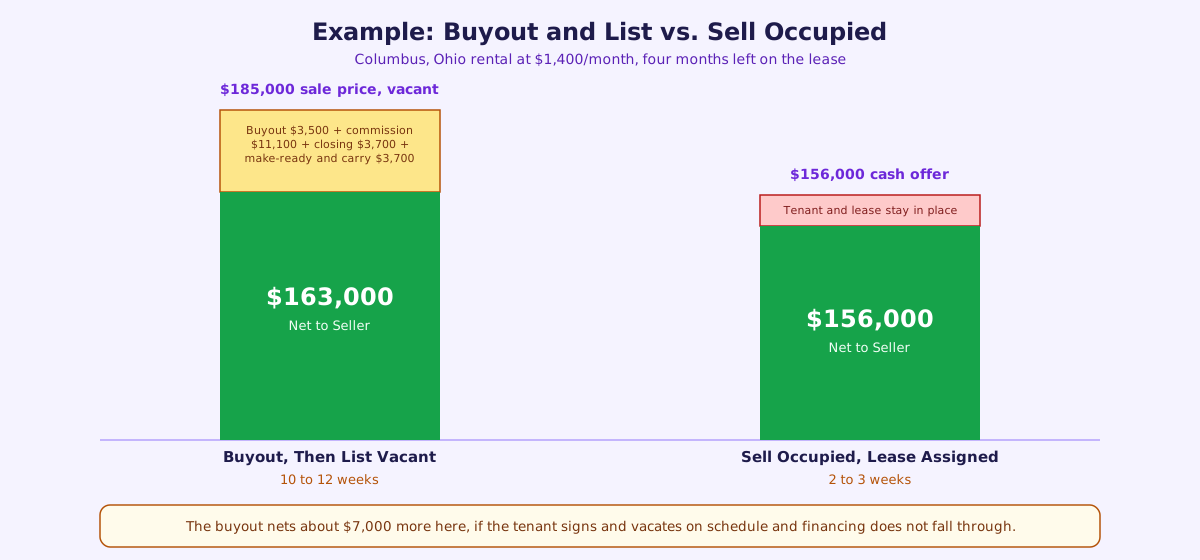
Example: a landlord in Columbus, Ohio has a tenant paying $1,400 a month, with a lease that still has four months left and no grounds for a for-cause eviction. The landlord wants to sell within six weeks. A buyout offer of $3,500 (about 2.5 months of rent) gets a signed move-out agreement for three weeks out. Filing for eviction isn't an option here at all since the tenant isn't in breach. Selling to a cash buyer with the tenant and lease still in place is the third path.
| Buyout, Then List Vacant | Sell Occupied, Lease Assigned | |
|---|---|---|
| As-is value, vacant | $185,000 | n/a |
| Cash offer, tenant and lease in place | n/a | $156,000 |
| Buyout payment to tenant | -$3,500 | $0 |
| Agent commission (6%) | -$11,100 | $0 |
| Closing costs (2%) | -$3,700 | $0 |
| Make-ready / cleaning | -$1,800 | $0 |
| Carrying costs while vacant and listed (2 months) | -$1,900 | $0 |
| Net to seller | $163,000 | $156,000 |
| Timeline | About 10 to 12 weeks total | 2 to 3 weeks |
A buyout and vacant listing nets about $7,000 more here, if the tenant actually signs and vacates on schedule and a financed retail buyer closes without delay. Selling occupied skips the buyout negotiation, the move-out risk, and the listing period entirely, at a lower number. If six weeks is a hard deadline and the buyout negotiation stalls even briefly, the occupied sale is the only path that still hits it.
Offer the tenant first right to buy, if they've expressed interest and can qualify for financing, which skips the vacancy question entirely.
Negotiate a short lease extension with a built-in move-out date, if your sale timeline has any flexibility, which can cost less than a buyout while still giving you certainty. HUD's tenant rights overview is a plain-language starting point for what notice and process your state requires either way.
Check your city's relocation-assistance ordinance before you set a buyout number, since some local rules set a floor you'd owe anyway on a no-fault termination, which should anchor your offer instead of guessing. A local landlord-tenant attorney can confirm your state and city's exact notice, grounds, and payment rules before you send a buyout offer or a notice to vacate.
Sell the property with the tenant and lease in place to a buyer who underwrites that as part of the deal, which is often the fastest path when any of the above options would take longer than you have. See our tired landlord situation guide, our guide on selling a rental property with tenants, and our guide on the cost of evicting a tenant before you sell for a closer look at eviction costs alone. Send us the property and we'll factor the tenant and lease into a written offer.
We buy rental properties with a tenant and an active lease still in place, no buyout or eviction required first. Tell us the situation and we'll give you a written offer within twenty-four hours, factoring in the tenancy instead of asking you to resolve it first. No repairs required, no commissions, and you pick the closing date. If a buyout and a vacant listing nets you more, this guide shows you that math too.
Send us the property here and we'll look at the tenant and lease situation and the numbers before you decide anything.
All guides · Tired landlord situation guide · Selling a rental property with tenants · The cost of evicting a tenant before you sell
Step 1 of 5
No obligation, no fees, no repairs. We respond the same day.
You’ll talk to Trevor McAmis, Owner & Acquisitions Lead
(313) 710-6129
Takes about two minutes. Your address is never shared.