<b>A real estate closing attorney typically costs $500 to $2,000 as a flat fee, or $150 to $600 an hour if billed hourly — and in Georgia and North Carolina, it isn't a choice.</b> Both states' supreme courts and state bars have ruled that conducting a residential closing is the practice of law, so a non-attorney title company legally cannot run the closing the way it can in Texas, Ohio, Michigan, or most other states. That distinction matters for a seller's math because the fee isn't really optional overhead in those two states — it's a fixed cost of selling there at all. This guide breaks down what the fee buys, which states actually require it versus which just commonly use one, and the real dollar comparison to a title-only closing.

Step 1 of 5
Tell us the state and we'll walk you through what's actually required there and what it costs.
You’ll talk to Trevor McAmis, Owner & Acquisitions Lead
(313) 710-6129
Takes about two minutes. Or call (313) 710-6129 — we answer.
Educational only. This explains how these situations generally work. It is not legal, tax or financial advice, and the rules differ by state — talk to an attorney or CPA about your own situation before you act on any of it.
The job overlaps with a title company's in places — both confirm clear title, prepare or review the deed, and make sure funds move correctly at closing — but an attorney is licensed to do things a title agent legally cannot: give you legal advice about the contract itself, resolve a title defect that needs a legal opinion rather than just a cleared exception, and take personal professional responsibility for the closing being handled correctly.
In a straightforward sale with clean title, the overlap is large. Where it isn't optional overhead is exactly the situation where something is already wrong — a cloudy title, an estate or trust seller, a contract dispute — and a title agent, who legally cannot give legal advice, has to stop and tell you to go hire one anyway.
This is the distinction most cost articles blur together, and it matters because the honest cost comparison for a seller depends entirely on which category a given state falls into. In a true attorney-required state, the fee isn't negotiable overhead you can shop away — it's baked into the legal cost of closing at all, the same way title insurance is.
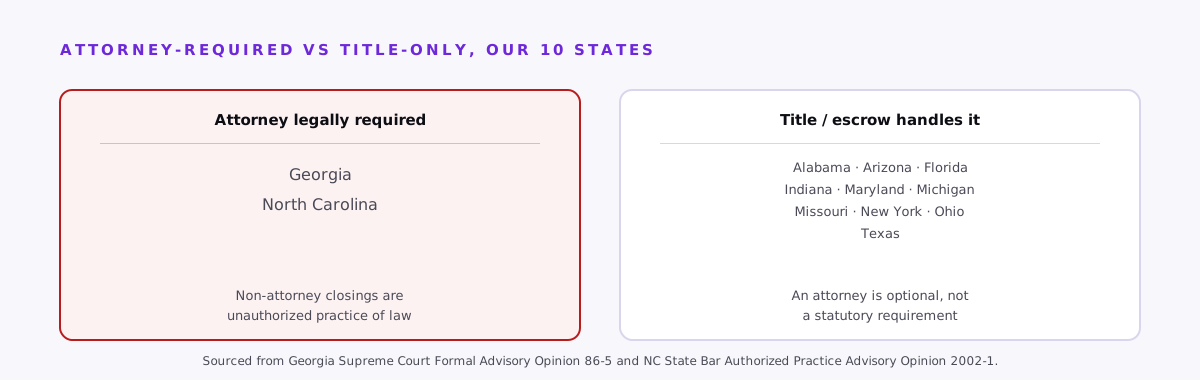
Georgia. The Georgia Supreme Court's Formal Advisory Opinion 86-5 (1986), reaffirmed in In re UPL Advisory Opinion 2003-2 (277 Ga. 472, 2003), holds that a real estate closing is the practice of law and requires a licensed Georgia attorney to be physically present and in control of the closing from start to finish — a non-attorney cannot be delegated that role. This applies statewide, including Atlanta, Savannah, Macon, and Columbus.
North Carolina. The North Carolina State Bar's Authorized Practice Advisory Opinion 2002-1, adopted 2003 and revised 2012, interprets the state's unauthorized-practice-of-law statute (N.C. Gen. Stat. Chapter 84) as prohibiting a non-attorney from handling a residential closing — interpreting title, resolving clouds on title, overseeing document execution, and disbursing funds are all reserved to a licensed attorney. This covers Durham, Fayetteville, Greensboro, High Point, Wilmington, and Winston-Salem.
Everywhere else in Restar Acquisitions' footprint — Alabama, Arizona, Florida, Indiana, Maryland, Michigan, Missouri, New York, Ohio, Texas — closings are legally handled by a title company or escrow agent, with no state requirement that an attorney be present. An attorney can still be hired in any of these states for advice or to handle a specific problem, and local custom varies by state and even by county — some New York and Maryland closings routinely involve an attorney by practice, not by statute — but it's an optional cost there, not a mandatory one. Confirm your specific state and county's practice before assuming either way; this is a general pattern, not a guarantee for every transaction type.
Attorney fee for a residential closing commonly runs as a flat fee of $500–$2,000, with most straightforward sales landing around $750–$1,250. Hourly billing, used more often when something non-routine comes up mid-transaction, typically runs $150–$600 an hour depending on the attorney's experience and market.
Title company / escrow settlement fee, the comparable charge in a non-attorney state, typically runs $300–$800, sometimes figured as roughly $2 per $1,000 of sale price in some markets — see our full breakdown of seller closing costs for everything else that stacks on top. This fee exists in attorney states too, in addition to the attorney's fee — the two aren't substitutes for each other; an attorney in Georgia or North Carolina still works alongside a title company handling title insurance and the title search itself.
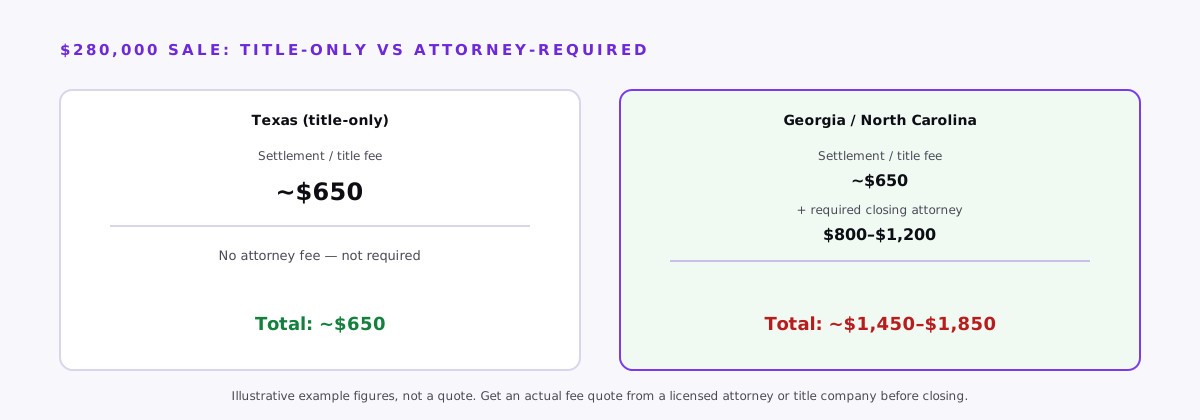
That means the honest state-to-state cost difference isn't the full attorney fee — it's the attorney fee added on top of settlement costs that exist everywhere. On a $280,000 sale: a Texas seller might see roughly $650 in settlement/title fees and nothing else. A Georgia seller on the same sale typically sees that same $650 in settlement/title fees plus $800–$1,200 for the required closing attorney — call it $1,450–$1,850 total, versus $650.
The attorney or settlement fee itself is a small, fairly fixed line item regardless of how you sell — it doesn't swing meaningfully between a cash sale and a financed retail sale, and it's not the number that decides which path nets more. What does swing is everything stacked around it: the agent commission, repair costs, and the months of carrying costs a financed retail listing usually adds.
Here's the honest comparison on a $265,000 Georgia house needing $6,000 in repairs, attorney fee included on both sides since Georgia requires it either way:
| Retail listing | Cash sale | |
|---|---|---|
| List / offer price | $265,000 | $238,000 |
| Repairs before listing | −$6,000 | $0 (sold as-is) |
| Agent commission (~5.5%) | −$14,575 | $0 |
| Closing attorney fee (Georgia, required either way) | −$1,000 | −$900 |
| Title/settlement fee | −$550 | −$450 |
| Carrying costs while marketing (2–3 months) | −$3,000 | $0 |
| Net to seller | ~$239,875, in 2–3+ months | ~$236,650, in 1–2 weeks, with certainty |
In this example, listing nets more once a buyer is actually found and closes — the honest tradeoff is the 2–3+ months of uncertainty and showings that get you there, against a faster, more certain cash number that lands close behind it. A house in a slower market, needing more repairs, or with a seller who values certainty more than the last few thousand dollars will often tip the other way.
Restar Acquisitions buys houses as-is for cash in 29 markets across 10 states, including Georgia and North Carolina, and we're used to working alongside a required closing attorney there — it's routine, not a reason to slow down. We give a written offer within 24 hours, no repairs or commissions, and you pick the closing date. We're a direct buyer, not a real estate agent or attorney, and we don't represent you in the transaction.
Alternatives worth checking before you decide:
This article is for general education only and isn't legal advice. Attorney-involvement requirements and typical fees vary by state, county, and transaction, and can change over time. Confirm your specific state's requirement and get an actual fee quote from a licensed attorney or title company before closing.
Whether your state requires a closing attorney or not, we handle that side of the paperwork as part of a normal cash closing. You'll get a written offer within 24 hours and a clear number for what you actually net.
All guides · Seller closing costs · Cost of selling FSBO vs agent vs cash buyer · Cash offer vs listing net proceeds
Step 1 of 5
No obligation, no fees, no repairs. We respond the same day.
You’ll talk to Trevor McAmis, Owner & Acquisitions Lead
(313) 710-6129
Takes about two minutes. Or call (313) 710-6129 — we answer.