<b>A mandatory point-of-sale septic inspection usually costs $300–$900; a well inspection runs $250–$550</b> (more with a flow test). These are legally required in places like Massachusetts, Arizona, and certain NY counties and are separate from a buyer's optional home inspection. If the system fails, repairs can run $9,000–$15,000 for a septic system or $5,500–$22,000 for a failed well, and who pays is negotiable.
Step 1 of 5
Tell us about the property and we'll give you a written cash offer within 24 hours that accounts for the system's condition directly, no repairs, no commissions.
You’ll talk to Trevor McAmis, Owner & Acquisitions Lead
(313) 710-6129
Takes about two minutes. Or call (313) 710-6129 — we answer.
Educational only. This explains how these situations generally work. It is not legal, tax or financial advice, and the rules differ by state — talk to an attorney or CPA about your own situation before you act on any of it.
If you're trying to sell a house in a rural or semi-rural area and just learned your state, county, or town requires a septic inspection (or well inspection) before the title can transfer, you're not imagining it, and you're not alone. This is different from the general home inspection a buyer orders for their own peace of mind — a point-of-sale inspection is a legal gate your closing can't pass through until a licensed inspector signs off, or until you and the buyer work out what happens if it doesn't pass.
A buyer's home inspector looks at the roof, the furnace, the foundation — a general health check the buyer pays for and can walk away over. A point-of-sale septic inspection (sometimes called a Title 5 inspection, a property-transfer inspection, or a certificate-of-compliance inspection, depending on the jurisdiction) is a separate, legally mandated inspection of the septic tank, distribution box, leach field, and sometimes the well, ordered specifically because the property is changing hands. In many places you cannot legally close without it. It's performed by a licensed system inspector or sanitarian, not the buyer's general inspector, and it produces a pass/fail/conditional-pass certificate that gets filed with the local board of health or recorded with the deed. The EPA's own homebuyer's guide to septic systems is a useful general primer on how these systems work, separate from any state or county point-of-sale rule.
Requirements vary enormously by state and even by county, so the honest starting point is: check with your state environmental agency or your county/town health department before you assume either way. Three real, verifiable examples show how different the rules can look.
Massachusetts Title 5 — part of the state's Environmental Code in effect since 1978 (310 CMR 15.301, administered by the Department of Environmental Protection) — requires a septic inspection within 2 years before, or 6 months after if weather prevents it, most property transfers. The inspection stays valid for 3 years if the system is pumped annually in the meantime. Exemptions exist for transfers between spouses, parents and children, siblings, and trusts. The property owner is normally responsible for arranging it, though buyer and seller can agree in writing to shift that.
Arizona requires an onsite wastewater (septic) inspection within 6 months before transfer under Arizona Administrative Code R18-9-A316, with the seller giving the buyer a Report of Inspection and the buyer filing a Notice of Transfer with the Arizona Department of Environmental Quality (or a delegated county health department, like Maricopa County's) within 15 days after closing. This requirement takes precedence over any conflicting terms in a purchase contract — it's a legal mandate, not something the parties can waive by agreement. (Maricopa County Environmental Services)
Erie County, New York requires a dye test of the septic system and a Property Transfer Certification from the county Department of Health at the time of sale, under Article IV of the county Sanitary Code, which prohibits any sewage discharge to the ground surface. Water systems must also test free of coliform bacteria as part of the same certification.
Other counties in New York (Cayuga, Warren, Allegany among them) and townships in New Jersey run similar transfer-inspection programs, but the trigger conditions, validity windows, and exemptions differ enough that you should confirm your specific county's rule rather than assume Massachusetts's, Arizona's, or Erie County's timeline applies to you.
Septic inspection: $300–$900, with most paid inspections landing around $400–$700 for a standard real-estate-transaction inspection (higher if a camera scope or full pump-out is bundled in). Well inspection: $250–$550 for a standard visual-plus-flow inspection of the pump, casing, and pressure tank; add $200–$600 for a dedicated flow/yield test if your lender or local rule requires one separately. Water potability testing (bacteria/nitrate panel), often required alongside a well inspection, typically runs $50–$350 depending on the lab and panel. We cover this specific test in detail in our guide to the cost of a well water test before selling a house, which is worth reading alongside this one if your sale needs both a septic inspection and a water test.
A failed septic inspection doesn't usually block the sale outright — Title 5, for instance, gives you up to 2 years to fix a failed system — but it does force a financial decision before closing. Septic repairs or replacements commonly run $9,000–$15,000; a failed well can mean $5,500–$22,000 to drill a new one (a typical 150-foot well lands around $9,000–$13,000) or $500–$5,000 for a water treatment system if contamination, not the well itself, is the problem. We go deeper on repair-vs-replace math in selling a house with a failed septic system.
Worked example: a house worth $310,000 with a sound septic system fails its point-of-sale inspection, and the repair estimate comes in at $12,000 (the midpoint of the typical $9,000–$15,000 range). Seller pays for the repair, then lists retail: $310,000 sale price − $12,000 repair − $18,600 commission (6%) − $4,650 closing costs (1.5%) = $274,750 net, requiring $12,000 cash up front and roughly 2–3 months. Seller lists as-is and negotiates a buyer credit instead of repairing: $310,000 contract price − $18,600 commission − $4,650 closing costs − $16,000 credit = $270,750 net, no cash upfront but still a 60–90 day retail timeline and a shrunken buyer pool. Seller sells as-is to a cash buyer who prices in the needed repair: a cash offer around $265,000, no commission, no closing costs to the seller, closing in roughly 2–3 weeks, for net proceeds around $264,500.
| Repair, then list retail | List as-is, buyer credit | Sell as-is, cash offer | |
|---|---|---|---|
| Cash needed upfront | ~$12,000 | $0 | $0 |
| Est. timeline to closed funds | 2–3 months | 2–3 months | 2–3 weeks |
| Inspection contingency | Must pass before close | Disclosed, negotiated | Waived |
| Commission | ~6% | ~6% | None |
| Net proceeds (example above) | $274,750 | $270,750 | $264,500 |
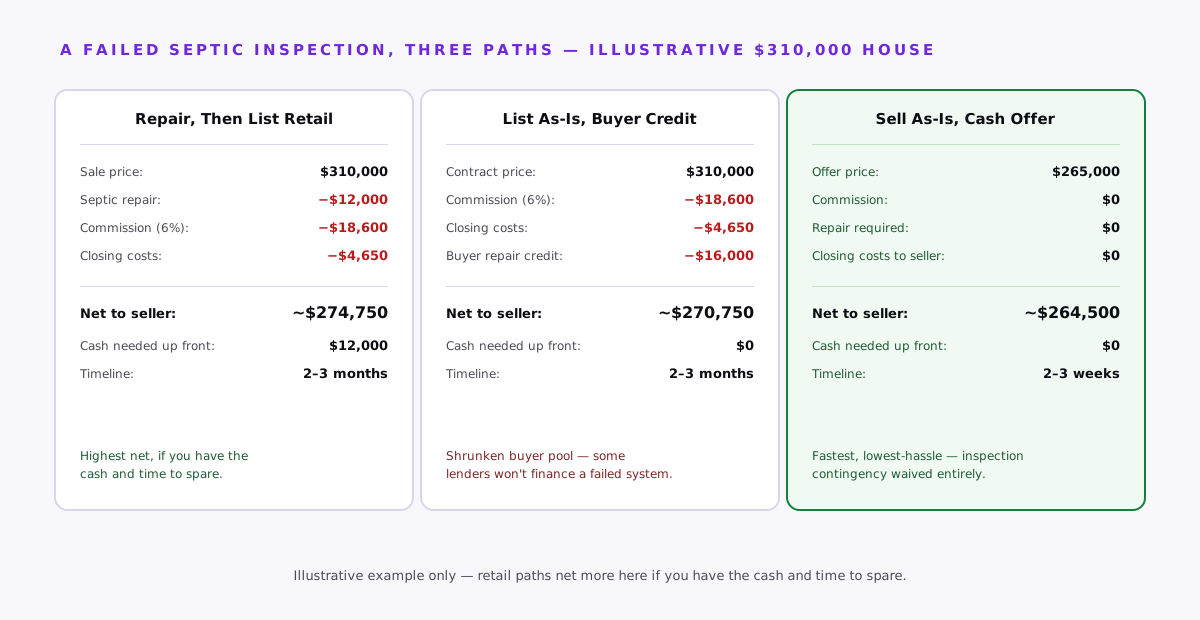
The retail paths net more money in this example — by about $6,000–$10,000 — but only if you can front the repair cash (or absorb a credit) and can wait out a 60–90 day sale. If you have the time and the cash, fixing it and listing is usually the better financial outcome. If the timeline or the upfront cost is the real obstacle, that's the tradeoff a cash sale is pricing in, not a bad deal — just a different one. For a broader side-by-side of how retail and cash-sale net proceeds compare outside this specific scenario, see our cash offer vs. listing net proceeds breakdown.
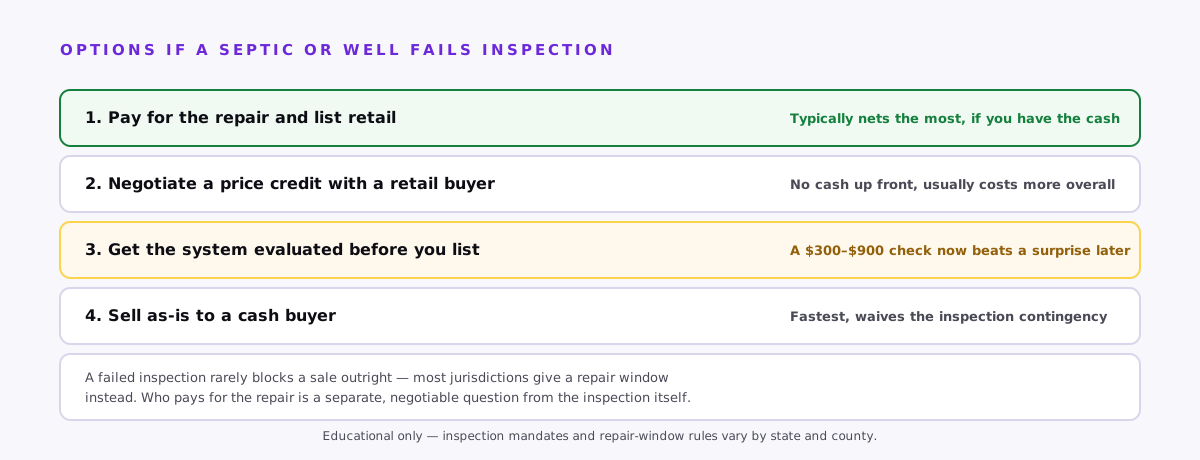
Pay for the repair and list retail — typically nets the most if you have $9,000–$15,000+ available and 2–3 months to spare. Negotiate a price credit with a retail buyer instead of doing the repair yourself — avoids fronting cash but usually costs more than the repair itself once the buyer's risk premium is factored in, and narrows your buyer pool. Get the system professionally evaluated before you list — a $300–$900 inspection now is far cheaper than a failed inspection discovered mid-contract, with a buyer already attached and a closing date at risk. Sell as-is to a cash buyer who waives the inspection contingency and prices the known condition into the offer — the fastest, lowest-hassle path, typically at a lower price than a repaired retail sale.
Restar Acquisitions buys houses as-is for cash, with a written offer within 24 hours — no repairs, no commissions, and you pick the closing date. We're not a replacement for running your own numbers against a repaired retail sale, and for many sellers with time and cash on hand, retail is the better math. We're simply one option to compare against the others above.
All guides · Cost of a well water test before selling a house · Selling a house with a failed septic system · Cash offer vs. listing net proceeds
Step 1 of 5
No obligation, no fees, no repairs. We respond the same day.
You’ll talk to Trevor McAmis, Owner & Acquisitions Lead
(313) 710-6129
Takes about two minutes. Or call (313) 710-6129 — we answer.