A corporate Guaranteed Buyout (GBO) has your employer's relocation company purchase your home at the average of two independent appraisals, usually tax-free to you, after you market it yourself for 60-plus days first. It often runs 90 to 150-plus days end to end and the appraised value typically sits below a best-case retail price. A cash sale is faster and more certain, but taxed the same as any home sale and without the employer-paid structuring.

Step 1 of 5
Tell us your start date and whether your employer offers a buyout program. We'll give you a cash number that fits your timeline.
You’ll talk to Trevor McAmis, Owner & Acquisitions Lead
(313) 710-6129
Takes about two minutes. Or call (313) 710-6129 — we answer.
Educational only. This explains how these situations generally work. It is not legal, tax or financial advice, and the rules differ by state — talk to an attorney or CPA about your own situation before you act on any of it.
If your employer is relocating you and mentioned a "guaranteed buyout," "guaranteed offer," or a "BVO"/"AVO" program, it's worth understanding the actual mechanics before assuming it's simply "the company buys your house." It isn't quite that — it's a specific, tax-structured transaction, and the structure is the whole point. If the tax exclusion on the move itself matters to you too, see our guide to selling a house for a job relocation, which covers the separate partial capital-gains exclusion available on an early move.
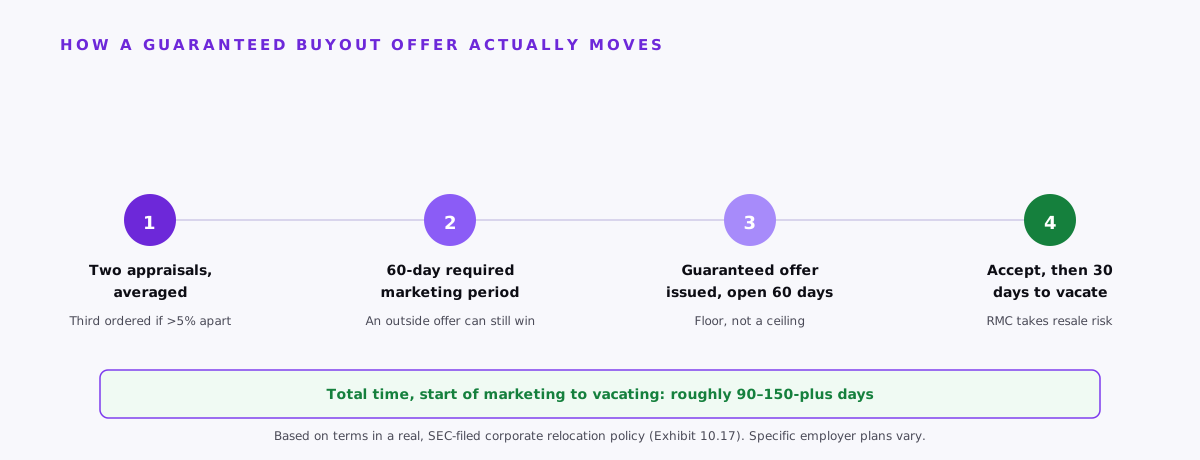
We found an actual filed example of this kind of policy in SEC records — Computer Associates International's relocation policy, filed as SEC Exhibit 10.17 — which lays out terms that match how these programs generally work industry-wide:
Add it up and a real GBO process commonly runs 90 to 150-plus days door to door, before counting however long the relocation company then takes to resell the home on its own.
This is distinct from the related Buyer Value Option (BVO) and Amended Value Option (AVO), which handle a buyer you found differently: in a BVO, there's no upfront appraisal — the relocation company buys the house at the price your own buyer agreed to, then immediately resells to that buyer. An AVO is a hybrid: an appraisal sets a baseline value like a GBO, but that value gets "amended upward" if your own buyer offers more. Different employers structure these differently — ask your employer's relocation policy for the specific terms rather than assuming any one version applies.
Most explanations of a corporate relocation buyout gloss over why the relocation company technically purchases the house itself instead of simply reimbursing the employee's selling costs directly. That structure isn't paperwork for its own sake — it determines whether the money involved counts as taxable income to the employee or not, and it matters for the actual net proceeds a relocating homeowner walks away with.
The controlling authority is IRS Revenue Ruling 2005-74, which applies a "benefits and burdens of ownership" test to employer home-buyout structures. The ruling walks through three scenarios:
1. A straight appraisal-based buyout (the employer/relocation company buys at the appraised value and genuinely bears the risk of reselling it later) — treated as two separate sales. The relocation company's carrying costs, resale losses, or gains are not taxable income to you.
2. An AVO-style deal (appraisal sets a baseline, you can still bring a higher outside offer, but the employer isn't contractually bound to sell to that specific buyer) — still treated as two separate sales, same non-taxable outcome for you.
3. A "contingent sale" where the employer's purchase from you is contractually tied to simultaneously closing with a specific buyer you negotiated with directly — this is treated as one sale, employee-to-buyer, merely facilitated by the employer. In that version, the costs the employer absorbs on your behalf are taxable compensation to you under IRC §§61(a)(1) and 82.
In plain terms: the two-step "company buys it, company resells it" structure only stays tax-free to you if the relocation company takes on genuine (even if brief) ownership risk, rather than acting as a pass-through tied to a predetermined buyer. That's why these programs are built the way they are — it's not paperwork theater, it's the difference between a tax-free benefit and taxable W-2 income.
This matters more now than it used to. Under the Tax Cuts and Jobs Act (2017), employer-paid moving and home-sale assistance generally became taxable income to the employee, suspended through the end of 2025 with a sunset written into the original law. That sunset did not happen. The One Big Beautiful Bill Act, signed July 2025, made that suspension permanent for civilian employees. So as of this writing, if your employer simply cut you a check to cover your home-sale costs, that check is taxable compensation to you, same as it's been since 2018 — which is exactly why the GBO/AVO/BVO structuring still matters: it remains one of the only ways to get this kind of help without it generating a tax bill.
This is general information about how these programs are typically structured, not tax advice for your specific situation. Confirm the tax treatment of your employer's specific plan with a CPA.
Several numbers circulate around this topic on cash-home-buyer marketing sites and relocation-industry pages, and we checked each one against a named, independently verifiable source before deciding whether to use it in this article. Two specific figures did not hold up to that check and are flagged below rather than repeated as fact:
One figure we did find worth mentioning, with a clear hedge: a 2024 industry benchmark study (WHR Global's Global Mobility Benchmark Study) was cited secondhand as putting employer adoption of GBO specifically at around 14% of organizations offering relocation benefits. We could not independently confirm that figure against the primary survey document, so treat it as a moderately-sourced industry estimate, not a verified statistic. If a number isn't attached to a named source here, treat it as directional reasoning, not a verified fact.
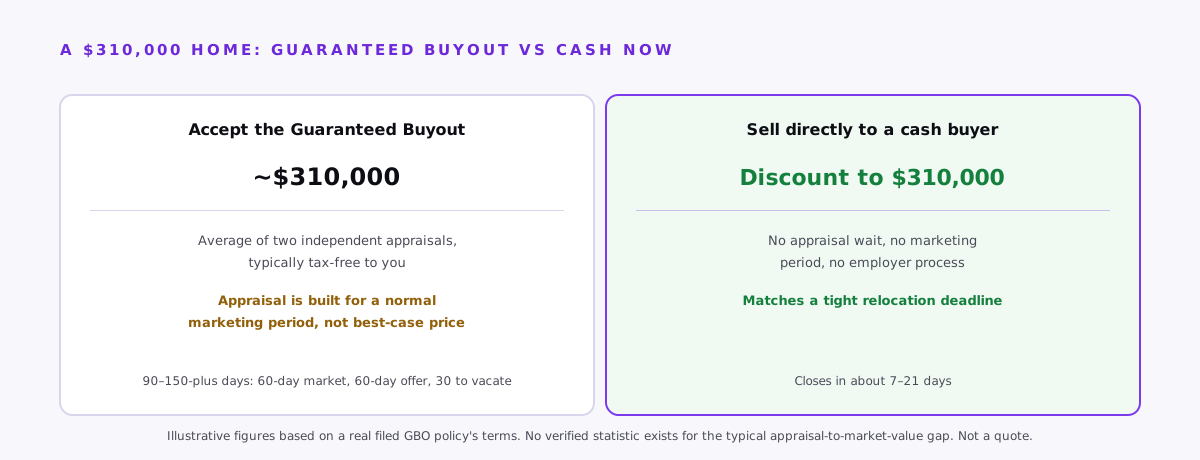
The three realistic paths for a relocating homeowner land very differently on timeline, certainty, and tax treatment, and the right choice depends more on your actual moving deadline than on which number looks biggest on paper. Worked below on a home appraised around $310,000 under a GBO program:
| Route | What you receive | Timeline | What you give up |
|---|---|---|---|
| Accept the Guaranteed Buyout | ~$310,000 (average of two appraisals), typically structured as a tax-free benefit per the mechanics above | 90-150+ days from marketing start to vacate | Possible upside if the open market would have paid more; appraisals are built around typical-marketing-period value, not best-case price |
| List on the open market during your 60-day window, sell to a retail buyer | Potentially higher if a strong buyer appears — but financed sales carry inspection and appraisal contingencies that can still collapse the deal | 60-120+ days, with financing-fallthrough risk | Certainty — and if it doesn't sell in time, you're back to the GBO process anyway, having burned part of your relocation timeline |
| Sell directly to a cash buyer instead of using the employer program | Typically at a real discount to retail, reflecting no-repair/no-financing-contingency terms | 7-21 days | The employer-paid tax structuring, and any chance at the GBO's appraised value |
There's a real argument for trying the open-market route first within your marketing window specifically because many GBO policies let you take an outside offer instead — often if it comes in above a set threshold relative to the guaranteed amount (97% of it, in the one real filed policy we reviewed) — meaning the GBO functions as a floor, not a ceiling, as long as you're willing to actually market the house during that window rather than skip straight to the guaranteed offer.
A direct cash sale makes the most sense when your relocation timeline is tighter than the GBO's own 90-150+ day process allows, or when your employer's program doesn't cover your situation at all (some benefits are tiered by role or tenure — check your specific policy rather than assuming you qualify). Our cash offer vs. listing net proceeds guide breaks down that same math in more detail outside the relocation context, and our guide to how fast a house sale can actually close covers what drives a cash closing timeline specifically.
If your relocation timeline allows the 90 to 150-plus day GBO process, and your employer's plan covers your situation, that route is usually structured to stay tax-free — worth using.
Where a direct cash sale earns its place is when your start date is tighter than the GBO process allows. Send the address and we'll send a written offer within 24 hours and a closing date that fits your move. No cost, no obligation.
All guides · Selling a house for a job relocation · Cash offer vs listing net proceeds · How fast can you really close on a house
Step 1 of 5
No obligation, no fees, no repairs. We respond the same day.
You’ll talk to Trevor McAmis, Owner & Acquisitions Lead
(313) 710-6129
Takes about two minutes. Or call (313) 710-6129 — we answer.
