The cost of a bridge loan when buying before you sell is more than the quoted interest rate suggests, once you add origination fees, appraisal costs, and the fact that those fixed fees get spread over just a few months instead of a full year. On a $150,000 bridge loan for six months, the real all-in cost commonly lands around $10,000 to $16,000 — which works out to an effective annualized cost well above the interest rate on the paperwork. This guide walks through how a bridge loan actually works, a worked example with real numbers, the qualifying hurdles lenders apply, and the alternatives worth comparing it against before you sign.
Step 1 of 5
Send the address and we'll tell you honestly how a cash offer compares to carrying a bridge loan.
You’ll talk to Trevor McAmis, Owner & Acquisitions Lead
(313) 710-6129
Takes about two minutes. Or call (313) 710-6129 — we answer.
Educational only. This explains how these situations generally work. It is not legal, tax or financial advice, and the rules differ by state — talk to an attorney or CPA about your own situation before you act on any of it.
This is educational information, not financial or legal advice. Loan terms vary by lender and by your specific credit, equity, and market. Talk to a mortgage lender about your actual numbers before deciding.
A residential bridge loan is typically a short-term second lien against your current, departing home — not a loan cross-collateralized against the new property you're buying. Fannie Mae's own guidance to lenders is explicit on this point: “the bridge loan cannot be cross-collateralized against the new property,” and the lender must separately document that you can afford payments on the new home, the current home, and the bridge loan all at the same time (Fannie Mae Selling Guide, B3-4.3-14, Bridge/Swing Loans).
Mechanically: you keep your existing first mortgage in place if you have one, take out the bridge loan as a second lien on the current home, and use the proceeds to cover the down payment and closing costs on the new purchase. When the old home sells, the sale proceeds pay off both the original mortgage and the bridge loan. Terms commonly run 6–12 months, interest-only, with the full principal due as a balloon payment once the old home sells — Fannie Mae itself sets no specific maximum term length.
The quoted interest rate is only part of the bill. Residential bridge loans generally run roughly 1.5 to 5 percentage points above a standard first-mortgage rate, and lenders typically charge 1.5% to 3% of the loan amount as an origination fee on top, plus a few hundred dollars each for appraisal and underwriting. Because bridge loans of 12 months or less are exempt from the standard federal disclosure requirements that apply to a normal purchase mortgage — per Consumer Financial Protection Bureau Regulation Z, which specifically defines and exempts “a temporary or 'bridge' loan with a term of 12 months or less” used to buy a new home while planning to sell the current one (CFPB, 12 CFR § 1026.43(a)(3)(ii)) — fee disclosure on these loans is also less standardized than what you'd get on a normal mortgage, so it pays to ask for every fee in writing before you commit.
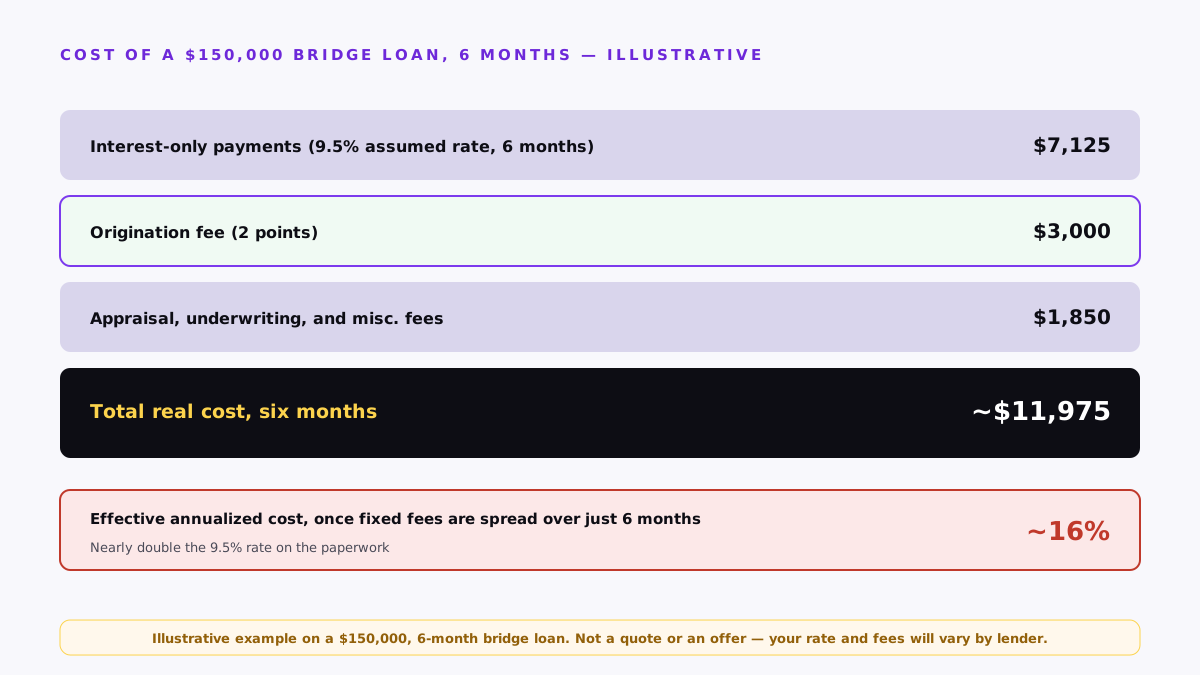
Worked example (illustrative, not a quote or offer): a $150,000 bridge loan, 6 months, interest-only, at an assumed 9.5% rate — a reasonable midpoint given prime sits at 7.00% as of September 2026 and bridge loans commonly price 1.5–5 points above prime. Monthly interest: $150,000 × (9.5% ÷ 12) = $1,187.50/month. Six months of interest-only payments: $1,187.50 × 6 = $7,125. Upfront fees: a 2-point origination fee ($3,000), appraisal (~$600), underwriting (~$750), and miscellaneous title-related fees (~$500) — $4,850 total. Total real cost of the loan: roughly $11,975, or about 8% of the amount borrowed, for six months' use.
That $4,850 in fixed fees is the part that catches people off guard. Spread over only 6 months instead of a full year, it pushes the effective annualized cost to roughly 16% ($11,975 ÷ $150,000 ÷ 0.5 years) — nearly double the 9.5% rate quoted on the paperwork. The shorter the bridge, the worse this ratio gets, because the fixed fees don't shrink even when the loan term does.
Lenders generally want you to hold at least 15%–20% equity in your current home, which caps the bridge loan at roughly 80%–85% of that equity. The bigger hurdle is debt-to-income: because a bridge loan creates what Fannie Mae calls a contingent liability, its guidance requires the payment to be included in your DTI calculation right alongside your current mortgage and your new mortgage — effectively underwriting you as if you're carrying three housing debts at once (Fannie Mae Selling Guide, B3-6-05, Monthly Debt Obligations). The one way around that: if you already have a fully executed sales contract on your current home with financing contingencies cleared, Fannie Mae's guidance allows the lender to exclude the old mortgage and bridge payment from your DTI — which is exactly why bridge loans work best for people who are under contract to sell, not people who are just hoping to sell soon.
Without that executed contract, expect the qualification bar to be meaningfully higher than a standard purchase mortgage, since you're being underwritten to carry all three payments simultaneously if your old home takes longer to sell than planned.
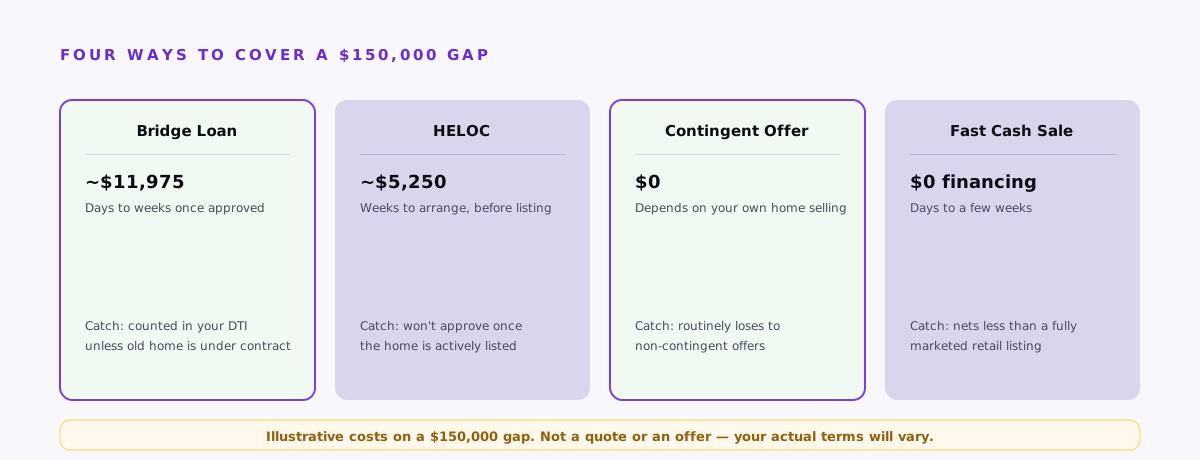
| Route | Approx. cost to cover a $150,000 gap | Speed | Main catch |
|---|---|---|---|
| Bridge loan, 6 months | ~$11,975 | Days to weeks once approved | Counted in your DTI unless the old home is already under contract |
| HELOC, 6 months at ~7% | ~$5,250 interest, little to no origination fee | Weeks to arrange before listing | Most lenders won't approve one once the home is actively listed |
| Contingent offer | $0 financing cost | Depends entirely on your own home selling | Routinely loses to non-contingent offers in a competitive market |
| Cash sale, fast close | $0 financing cost, but a lower sale price | Days to a few weeks | Nets less than a fully marketed retail listing |
A HELOC on your current home instead. Generally cheaper — HELOC rates have recently run closer to prime, versus the elevated rates bridge loans carry — but most lenders won't approve a new HELOC once your home is already on the market, so it has to be arranged weeks or months in advance, and it still requires sufficient equity and normal underwriting time. See our guide on the cost of a HELOC or second mortgage when you sell for the arithmetic on that route specifically.
A contingent offer on the new house. No bridge financing cost at all, but weak in a competitive market where sellers routinely pass over offers contingent on the buyer's own home selling first.
Sell first, then rent or move temporarily. Avoids the bridge loan's cost entirely and removes the two-mortgage qualification hurdle, at the cost of a double move and some housing uncertainty in between.
Sell to a cash buyer with a fast, flexible close. This is the honest comparison, not a free alternative: a fast cash sale typically nets less than a fully marketed retail listing, the same tradeoff covered in our guide on cash offers versus listing net proceeds. But it removes the bridge loan's roughly $12,000 real cost in the example above, the DTI qualification hurdle, and the risk of carrying three payments if the old home sits longer than expected — worth weighing against the bridge loan's cost and qualification risk directly, not assuming either option is automatically better. See also our guide on how fast you can really close on a house for what a fast timeline actually looks like in practice.
We'll give you a written offer within 24 hours and can close on your timeline — often fast enough to skip the bridge loan and the two-mortgage juggle entirely.
All guides · Cash offer vs listing net proceeds · Cost of a HELOC or second mortgage when you sell · How fast can you really close on a house
Step 1 of 5
No obligation, no fees, no repairs. We respond the same day.
You’ll talk to Trevor McAmis, Owner & Acquisitions Lead
(313) 710-6129
Takes about two minutes. Or call (313) 710-6129 — we answer.
