A second home that was never your primary residence and never rented out falls into a gap the tax code doesn't forgive: no Section 121 exclusion, and no depreciation recapture either, since nothing was ever depreciated. The entire gain above your basis is taxable. Here's exactly how that's calculated, what rate applies, and why the number doesn't change whether you list it or sell for cash.
Step 1 of 5
Tell us about the property. We'll give you a straight cash number so you can compare net proceeds before and after the tax bill.
You’ll talk to Trevor McAmis, Owner & Acquisitions Lead
(313) 710-6129
Takes about two minutes. Or call (313) 710-6129 — we answer.
Educational only. This explains how these situations generally work. It is not legal, tax or financial advice, and the rules differ by state — talk to an attorney or CPA about your own situation before you act on any of it.
A true second home — never rented, not your primary residence — gets no tax break at all: not the $250,000/$500,000 primary-residence exclusion, and no depreciation recapture since it was never depreciated. The entire gain above your adjusted basis is taxable, typically at 15% or 20% federal long-term rates, plus possibly a 3.8% surtax, regardless of whether you sell retail or for cash.
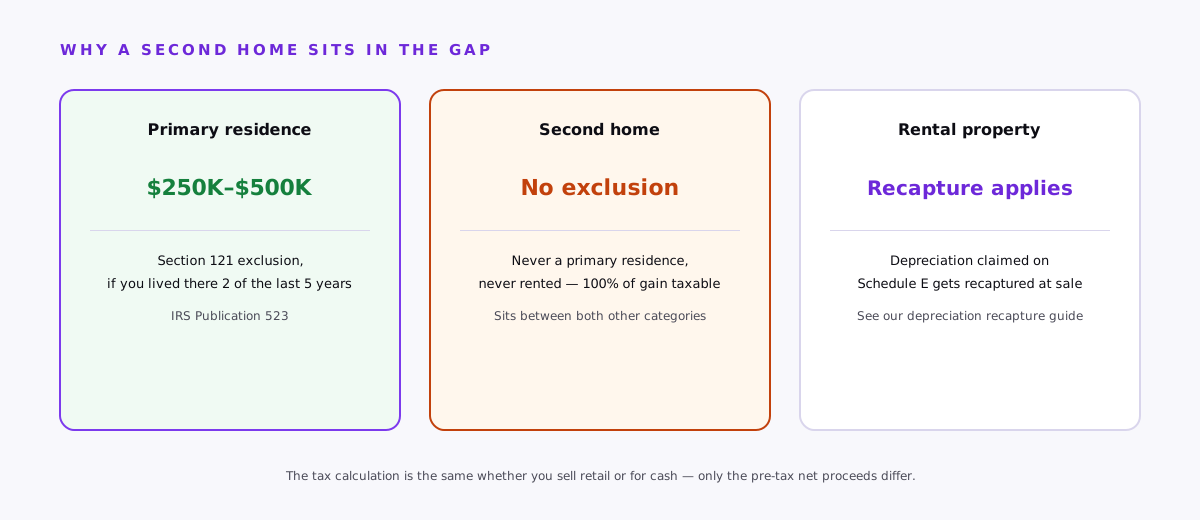
The IRS's primary-residence exclusion — up to $250,000 of gain tax-free, $500,000 married filing jointly — only applies if you owned and used the home as your main residence for at least 2 of the 5 years before the sale (IRS Publication 523). The IRS is explicit that a taxpayer “has only one main home at a time,” decided by facts like where you actually live most of the year, your mailing address, and voter registration (IRS Publication 523). If the house you're selling was a vacation home, a cabin you visited a few weeks a year, or a second property you never rented out, it almost certainly fails that test — meaning 100% of the gain is taxable, with no exclusion whatsoever.
This is different from the two most common scenarios covered elsewhere on this site: our primary-residence capital gains guide covers a home that does qualify for the Section 121 exclusion, and our depreciation recapture guide covers a property that was rented and depreciated on Schedule E. A genuine second home that was never your main residence and never a rental sits in a gap between both: no exclusion, and — since nothing was ever depreciated — no depreciation recapture either. It's simply a straightforward capital gain, in full.
The formula is the same one used throughout this site's other tax guides: amount realized (sale price minus selling costs) minus adjusted basis (purchase price plus capital improvements) equals your gain (IRS Publication 523). There's no depreciation to add back here, because a property that was never rented or used in a business was never eligible to be depreciated in the first place.
If you owned the home more than a year, the gain is taxed at long-term capital gains rates. The IRS's confirmed 2025 brackets are $0–$48,350 at 0%, $48,350–$533,400 at 15%, and above that at 20% for a single filer, with married-filing-jointly thresholds roughly double (IRS Topic no. 409). The 2026 brackets move up slightly for inflation — Revenue Procedure 2025-32 sets them at roughly $0–$49,450 (0%), $49,450–$545,500 (15%), and above that at 20% for a single filer, per independent secondary reporting on the official revenue procedure; treat the exact 2026 numbers as approximate until you check the current-year threshold with a CPA or the IRS's own published table for your filing status. If you owned the home a year or less, the gain is short-term and taxed as ordinary income at your regular bracket instead — a meaningfully higher rate for most sellers.
On top of federal capital gains tax, the Net Investment Income Tax can add another 3.8% if your modified adjusted gross income exceeds $200,000 (single) or $250,000 (married filing jointly) — and capital gains explicitly count as net investment income under the IRS's own rule (IRS, Net Investment Income Tax FAQs). A second home's gain isn't excluded from this calculation the way a Section 121-excluded primary-residence gain would be; since none of the gain is excluded in the first place, all of it is exposed to NIIT if your income is over the threshold.
State tax treatment varies by where the property — and often where you — are located. Florida and Texas have no state income tax, so no state-level capital gains tax applies in either state. Georgia and New York both tax capital gains as ordinary income under their regular state brackets, and Ohio does the same — its own tax instructions confirm “Ohio does not have a separate capital gains tax rate; capital gains are taxed as ordinary nonbusiness income” (Ohio Department of Taxation, IT-1040 instructions). The exact bracket percentages change yearly and by filing status, so confirm the current rate with your state's revenue department or a CPA rather than relying on a flat number here.
Say you bought a vacation property for $180,000, put $20,000 into real capital improvements over the years, and sell it for $340,000 after $20,000 in selling costs. These are illustrative numbers on one hypothetical property, not a quote for yours.
| Amount | |
|---|---|
| Sale price | $340,000 |
| Less: selling costs | −$20,000 |
| Amount realized | $320,000 |
| Purchase price | $180,000 |
| Plus: capital improvements | +$20,000 |
| Adjusted basis | $200,000 |
| Taxable gain | $120,000 |
| Federal tax at 15% long-term rate | $18,000 |
| NIIT at 3.8% (if income is over the threshold) | +$4,560 |
| Total federal tax | $22,560 |
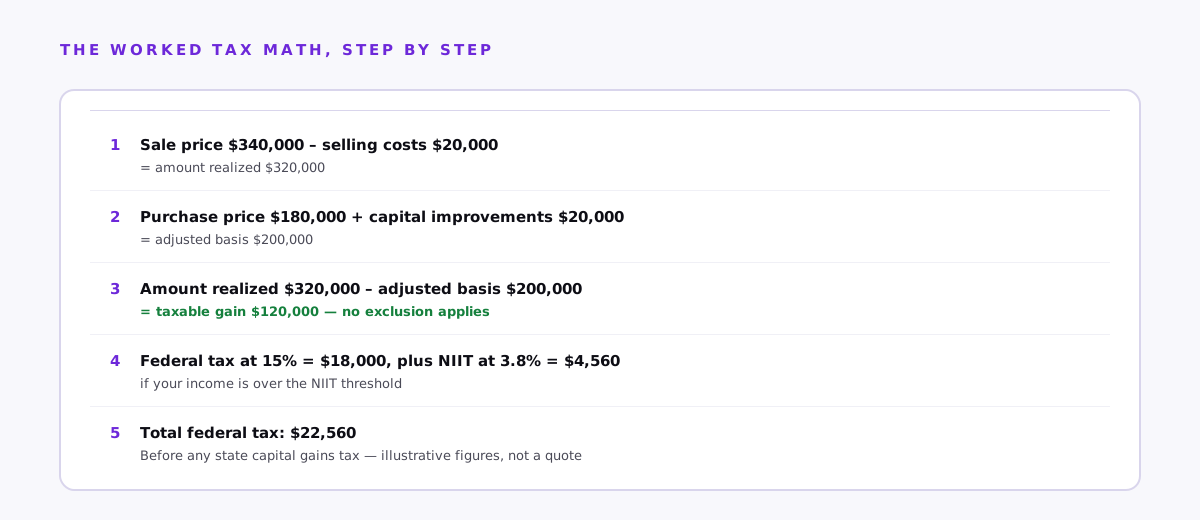
That's before any state capital gains tax, which depends entirely on where you live and the property sits — in Florida or Texas, nothing more; in Georgia, New York, or Ohio, add your state's ordinary-income rate on top.
This is the one honest point that doesn't change no matter how you sell: the tax bill is calculated on your gain, not on how you sold the house. A $340,000 sale triggers the same $120,000 taxable gain whether it closes through a six-month retail listing or a two-week cash sale — the tax code doesn't care about the sale method, only the numbers above. What does change between the two paths is the net amount left over before taxes: a retail sale typically nets more before the tax bill, minus commission and closing costs, while a cash, as-is sale nets less upfront, minus the cash-offer discount, but closes faster and without financing risk. Either way, set aside money for the tax bill before you spend the proceeds — our cash offer vs. listing net proceeds guide walks through that comparison in more detail.
A 1031 exchange lets an investor defer capital gains tax by rolling proceeds into a similar investment property, but the IRS is explicit that it doesn't apply to property “used solely as your personal residence” (IRS, 2025 Instructions for Form 8824). The Tax Court has enforced this directly: in Moore v. Commissioner, taxpayers who traded one personal-use lakeside vacation home for another were denied 1031 treatment, because a “mere hope or expectation that property may be sold at a gain cannot establish an investment intent” when the owner actually used the property as a residence. If your second home was purely personal use, a 1031 exchange is not a legitimate option — don't let anyone tell you otherwise without a specific conversion-to-rental strategy reviewed by a CPA first.
This is educational information, not tax advice — talk to a CPA about your specific basis, income, state, and timing before you sell.
The tax is the same whether you list or sell for cash — what changes is your pre-tax net. Send us the address here and we'll give you a straight number to weigh against a retail listing.
All guides · Capital gains tax on a primary residence · Depreciation recapture when selling a rental · Cash offer vs listing net proceeds
Step 1 of 5
No obligation, no fees, no repairs. We respond the same day.
You’ll talk to Trevor McAmis, Owner & Acquisitions Lead
(313) 710-6129
Takes about two minutes. Or call (313) 710-6129 — we answer.
