If you bought or refinanced in the last few years, you may owe close to what the house is worth, on a rate today's buyers can't get. That makes a normal sale expensive, but it also gives you options most owners never hear about. Our free guide lays out all five, with the risks.

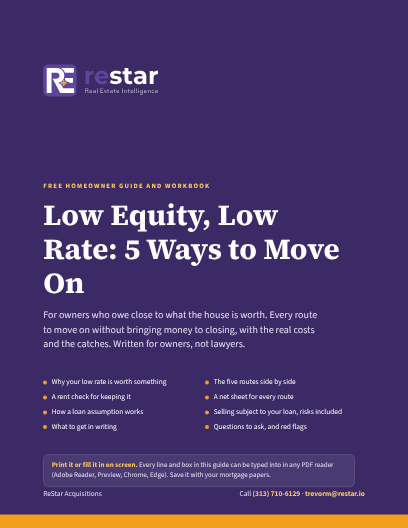
9 pages: the five routes side by side, a net sheet, a rent check, and what to get in writing. Print it or fill it in on screen. Free.
Educational only. This explains how these situations generally work. It is not legal, tax or financial advice, and the rules differ by state. Talk to an attorney or CPA about your own situation before you act on any of it.
Take a house worth $300,000 with $250,000 left on the loan. On paper that is $50,000 of equity. Agent fees and closing costs of about 8% take $24,000, which leaves $26,000 before repairs the buyer asks for and the payments you make while it sells.
Now the other side. At 3.25% the payment on $250,000 is about $1,088 a month (principal and interest). Borrowed at 7%, the same balance costs about $1,663. That gap of about $575 a month is why your loan itself has value, and why routes 1, 3 and 4 below exist.
Move out, keep the loan, and let a tenant's rent cover the payment.
Best when: Rent in your area beats your full payment (with taxes and insurance) by a margin, and you are ready to be a landlord or pay a manager about 8 to 10% of the rent.
You walk away with: The house, the low rate and any growth in value. Monthly cash flow if the numbers work.
The catch: Repairs, vacancies and late rent are yours. Check your loan and insurance rules for renting.
Sell on the open market and pay off the loan at closing.
Best when: You have enough equity to cover agent fees, closing costs and repairs, and time to wait.
You walk away with: Whatever is left after the payoff, fees, repairs and the months of payments while it sells.
The catch: With under 15 to 20% equity, the costs can eat it all, and some owners bring money to closing.
A buyer takes over your loan, with the lender's approval, at your rate.
Best when: Your loan is FHA or VA. Most conventional loans can't be assumed.
You walk away with: The price minus the loan. The buyer often pays you your equity in cash.
The catch: The buyer must qualify, approval can take 45 to 90 days, and with a VA loan your VA entitlement can stay tied up unless the buyer is a veteran who substitutes theirs.
An investor buys the house and takes over the payments, while your loan stays in place.
Best when: Fees would leave you with little or nothing, your payments are current, and you want a fixed closing date with no repairs or showings.
You walk away with: No agent fees, no repairs, no money to bring. Sometimes some cash at closing.
The catch: The loan stays in your name until it is paid off or refinanced. If the buyer stops paying, your credit takes the hit. The lender can call the loan due (the due-on-sale clause).
The lender accepts less than you owe, or takes the house back without a foreclosure.
Best when: You owe more than the house is worth and can't keep paying.
You walk away with: A clean exit, often with the shortfall forgiven. Some lenders pay moving money.
The catch: Credit damage (less than a foreclosure), lender approval takes 60 to 120 days, and forgiven debt can be taxable.
Free help: a HUD-approved housing counselor costs nothing, 800 569 4287 or the CFPB counselor finder.
The loan stays in your name until it is paid off or refinanced, and most mortgages let the lender call the loan due when the house is sold (12 U.S.C. 1701j-3 exempts some transfers, but not a sale to an investor). These protections apply to any buyer, including us:
See also the CFPB's warnings about mortgage relief scams.
Nine pages to print and fill in with a pen, or type into on screen: the net sheet, a rent check, questions for your servicer, and the protections checklist.
Get the free guide →If a sale looks like your route, we can send written terms, cash or subject to your loan, with every protection above in the contract. If renting it or an assumption would leave you better off, we will tell you.
Step 1 of 5
Send the address. We reply with written terms you can compare with a listing or a rental.
You’ll talk to Trevor McAmis, Owner & Acquisitions Lead
(313) 710-6129
Takes about two minutes. Your address is never shared.
We are a home buyer, not attorneys, lenders or financial advisers. This page and the guide are general information, not legal, tax or financial advice. Rules differ by state; some states have special rules for these sales. Talk with an attorney or a HUD-approved counselor about your own situation.
