Every market page publishes the numbers behind its offer. See the math
Home › Guides › What to Do When a Buyer's Financing Falls Through
Guide
What to Do When a Buyer's Financing Falls Through
You had a closing date. Maybe you'd already made plans around it. Then the buyer's lender pulled the loan, and now you're back to square one with no explanation of what happens next. Here's the actual mechanics — what happens to escrow, what your options are, and why this specific failure mode is the one a cash offer eliminates entirely.
Tell us what happened and where things stand. We'll tell you honestly whether a cash offer makes sense right now, or whether relisting is the better move.
Takes about two minutes. Or call
(313) 710-6129 — we answer.
Educational only. This explains how these situations generally work. It is not legal, tax or financial advice, and the rules differ by state — talk to an attorney or CPA about your own situation before you act on any of it.
What to do when a buyer's financing falls through: the short answer
First, get a signed mutual release so your earnest money can be disbursed — the escrow holder generally can't release it without both signatures. Then decide: relist, activate a backup offer if you have one, renegotiate with the same buyer if the issue is fixable, or take a cash offer to remove financing risk entirely.
This is educational information, not legal advice. Earnest money, escrow, and disclosure rules vary by state — confirm your specific situation with your agent, your closing attorney, or your state real estate commission.
How often this actually happens
It's more common than it feels when it's happening to you. NAR's Realtors Confidence Index — a monthly survey of member agents released alongside the existing-home sales report — has shown contract terminations running in a 4%–7% band most months since 2023, with a separate 12–15% of contracts experiencing a delayed (not dead) settlement, most often tied to appraisal issues. It's not always this steady: terminations spiked to 12% in April 2020 and hit 16% in July 2022 during a sharp mortgage-rate move, so the rate tracks the broader lending environment.
NAR's own commentary names home inspection issues, buyer financing problems, and appraisal issues as the recurring causes behind both delayed and dead deals. On the financing side specifically, Freddie Mac research found roughly 13% of purchase-mortgage applications were denied in a recent full-year period, and in a later survey, 60% of denied applicants pointed to debt or credit issues as the reason. Under federal law (Regulation B, 12 CFR § 1002.9), the lender has to tell the buyer the specific reason for a denial — which is often the first the seller hears of what actually went wrong, secondhand.
What happens to the earnest money
If the buyer terminated within their financing contingency window and followed the required notice procedure, they're typically entitled to a full refund. But procedure matters: almost every state requires a signed mutual release from both buyer and seller before the escrow holder, title company, or broker can disburse anything — neither party can force a release unilaterally, even when the outcome seems obvious. Once that release is signed, funds are commonly disbursed within roughly 1–10 business days.
The trust-account and dispute rules that govern this differ by state. A few examples across our markets:
Texas — the broker must deposit earnest money within 2 business days of receipt (TREC Rule §535.146), and disbursement on a disputed deal requires both signatures on TREC Form 38-8, or a court order.
Florida — escrow must be deposited within 3 business days (Fla. Stat. §475.25); on a genuine dispute, the broker must notify the Florida Real Estate Commission within 15 business days and resolve it through an escrow disbursement order, mediation, or arbitration.
North Carolina — on a disputed deposit, the holding firm must notify all claimants, then wait 90 days before depositing the funds with the Clerk of Superior Court if nobody's resolved it (N.C. Gen. Stat. §93A-12).
Georgia, Ohio, Michigan, Indiana, Maryland — each requires the broker to hold funds in a separate trust or escrow account, released only by mutual agreement or court order, with the specific waiting periods set by state license law rather than the purchase contract.
New York — often handled differently altogether, since many New York transactions run through an attorney-held escrow rather than a broker trust account; ask your closing attorney directly rather than assuming a broker-style timeline applies.
If your deal is stuck because one side won't sign the release, that's a legal question for your agent or an attorney — it isn't something the escrow holder can resolve by picking a side.
Do you have to disclose that a deal already fell through?
There's no universal legal duty to disclose why a prior contract died, and this varies by state. What you generally can't do is withhold a material defect you learned about during that contract — for example, if the prior buyer's inspection turned up something specific and disclosable, that finding usually has to be disclosed to the next buyer separately, regardless of how the earlier deal ended. The failed contract itself typically isn't the disclosable fact; what someone learned during it can be.
One practical note: most MLS systems don't reset a listing's cumulative days-on-market when it goes back on market after a fallout — a house that sat 60 days before going under contract typically still shows 60+ days, not zero, once it's relisted. That's a market-perception issue more than a legal one, but it's worth knowing before you decide how to price a relist.
Your options right now
Relist. The default path if nothing else applies — re-enter the market, possibly with an adjusted price or terms informed by whatever caused the last deal to die.
Activate a backup offer, if you have a kick-out clause. If your original contract included a kick-out (sometimes called a 72-hour or release clause) and you already had a backup buyer waiting, you may be able to move directly to that buyer once the release is signed. This only helps if that structure was already in place before the fallout — it can't be added retroactively.
Renegotiate or extend with the same buyer. Worth considering if the problem is fixable — an appraisal gap where the buyer can bring more cash, or a short underwriting delay — rather than a fundamental denial.
Take a cash offer. This removes financing-contingency risk structurally, not just statistically: no lender means no appraisal tied to a loan and no underwriting approval standing between you and closing.
Why a cash offer specifically removes this risk
The comparison isn't about which type of buyer is more trustworthy — it's about how many parties can independently kill the deal. A financed purchase has to clear the buyer's application, the appraisal, and underwriting, on top of everything the buyer and seller agree to. A cash purchase only has to clear what buyer and seller agree to, because there's no lender in the chain to add a fourth point of failure.
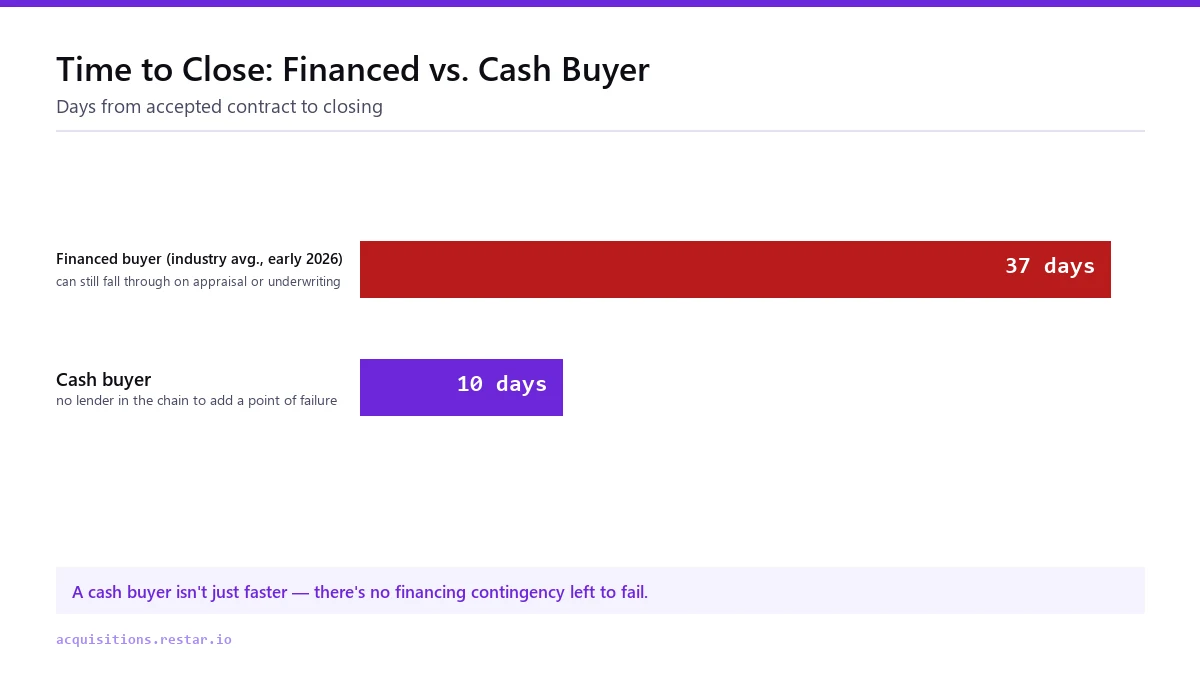
That shows up in the numbers on closing speed. Industry-standard mortgage-technology data puts the average conventional purchase loan at roughly 37 days from application to close as of early 2026, with the widely cited range across the industry running 30–45 days. Cash purchases commonly close in 1–2 weeks, since there's no loan-processing timeline to wait on.
Time to close: financed vs. cash buyerRestar Acquisitions · industry-average figures, not a quote.
Financed buyer
Cash buyer
Can the deal die on financing?
Yes — appraisal, underwriting, or denial
No lender involved
Typical time to close
~30–45 days
~1–2 weeks
Appraisal required?
Usually, tied to the loan
Not required to close
Likely price
Typically closer to full retail value
Typically below retail, reflecting speed and certainty
That last row is the honest tradeoff, and it's the one every cash offer should show you plainly: you're not choosing the higher number, you're choosing certainty over a shot at a higher number that a second financed buyer might not deliver either. If you're not under real time pressure and you're willing to risk a second financed buyer, relisting can still net more. If getting this resolved without a repeat is worth more to you right now than maximizing price, that's a reasonable call too — and it's yours to make with the real numbers in front of you, not a guess.
Common questions
Am I entitled to keep the earnest money if the buyer's financing fell through?
Generally no, if the buyer terminated within their financing contingency period following the proper notice procedure — that money is typically returned to the buyer. You'd only have a claim if the buyer breached the contract outside the contingency's terms, which is a question for your agent or an attorney.
How do we actually get the earnest money released?
Both parties typically need to sign a mutual release form authorizing the escrow holder, title company, or broker to disburse the funds. Without both signatures, most escrow holders won't release anything without a court order, even when the outcome seems obvious to everyone involved.
Do I have to tell the next buyer that a previous deal fell through?
There's generally no legal duty to disclose that fact itself, though this varies by state. What you likely do have to disclose is any material defect you learned about during the prior contract — for example, something a previous inspection uncovered.
Will my house look worse to buyers because it's back on the market?
It can create a perception issue, since most MLS systems keep the original cumulative days-on-market count rather than resetting to zero. It's not automatically a red flag, but it's worth discussing pricing strategy with your agent before relisting.
Should I just wait for another financed buyer?
That depends on your timeline and risk tolerance. Financed deals typically close in 30–45 days and can still fall through on appraisal or underwriting a second time. If you can absorb that risk and want to hold out for the highest price, relisting is reasonable. If another fallout would be genuinely costly to you, a cash offer trades some price for certainty.
Can I just extend the closing date instead of starting over?
Often, yes, if the underlying issue is fixable and the buyer wants to stay in the deal — this is usually handled with a signed extension addendum. It only makes sense if the buyer has a realistic path to closing, not an open-ended hope that financing works out eventually.
If you don't want to risk this happening twice, a cash offer removes the risk entirely
There's no lender in our transaction, which means there's no appraisal contingency, no underwriting, and no financing that can fall through a second time. Send us the address and we'll give you a plain offer and a closing date you can actually plan around.
If relisting and waiting for a stronger financed buyer is the better math for you, we'll tell you that too.
Every offer on this site is underwritten by a person, not a form. If the
numbers do not work for you, say so and I will tell you what would.
Also from Restar
Want the data behind all of this?
Restar Acquisitions is the acquisitions arm of Restar — a housing-market analytics
platform tracking 180+ metrics across every U.S. market, with composite scores and 12-month
price forecasts. The numbers on this page come from the same work.