Earnest money is a deposit a buyer puts down after signing a purchase contract to show they are serious, held by a neutral third party until closing. In a typical deal it runs 1% to 3% of the price. In a cash, as-is sale it works the same way but there are usually fewer contingencies that put it at risk in the first place.

Step 1 of 5
Send the address. We will tell you the offer, the deposit, and the closing date in writing — no fine print explaining itself later.
You’ll talk to Trevor McAmis, Owner & Acquisitions Lead
(313) 710-6129
Takes about two minutes. Or call (313) 710-6129 — we answer.
Educational only. This explains how these situations generally work. It is not legal, tax or financial advice, and the rules differ by state — talk to an attorney or CPA about your own situation before you act on any of it.
The Consumer Financial Protection Bureau defines earnest money as a deposit a buyer pays to show good faith on a signed contract, held by a third party — typically a title company, escrow agent, or real estate attorney — rather than going straight to the seller.
It is not a fee, and it is not the down payment, though it usually counts toward the down payment or closing costs if the sale closes. It is a deposit at risk: proof the buyer has something to lose if they walk away without a covered reason.
A seller who accepts an offer with no earnest money, or an unusually small one, is taking the buyer's word for it with nothing backing that word up. That is the entire reason the practice exists.
1% to 3% of the purchase price is the typical range nationally, moving toward the higher end in competitive markets where sellers can be selective about which offer to trust. Here is what that looks like in actual dollars:
| Purchase price | 1% | 2% | 3% |
|---|---|---|---|
| $90,000 | $900 | $1,800 | $2,700 |
| $150,000 | $1,500 | $3,000 | $4,500 |
| $220,000 | $2,200 | $4,400 | $6,600 |
There is no fixed rule requiring any specific amount — it is negotiated as part of the offer, same as price and closing date. A buyer offering a larger deposit is signaling more confidence in closing; a seller can reasonably ask for more when a house has sat on the market or a prior deal already fell through.
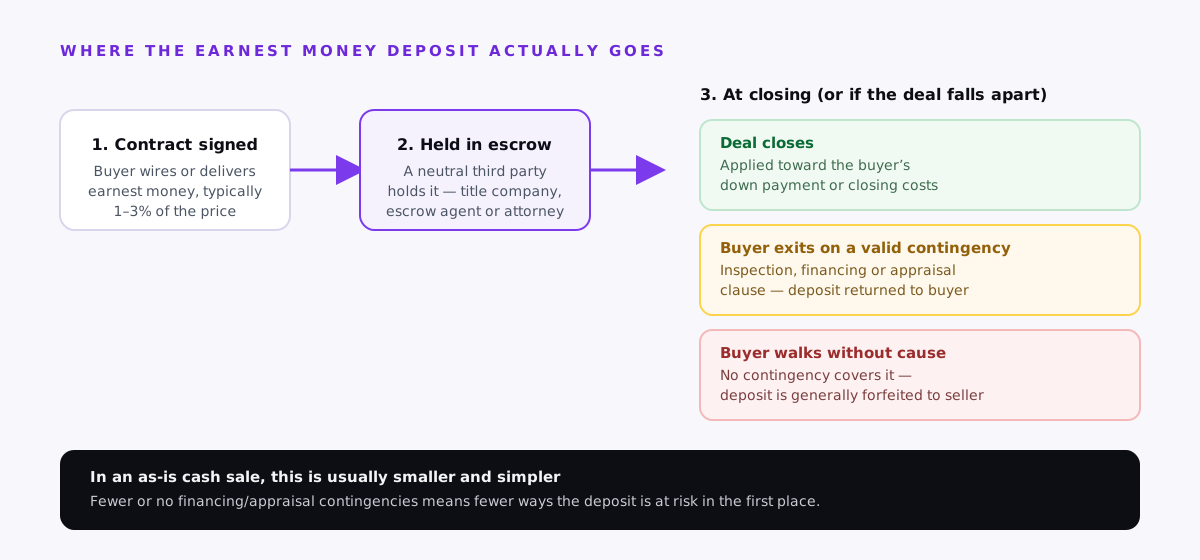
The money does not sit with either party. It goes into an escrow account controlled by a neutral third party named in the contract, and neither the buyer nor the seller can unilaterally pull it out. Releasing it — to either side — requires both signatures, or a court order in a genuine dispute.
This matters because it means the deposit is not leverage either party can threaten to use mid-negotiation. It sits still until the deal closes, falls through for a covered reason, or falls through without one.
| Outcome | What happens to the deposit |
|---|---|
| Sale closes | Applied toward the buyer's closing costs or down payment — it is not an extra cost on top of the price |
| Buyer exits on a contingency named in the contract | Returned in full to the buyer — inspection findings, financing falling through, or an appraisal gap are the common ones |
| Buyer walks with no covered reason | Generally forfeited to the seller as agreed compensation for taking the house off the market |
Read the contingency section of the contract before you sign, not after an offer falls apart. What counts as "covered" is written there specifically, and it is the entire difference between getting the deposit back and losing it.
A financed retail deal typically carries a financing contingency and an appraisal contingency, both of which exist precisely because a lender might not fund the loan. Those protect the buyer, but they also mean the deal has more ways to collapse in the weeks it takes underwriting to finish — commonly four to six weeks of exposure.
A cash, as-is sale usually drops the financing and appraisal contingencies entirely, since there is no lender in the transaction to satisfy. Fewer contingencies means fewer paths to losing the deposit, and a shorter contract-to-closing window — often one to two weeks instead of over a month — means less time for anything unrelated to go wrong.
None of that changes what the earnest money itself is for. It changes how many ways there are to end up on the wrong side of it.
In a multiple-offer situation, buyers often raise their earnest money specifically to make an offer look stronger without changing the price — a $150,000 offer backed by $4,500 reads as more committed than the same offer backed by $500, and sellers comparing offers notice the difference.
In slower markets with less competition among buyers — which describes much of the housing stock in the smaller and mid-sized markets we buy in — deposits tend to sit at the low end of the typical range, or even get waived on a straightforward cash deal, simply because there is no bidding pressure pushing it up.
That means a small deposit is not automatically a red flag, and a large one is not automatically a stronger buyer. What actually matters is whether the money is real and actually placed in escrow — ask for proof of deposit, not just a number written into the offer letter. According to Freddie Mac's homebuying cost guide, this good-faith deposit is standard practice across financed and cash deals alike, typically 1% to 2% of the price, placed in escrow and credited back at closing.
Earnest money tells you whether a buyer is serious. It does not tell you whether the offer itself is a good one. A cash, as-is offer is genuinely lower than what a fully repaired retail listing would likely bring — that is the tradeoff for skipping repairs, commissions, and months of holding costs, and any buyer who does not say that plainly is not being straight with you.
The full arithmetic comparing a retail sale against a cash sale on the same house, side by side, is in cash offer vs. listing net proceeds. Look at that number before the deposit — the deposit is refundable risk protection; the offer price is what you actually walk away with.
Send us the address. We will send back a written cash offer with the deposit amount, what it is held against, and a real closing date — and we will tell you honestly how it compares to what a repaired retail listing would likely net.
All guides · How a cash sale works · Cash offer vs. listing net proceeds · Seller closing costs
Step 1 of 5
No obligation, no fees, no repairs. We respond the same day.
You’ll talk to Trevor McAmis, Owner & Acquisitions Lead
(313) 710-6129
Takes about two minutes. Or call (313) 710-6129 — we answer.