Every market page publishes the numbers behind its offer. See the math
Home › Guides › The Real Math on a Financed Offer: What Fall-Through Risk Actually Costs a Seller
Guide
The Real Math on a Financed Offer: What Fall-Through Risk Actually Costs a Seller
A financed offer's higher price isn't the whole number — it comes with a real chance of falling apart over financing, appraisal, or inspection, then costing you weeks of relisting. Weighting each offer by its actual chance of closing shows when a lower cash offer nets more than a higher financed one, and when it doesn't.
Takes about two minutes. Or call
(313) 710-6129 — we answer.
Educational only. This explains how these situations generally work. It is not legal, tax or financial advice, and the rules differ by state — talk to an attorney or CPA about your own situation before you act on any of it.
The comparison most sellers never actually run
This is educational information, not financial advice. Run your own numbers with a real estate professional before deciding between offers.
When two offers land on the table — a financed offer at a higher price, and a cash offer at a lower one — almost everyone compares the headline numbers and stops there. That is an incomplete comparison, because the financed offer is not a guaranteed number. It is a number with a probability attached: some real percentage of financed contracts do not make it to closing, or close late enough to cost real money.
The correct comparison is not “$250,000 vs $220,000.” It is $250,000 times the odds it actually closes, versus $220,000 times the odds that one does — and a lower guaranteed number can beat a higher uncertain one once you do that arithmetic honestly.
How often financed deals actually fall through
This is not a hypothetical risk — the National Association of Realtors tracks it directly in its monthly Realtors Confidence Index survey. As of mid-2026, roughly 6% of purchase contracts were reported terminated in the prior three-month period — in line with the 4–7% range the index has held since March 2023, after peaking near 12% in April 2020. Separately, 14–16% of contracts settled later than the original closing date, and appraisal issues alone delayed 6–7% of contracts in recent readings (NAR, Realtors Confidence Index).
That means, on financed offers broadly, roughly 1 in 16 to 1 in 17 doesn't close at all, and close to 1 in 7 closes late — sometimes by weeks. A cash offer from a buyer who isn't financing the purchase removes the two biggest causes of both: there is no lender appraisal to come in short, and no loan underwriting to fall through in the final days before closing.
The math: expected value, not headline price
Expected value just means: multiply each possible outcome by its probability, and add them up. Applied to a home sale: expected value = (offer price × probability it closes) − (cost of a fall-through × probability it doesn't).
Take a house where you have two offers on the table: a financed offer at $250,000, standard contingencies, 45-day close, and a cash offer at $228,000, no financing contingency, 15-day close. Assume the financed offer carries a 10% chance of falling through entirely — a bit above the NAR-reported average, to be conservative about risk rather than optimistic — and, if it does, you lose 6 weeks relisting at $1,700 a month in carrying costs (about $2,550), plus you are back to square one on marketing.
Line
Financed offer
Cash offer
Face price
$250,000
$228,000
Probability it closes
90%
~99%
Cost if it falls through
−$2,550 (relist + 6 weeks carry)
−$400 (faster relist)
Expected value
$224,745
$225,716
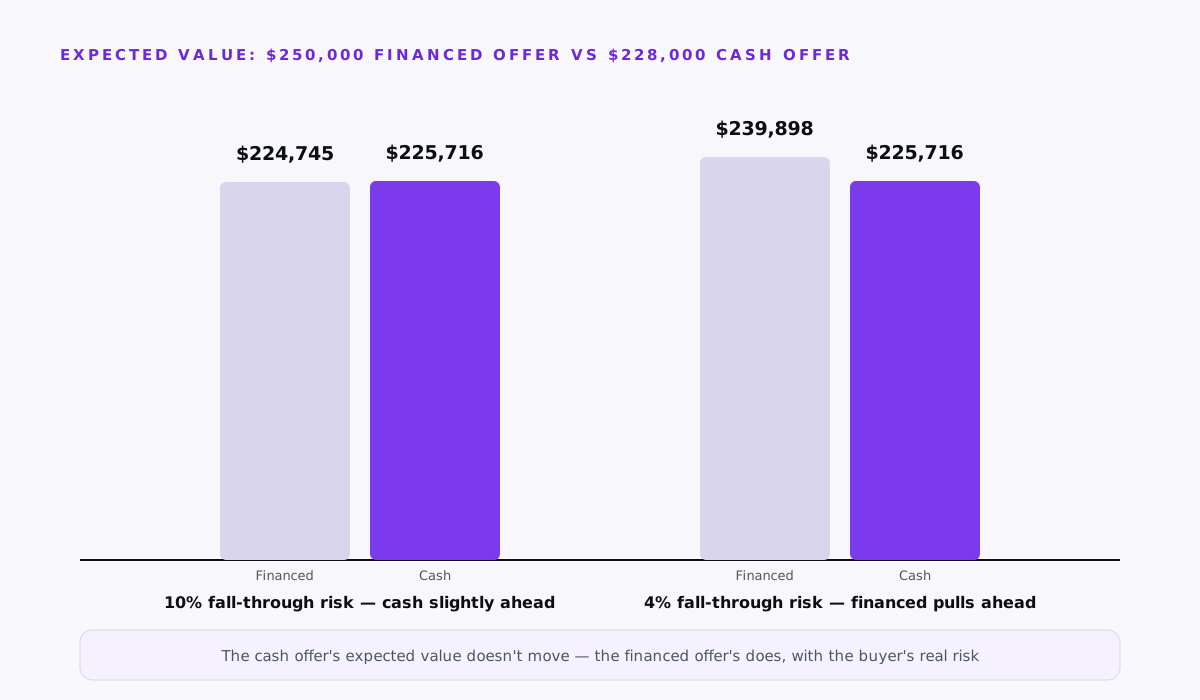
On these assumptions, the cash offer's expected value is actually slightly higher than the financed offer's, despite a $22,000 lower face price, because the face price on the financed offer is discounted by real fall-through risk that the cash offer doesn't carry.
This is not a claim that cash always wins. Change the fall-through probability to 4% — the low end of NAR's reported range — and the financed offer's expected value rises to $239,898, comfortably ahead of the cash offer. The honest takeaway isn't “cash offers are worth more.” It's that the gap between a financed and a cash offer is smaller than the face-price gap suggests, and how much smaller depends on how risky that specific financed offer actually is.
The cash offer's value is fixed — the financed offer's moves with riskRestar Acquisitions · worked example from this page
What actually drives the risk up or down on a specific offer
The 6% average masks a wide range. A financed offer is safer than average when the buyer is pre-underwritten — not just pre-qualified — with income and assets already verified by the lender; the loan-to-value ratio is comfortable and the appraisal is unlikely to come in short; the buyer waived or shortened the inspection and financing contingency windows; and it's a conventional loan with a strong down payment, not a low-down-payment or non-QM product.
It's riskier than average when the buyer is only pre-qualified — a quick, unverified estimate — rather than pre-approved with documentation; the purchase price is near or above recent comparable sales, raising appraisal-gap risk; the buyer's contingency periods are long and unwaived; or you have limited visibility into the buyer's file, with no direct contact with their loan officer and no updates as underwriting progresses.
Ask the buyer's agent directly: is this pre-qualified or fully underwritten? What's the loan-to-value? Has an appraisal been ordered yet? Those answers move your real fall-through probability up or down from the 6% national average, and change which offer actually nets more.
Where this fits with the rest of the math
This page is about risk, not the full net-proceeds comparison. If you want the complete picture — commissions, repairs, holding costs, and closing costs on a retail sale versus what a cash, as-is offer nets — that arithmetic is worked in full in our cash offer vs listing net-proceeds guide. This page exists because that comparison is usually run with the financed offer's face price treated as certain, when it isn't, and the fall-through risk deserves its own honest accounting.
What to actually do with two offers in hand
1. Ask for the buyer's pre-approval letter, not just a pre-qualification. Ask their agent whether it has been underwritten, and by whom.
2. Ask about the appraisal gap. If the buyer isn't offering to cover a shortfall between the offer price and a low appraisal, that gap is a real fall-through risk you're carrying, not them.
3. Price out your own downside. What would 4–6 weeks of relisting actually cost you in carrying costs and lost time? Use that number, not a guess, in any comparison.
4. Run the expected-value math with your own honest probability estimate — even a rough one is better than comparing two sticker prices as if both were guaranteed.
5. Weigh certainty on its own terms if a deadline matters to you — a lower guaranteed number can be the right choice even when its expected value is close to a higher uncertain one, if you genuinely cannot afford the deal falling through in week six.
Common questions
How often do financed home purchase offers actually fall through?
Based on NAR's Realtors Confidence Index, roughly 6% of purchase contracts were reported terminated in recent readings, within the 4–7% range the measure has held since March 2023. That is a national average — individual deals can be meaningfully safer or riskier depending on how well-qualified the buyer is.
Is a cash offer always worth more than a financed offer once you factor in risk?
No. A well-qualified buyer with a strong appraisal and a comfortable loan-to-value ratio carries much lower fall-through risk than the national average, and a financed offer from that kind of buyer usually still nets more than a lower cash offer. The math only favors cash when the financed offer's real risk is meaningfully above average.
What's the biggest reason financed deals fall apart?
NAR's data points to buyer financing issues, appraisal problems, and home inspection findings as the top three. Appraisal issues alone were reported delaying roughly 6–7% of contracts in recent surveys.
How do I estimate the real fall-through risk on my specific offer?
Ask direct questions: is the buyer pre-approved with verified income and assets, or only pre-qualified? What's the loan-to-value? Is the offer price supported by recent comparable sales, or a stretch that risks an appraisal gap? Weaker answers on any of these push your real risk above the 6% national average.
Does this apply to offers from real estate investors or cash buyers too?
Cash buyers remove financing and appraisal risk specifically, but any buyer, cash or financed, can still walk during an inspection period if their contract allows it. The relevant question for any offer is what contingencies remain open and how likely the buyer is to exercise them.
To be direct about where we stand in this comparison: we are a cash buyer, and a cash, as-is offer from us is still very likely lower than a financed retail sale that actually closes without issue. If your buyer is well-qualified and the appraisal risk is low, take the financed offer — we would tell you that on the phone.
This page is for the situation where you are weighing a shakier financed offer against a lower but certain one. Send the address and we will send a written offer within 24 hours with the comparable sales it came from, so you have a real number to run the math against. No cost, no obligation. Start at tell us about the property.
Every offer on this site is underwritten by a person, not a form. If the
numbers do not work for you, say so and I will tell you what would.
Also from Restar
Want the data behind all of this?
Restar Acquisitions is the acquisitions arm of Restar — a housing-market analytics
platform tracking 180+ metrics across every U.S. market, with composite scores and 12-month
price forecasts. The numbers on this page come from the same work.