If your New York rental is truly rent-stabilized, the tenant and their below-market rent come with the property when you sell it. You can't evict a stabilized tenant just to deliver a vacant house, and most retail buyers won't want the unit. The realistic buyer pool for a rent-stabilized house in New York is usually an investor or cash buyer who will take it with the tenant in place.
Step 1 of 5
Tell us about the property and we'll give you a written cash offer within 24 hours that accounts for the tenant and the lease directly.
You’ll talk to Trevor McAmis, Owner & Acquisitions Lead
(313) 710-6129
Takes about two minutes. Your address is never shared.
Educational only. This explains how these situations generally work. It is not legal, tax or financial advice, and the rules differ by state. Talk to an attorney or CPA about your own situation before you act on any of it.
That's the short version. Here's how to figure out where your property stands, because "rent stabilized" gets used loosely and it has a precise legal meaning that most New York rentals, including most rentals in our own Rochester market, don't meet.
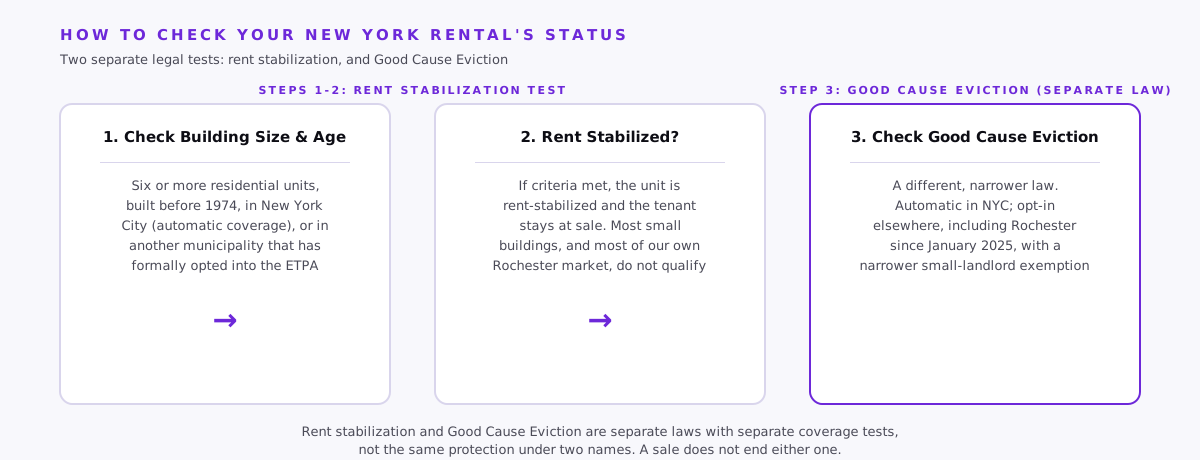
Rent stabilization isn't a general vibe about old buildings with long-term tenants. It's a specific regulatory status tied to a specific building, created under New York's rent stabilization laws and the Emergency Tenant Protection Act (ETPA). According to the state Division of Housing and Community Renewal's overview of rent stabilization and the ETPA (HCR, formerly DHCR), stabilized buildings are generally ones with six or more residential units built before 1974, located somewhere the law applies.
In New York City, that coverage is automatic once a building meets the age and unit-count test. Outside the five boroughs, it isn't automatic at all. A county or municipality has to opt in under the ETPA, and only after it proves a "housing emergency," meaning a vacancy study showing a rental vacancy rate under 5% for the type of housing being regulated. Parts of Nassau, Westchester, and Rockland counties have done this over the years (Yonkers, Mount Vernon, White Plains, New Rochelle, and Greenburgh are examples in Westchester). A handful of other upstate cities, including Kingston and Albany, have tried to opt in more recently under expanded authority passed in the 2019 Housing Stability and Tenant Protection Act (HSTPA), with mixed legal results; some adoptions have been upheld, others struck down in court.
If your rental is a single-family house, a two-family, or a small building under six units, it is not rent-stabilized under this framework, full stop, regardless of how long the tenant has lived there or how far below market the rent is. Rent stabilization is a building-size-and-age test, not a reward for a landlord who gave a long-term tenant a good deal.
Don't guess based on how the building feels or how long the tenant has lived there. There are three ways to actually check, in order of reliability: pull the official registration history, check the building against the size-and-age test, or have an attorney confirm it.
Pull your building's registration history from HCR's Division of Rent Administration. If units were ever registered as rent-stabilized, that history is on file. Check your building's age and unit count against the criteria above: six-plus units, built before 1974, in NYC or in a municipality that's formally opted into the ETPA. Ask a NY landlord-tenant attorney to pull the file and confirm. This matters enough that a guess isn't good enough, more on that below.
Since this is our own NY market, we checked it directly instead of assuming. As of now, Rochester and Monroe County have not adopted rent stabilization under the ETPA. The city commissioned a formal vacancy study in 2021 to see if it qualified, and that study found a vacancy rate of roughly 9%, well above the 5% threshold the ETPA requires to declare a housing emergency.
The conclusion at the time was that Rochester did not meet the legal bar to opt in. There's been continued local organizing pushing for a fresh vacancy study, and as of mid-2026 no new qualifying study had been completed. So the plain answer for a Rochester rental: it is not rent-stabilized in the ETPA/DHCR sense, and hasn't been at any point this has been checked. That does not mean a Rochester landlord has no tenant-protection law to worry about.
New York's statewide Good Cause Eviction Law (Real Property Law Article 6-A) took effect in April 2024. It's a different, narrower tool than rent stabilization. It doesn't registration-regulate rents the way stabilization does, but it does two things that matter to a seller: it requires a landlord to have a legally recognized "good cause" to decline a lease renewal or evict a covered tenant, and it lets a tenant challenge a rent increase as "presumptively unreasonable" if it exceeds the lower of 10% or 5% plus the change in the Consumer Price Index, per HCR's Good Cause Eviction fact sheet.
Good Cause applies automatically in New York City, and it's opt-in for other villages, towns, and cities, each of which can set its own exemption thresholds within limits set by the state. Rochester's City Council passed its version in December 2024, and Mayor Malik Evans signed it into law in January 2025, making Rochester the largest city in the state outside NYC to adopt it.
Local coverage of the ordinance describes it as one of the stronger versions in the state, with the small-landlord exemption narrowed so that only landlords who personally own a single rental unit statewide are exempt, and an upper rent exemption tied to a percentage of HUD fair market rent for Monroe County. If you own more than one rental unit anywhere in the state and your Rochester tenant's rent is under that upper threshold, the tenant is likely covered.
For a seller, the practical upshot is similar in kind to rent stabilization even though the legal label is different: you generally can't end a covered Rochester tenancy without a recognized reason, a sale to a new owner by itself is not one of those reasons, and the new owner, including a cash buyer, takes the property subject to the same obligations you had.
This is the part sellers get wrong most often: selling the building does not end the tenant's protections. Whether the unit is rent-stabilized or covered by Good Cause, the status runs with the apartment and the lease, not with you as the current owner. A buyer steps into your shoes. They inherit the existing lease, the renewal obligations, and, for a truly stabilized unit, the rent set by the NYC Rent Guidelines Board's annual allowable increase.
On eviction for the purpose of selling vacant: under the 2019 HSTPA, "owner's own use" is a narrow exception to non-renewal, and it only works if an individual owner (not an LLC, not a buyer who wants to resell) intends to personally occupy that specific unit as their primary residence, limited to one unit, and it comes with added protection for tenants who've been in place 15 years or longer. It is not a path to deliver a vacant house to some other buyer. Good Cause's personal-occupancy exception works the same way in principle: the landlord or immediate family has to intend to live there. Neither law gives a seller a lawful way to evict a tenant simply because selling vacant would bring a higher price.
Most retail buyers shopping for a house to live in want a vacant house on a normal closing timeline. A tenant with ongoing legal protections, especially one paying below-market rent with limited room to raise it, is a dealbreaker for that buyer. That shrinks your real buyer pool down to people who want an income-producing property: investors, landlords building a portfolio, and cash buyers like us who evaluate the property as an asset with a tenant attached rather than a house someone wants to move into. That's not a bad thing, it's just a different market, and it prices differently than the vacant house down the street comp your agent might show you.
Here's where sellers get a number stuck in their head from a vacant comp that isn't available to them. Example: a 3-unit building in Yonkers (Westchester County, ETPA-covered). One unit is rent-stabilized, tenant of 20 years, paying $1,350/month against a comparable market rent of $2,100/month. The other two units already rent at market, $1,900/month each.
| Scenario | Unit 1 rent | Units 2-3 rent (combined) | Annual gross rent | Operating expenses (35%) | NOI | Cap rate | Value |
|---|---|---|---|---|---|---|---|
| Sold with tenant in place (realistic path) | $1,350/mo | $3,800/mo | $61,800 | $21,630 | $40,170 | 7% | ~$574,000 |
| Fully vacant, all units at market (only reachable via a voluntary move-out, not eviction) | $2,100/mo | $3,800/mo | $70,800 | $24,780 | $46,020 | 7% | ~$657,000 |
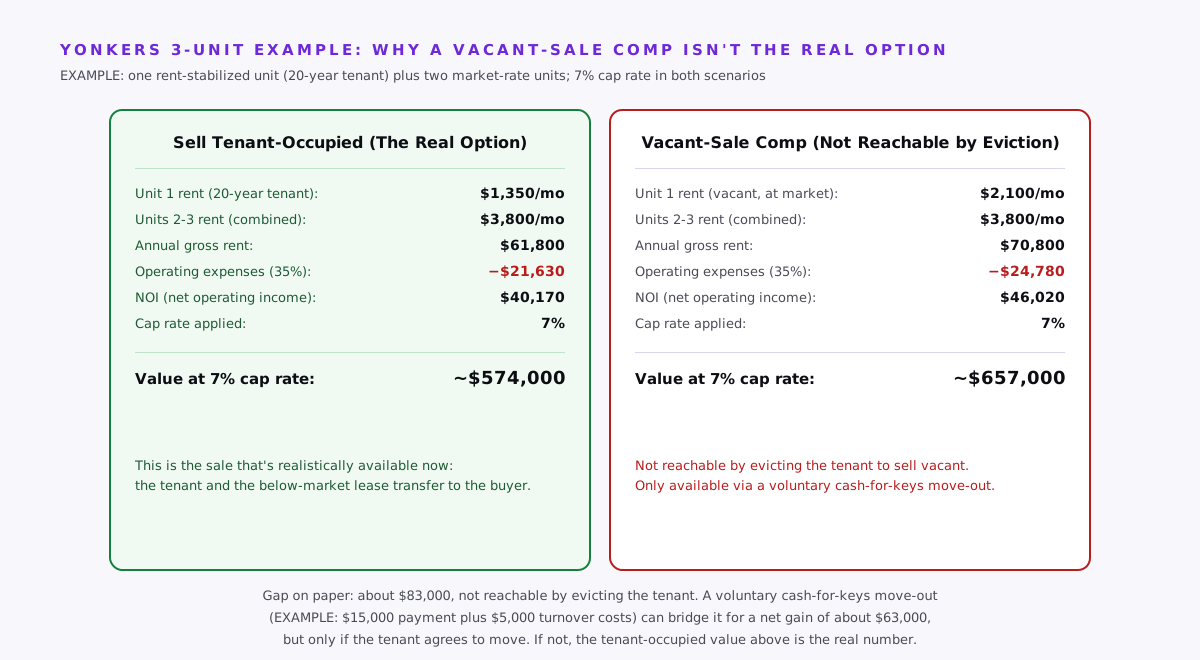
The gap is real, about $83,000 on paper. But the vacant row in that table is not something the owner can get to by evicting the tenant. Under the HSTPA, this owner has no individual-occupancy claim (an investor seller doesn't live there), and a 20-year tenancy carries extra protection on top of that. Eviction-for-sale isn't a lawful route here. If that owner tried to pursue it anyway, they'd be paying legal fees and holding costs for a case built on ground the law doesn't recognize, with a real chance of losing and still owning a tenanted building.
The one lawful route to the higher number is a voluntary cash-for-keys agreement: the owner offers the tenant a negotiated sum to vacate on their own terms, in writing, with no pressure and no threat attached, and the tenant chooses whether to accept. Say that costs $15,000 plus $5,000 in turnover costs (cleaning, minor repairs, re-marketing). Net gain versus the tenanted sale: $657,000 minus $20,000 minus $574,000, or roughly $63,000, and only if the tenant agrees and the owner can carry the vacancy and re-lease risk before the vacant sale closes. If the tenant says no, there is no vacant path, period, and the tenanted value is the real number.
Sell tenant-occupied to an investor or cash buyer. This is the path that matches the legal reality for most stabilized or Good-Cause-covered rentals. No eviction attempt, no waiting on a maybe.
Offer a voluntary cash-for-keys move-out, documented in writing, purely as the tenant's choice, before listing. This can unlock the vacant-sale value shown above, but only if the tenant agrees, and it has to stay voluntary, start to finish.
Wait for natural turnover. If the tenant is already planning to move, you can list vacant once they're out on their own schedule, with no legal risk.
Target buyers who specifically want income-producing property. Some buyers want the tenant and the cash flow. Pricing it as an investment asset, not a house, reaches that pool.
One note before you make any decision: confirm your property's exact rent-stabilization or Good Cause status, and your tenant's specific rights, with a New York landlord-tenant attorney. The rules turn on details (building age, unit count, local opt-in status, tenant tenure) worth getting an actual professional opinion on before you price or market the property.
We buy rental property as-is, including with a tenant in place, and we won't walk away from a deal because there's a lease attached to it. You get a written offer within 24 hours, no repairs, no commissions, and you pick the closing date. If a lawful vacant sale is realistically on the table for your property, retail can net more, and we'd rather say so than oversell the cash price.
All guides · Selling a rental property with tenants · Selling a house with an eviction in progress · We buy houses in Rochester, NY
Step 1 of 5
No obligation, no fees, no repairs. We respond the same day.
You’ll talk to Trevor McAmis, Owner & Acquisitions Lead
(313) 710-6129
Takes about two minutes. Your address is never shared.