Every market page publishes the numbers behind its offer. See the math
Home › Guides › Selling a House With Knob and Tube Wiring or an FPE Panel
Guide
Selling a House With Knob and Tube Wiring or an FPE Panel
Selling a house with knob and tube wiring, aluminum branch wiring, or a Federal Pacific Electric panel runs into a wall most sellers do not see coming, because it is not a buyer walking away over the look of the panel. It is an insurance underwriter, working from a four-point inspection report, declining to write a policy at all — and a mortgage cannot fund without one. The fix is not cheap, usually $8,000 to $25,000 for a full rewire, but going in blind and pricing a cash offer against a repair number you invented is worse. Here is what actually gets flagged, why it blocks financing rather than just alarming a buyer, and the honest math on fixing it first.
Takes about two minutes. Or call
(313) 710-6129 — we answer.
Educational only. This explains how these situations generally work. It is not legal, tax or financial advice, and the rules differ by state — talk to an attorney or CPA about your own situation before you act on any of it.
Selling a house with knob and tube wiring: the short answer
Selling a house with knob and tube wiring, aluminum branch wiring, or a Federal Pacific, Zinsco or Challenger panel is legal, but most insurers will not write a policy on the property until it is replaced. No insurance means no mortgage, which removes most financed buyers until the work is done or a buyer pays cash.
This is general educational information about how insurance underwriting affects a sale, not legal, insurance or financial advice. Whether your specific panel or wiring is insurable depends on your carrier, your state and an actual inspection. Have a licensed electrician assess the system and talk to an independent insurance agent before you price anything.
The four-point inspection, and what actually fails it
A four-point inspection is a limited, insurance-driven inspection of four systems — roof, electrical, plumbing and HVAC — and carriers commonly require one before writing or renewing a policy on an older home. It is not the full home inspection a buyer orders for their own protection; it exists purely to tell the underwriter whether the house is a risk they want on their books.
On the electrical side, a short list of findings reliably ends the conversation with a standard carrier:
Federal Pacific Electric (Stab-Lok), Zinsco, or Challenger panels. These have a documented history of breakers failing to trip under overload conditions, which is the one job a breaker exists to do.
Knob-and-tube wiring, the cloth-insulated system common in houses built before the 1950s, especially where it has been buried under modern insulation or spliced into with non-original materials.
Aluminum branch-circuit wiring, installed in roughly two million homes between 1965 and 1973, which loosens at outlet and switch connections in a way copper does not.
Any one of these is usually enough on its own. Combine one with an aging roof or outdated plumbing and most standard carriers will not offer a quote at any price — you move to the surplus and excess lines market, at a materially higher premium, if you can get coverage at all.
Why this blocks a financed sale specifically
This is the mechanism that turns an inspection finding into a sale problem, and it is worth being precise about it. A mortgage lender requires proof of hazard insurance before it will fund, full stop — it is protecting its collateral, not being cautious for your sake. If no carrier will insure the house as it sits, the buyer's loan cannot close, regardless of how much the buyer wants the property or how their own credit looks.
HUD's Single Family Housing Policy Handbook 4000.1, which governs FHA-insured loans, requires the property to be safe, sound and free of health and safety hazards before the loan can be approved — appraisers are trained to flag exposed, outdated or clearly unsafe electrical components, and a flagged system routinely triggers a request for an electrician's inspection or repair as a loan condition. Conventional lenders selling to Fannie Mae or Freddie Mac carry a parallel requirement that the property be insurable and in acceptable condition. An uninsurable electrical system fails both tests at once.
The result is the same pattern that shows up whenever title, insurance or financing has a hard stop: the pool of buyers who can actually close narrows to cash, and cash buyers price the repair and the uncertainty into the offer. The Consumer Product Safety Commission's own findings on aluminum wiring are part of why underwriters will not budge — CPSC-funded research found homes wired with aluminum built before 1972 were 55 times more likely to develop a fire-hazard condition at a wire connection than a copper-wired home of the same era. That is not a cosmetic concern to an insurer; it is exactly the kind of claim risk underwriting exists to avoid.
What it actually costs to fix
The panel alone is the cheap part. Swapping a Federal Pacific, Zinsco or Challenger panel for a modern one typically runs $1,500 to $4,000, and by itself it can sometimes get a marginal case insured if the rest of the branch wiring is sound copper.
A full rewire to remove knob-and-tube is the expensive part, and the range is wide because it depends on the size of the house and how accessible the walls are: commonly $8,000 to $25,000 for a typical single-family home, occasionally more on a larger or harder-to-access property, plus drywall or plaster patching afterwards that can add several hundred to a couple of thousand dollars on its own.
Aluminum branch wiring does not always require a full rewire. CPSC's own recommendation covers a repair method using connectors specifically rated for aluminum-to-copper splices at each outlet and switch, which is far cheaper than replacing every run in the house — but it still needs a licensed electrician, and some carriers will only accept a full rewire regardless. Get a specific quote before assuming either number applies to your house.
The honest comparison: fix it first, or sell into the problem
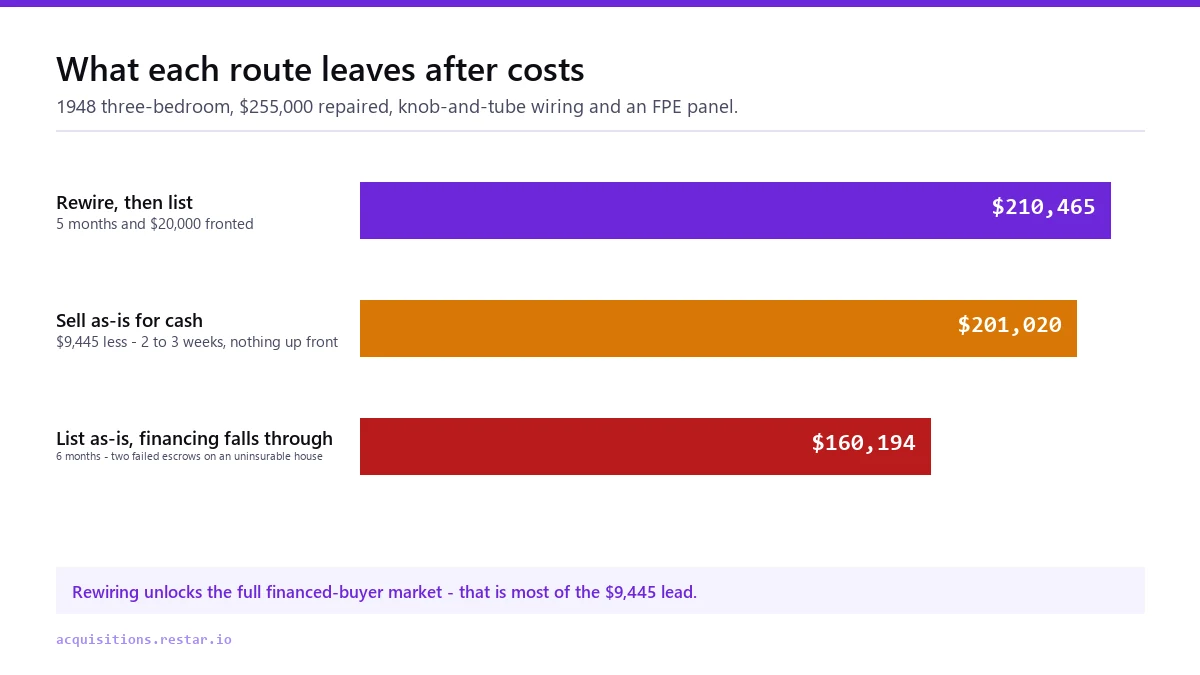
Here is the case that comes to us most often. A 1948 three-bedroom worth $255,000 repaired, with knob-and-tube wiring throughout and a Federal Pacific panel, needing $16,500 for a full rewire and panel swap plus $3,500 of general cosmetic work. Carrying costs run $980 a month.
Line
Rewire, then list
Sell as-is for cash
List as-is, hope for a cash buyer
Price
$255,000
$202,000
$178,000
Electrical + cosmetic repairs
−$20,000
$0
$0
Commission at 5.5%
−$14,025
$0
−$9,790
Seller closing costs
−$3,060
$0 — we cover standard closing costs
−$2,136
Buyer concession
−$2,550
$0
—
Carrying costs
−$4,900 (5 mo)
−$980 (3 wk)
−$5,880 (6 mo, financing fell through twice)
Net to you
$210,465
$201,020
$160,194
What each route leaves after costsRestar Acquisitions · worked example from this page
Rewiring, then listing beats our cash figure by $9,445, and beats the third route by $50,271. That third column is the one people back into without meaning to: a seller lists as-is, a financed buyer's loan dies at the insurance stage weeks into escrow, the house re-lists, and the cycle repeats while carrying costs and a stale listing eat the price down. Our guide to financed-offer fall-through risk covers that pattern in more general terms; an uninsurable electrical system is one of its most common and most avoidable causes.
The rewire route wins here because $20,000 of work unlocks the full financed-buyer market on a house that is otherwise cash-only. That math flips when the repaired value is lower relative to the rewire cost, when you cannot front $20,000, or when you genuinely cannot wait five months — and it is worth running with your own real numbers rather than assuming either direction.
What to actually do
Get an electrician's written assessment before you list, list as-is, or price anything. Guessing at whether your specific wiring or panel will pass a four-point inspection is how people end up either overpaying for unnecessary work or getting blindsided in week six of escrow.
Ask an independent insurance agent, not just one carrier, whether the house is insurable as it sits. Standard carriers vary, and a surplus-lines policy at a higher premium is sometimes available even when a standard carrier declines — which can be enough to get a financed buyer through underwriting, just at a cost that buyer will negotiate into the price.
If you cannot fund the repair, disclose it plainly and target the cash-buyer market on purpose rather than listing normally and discovering the problem mid-contract. A known issue priced in up front is cheaper than a financed deal that collapses after weeks of carrying costs and a second round of showings.
Where the repaired value clearly supports it, get the rewire quote and compare the real numbers the way the table above does, rather than assuming a cash sale is automatically the better outcome. It frequently is not.
Common questions
Can you sell a house with knob-and-tube wiring?
Yes, it is legal to sell. The obstacle is not legality, it is insurance: most standard carriers will not write a homeowners policy on a house with active knob-and-tube wiring, and a mortgage lender will not fund without proof of insurance. That removes most financed buyers until the wiring is replaced or a buyer pays cash and accepts the risk themselves.
Will homeowners insurance cover a house with a Federal Pacific panel?
Most standard carriers decline outright because Federal Pacific (Stab-Lok), Zinsco and Challenger panels have documented histories of breakers failing to trip under overload. A panel swap alone, typically $1,500 to $4,000, sometimes resolves this if the rest of the wiring is sound copper branch circuit; a surplus-lines policy at a higher premium is occasionally available even without replacing it.
How much does it cost to replace knob-and-tube wiring?
A full rewire commonly runs $8,000 to $25,000 depending on the size of the house and how accessible the walls are, plus drywall or plaster patching afterward. A panel replacement alone is separate and typically $1,500 to $4,000. Get a specific quote from a licensed electrician rather than relying on a general range.
Why does old wiring stop a buyer from getting a mortgage?
Lenders require proof of hazard insurance before funding a loan, and FHA loans specifically must meet HUD's Single Family Housing Policy Handbook 4000.1 requirement that a property be safe, sound and free of health and safety hazards. If no insurer will cover the house because of its electrical system, the buyer's loan cannot close regardless of their credit or down payment.
Is aluminum wiring as dangerous as knob-and-tube?
The Consumer Product Safety Commission's research found homes built before 1972 with aluminum branch wiring were 55 times more likely to develop a fire-hazard condition at a wire connection than comparable copper-wired homes. Unlike knob-and-tube, aluminum wiring sometimes doesn't need a full rewire — CPSC's recommended repair uses connectors rated for aluminum-to-copper splices at each outlet and switch, though some insurers still require a full replacement.
Should I rewire the house before selling, or sell it as-is?
It depends on the numbers. In the worked example on this page, rewiring and listing nets $210,465 against $201,020 for a cash sale, a $9,445 lead — because $20,000 of electrical work reopens the full financed-buyer market. That comparison reverses on a lower-value house, if you cannot fund the repair up front, or if you cannot wait several months for a sale to close.
Send us the address and what you know about the panel and the wiring. Within 24 hours we will tell you what we would pay as-is — and, as on this page, whether the numbers say a rewire and a normal listing would leave you further ahead. We would rather tell you to spend the $20,000 than sell a house you didn't need to sell for less.
Every offer on this site is underwritten by a person, not a form. If the
numbers do not work for you, say so and I will tell you what would.
Also from Restar
Want the data behind all of this?
Restar Acquisitions is the acquisitions arm of Restar — a housing-market analytics
platform tracking 180+ metrics across every U.S. market, with composite scores and 12-month
price forecasts. The numbers on this page come from the same work.