Selling a house with Japanese knotweed is possible. It does not block a sale. You can treat the plant over one to two growing seasons before listing, disclose it and list as-is with an agent, or sell the house as-is to a cash buyer now. The paths differ in cost and timeline, not in whether you can sell.
Step 1 of 5
No removal, no treatment plan, no waiting on a growing season. We'll work with the condition as it is.
You’ll talk to Trevor McAmis, Owner & Acquisitions Lead
(313) 710-6129
Takes about two minutes. Your address is never shared.
Educational only. This explains how these situations generally work. It is not legal, tax or financial advice, and the rules differ by state. Talk to an attorney or CPA about your own situation before you act on any of it.
Japanese knotweed (Reynoutria japonica, also sold historically as Polygonum cuspidatum) is a tall, bamboo-like perennial that spreads through underground stems called rhizomes. It shows up along fence lines, streambanks, and the edges of yards, and once established it is hard to kill outright. Other fast-spreading plants, kudzu and running bamboo among them, raise the same practical questions for a seller: what does it cost to deal with, does a buyer's lender care, and do you have to tell anyone it's there.
Japanese knotweed is well documented in the Northeast, the mid-Atlantic, and parts of the Midwest. It grows along waterways and disturbed ground in states like New York, Pennsylvania, Ohio, Michigan, Indiana, and Maryland, and the Pennsylvania Department of Conservation and Natural Resources tracks it as a regulated invasive species. North Carolina sees it mostly in its cooler western counties. It is rare in hot, dry climates, and sellers in warmer markets are far more likely to deal with kudzu, privet, or running bamboo than knotweed specifically.
If you're not sure what's growing on your property, a county extension office or a local landscaper who works with invasive species can usually identify it from a photo. Getting the plant identified correctly matters, because the cost and the disclosure questions below are specific to true Japanese knotweed, not every fast-growing vine in the yard.
The damage reputation is bigger than the research supports. A 2018 study by AECOM and the University of Leeds found reports of actual structural damage to the main house were rare: about 2% of the surveyed contractors and 6% of the surveyors had seen it, across 122 UK properties with knotweed present.
The researchers surveyed 51 contractors and 71 surveyors in total, and measured rhizome spread at excavation sites: it rarely extends more than four meters from the visible plant, with most stands spreading two to two and a half meters or less. Compared to other common plants, knotweed was no more damaging, and in some cases less damaging, than species like butterfly bush.
None of that means ignore it. Knotweed can push through cracks in driveways, patios, and garden walls, and it can grow into gaps around foundations, sheds, and drainage lines where there's already a weak point. The risk is real at those soft spots. It is not a documented cause of a house's main foundation failing on its own.
Lender treatment of knotweed is far more standardized in the United Kingdom, where some major lenders have had formal distance-based lending restrictions for years. US lenders do not have a comparable, published, nationwide policy. In practice, conventional and FHA underwriting treats knotweed the way it treats any other property condition flagged on an appraisal or inspection: as a potential effect on marketability and value that an underwriter can ask about, rather than a line item with a fixed rule. A conservative appraiser who sees an aggressive stand close to the house may note it as a condition issue, and a cautious buyer's inspector may flag it for further evaluation. That uncertainty, more than a specific lending rule, is the real friction in a financed sale.
No. Removal is one option among several, not a requirement. A house with knotweed in the yard can be sold through a standard retail listing, through an as-is listing with an agent, or directly to a cash buyer, with or without treatment underway. What changes by state and by sale type is whether, and how, you have to tell the buyer it's there.
Disclosure obligations vary by state, and none of the states this company operates in (Florida, Ohio, Michigan, Texas, Georgia, North Carolina, Arizona, Indiana, New York, Nevada, Maryland, Alabama, Pennsylvania, and Missouri) list invasive plants as a named line item on their standard seller disclosure form.
Pennsylvania's Seller Disclosure Law and Ohio's Residential Property Disclosure Form, like most states, use a general standard: a seller discloses known material defects, meaning conditions that would affect a reasonable buyer's decision or the property's value. Whether an aggressive knotweed stand next to the foundation counts as material is a judgment call, and it leans toward yes if you know about it and it's visibly spreading.
New York separately lists Japanese knotweed as a regulated invasive species that cannot knowingly be sold, propagated, or transported, which is a plant-sale restriction rather than a real estate disclosure rule, but it tells you the state takes the plant seriously enough to regulate it directly.
This is general information, not legal advice. Disclosure forms and the definition of a material defect vary by state and by contract. Check your state's specific disclosure form and talk to a real estate attorney before you sign anything.
Say a house would be worth $240,000 on the retail market if it had no knotweed at all. A dense patch runs along the back fence and close to a rear addition.
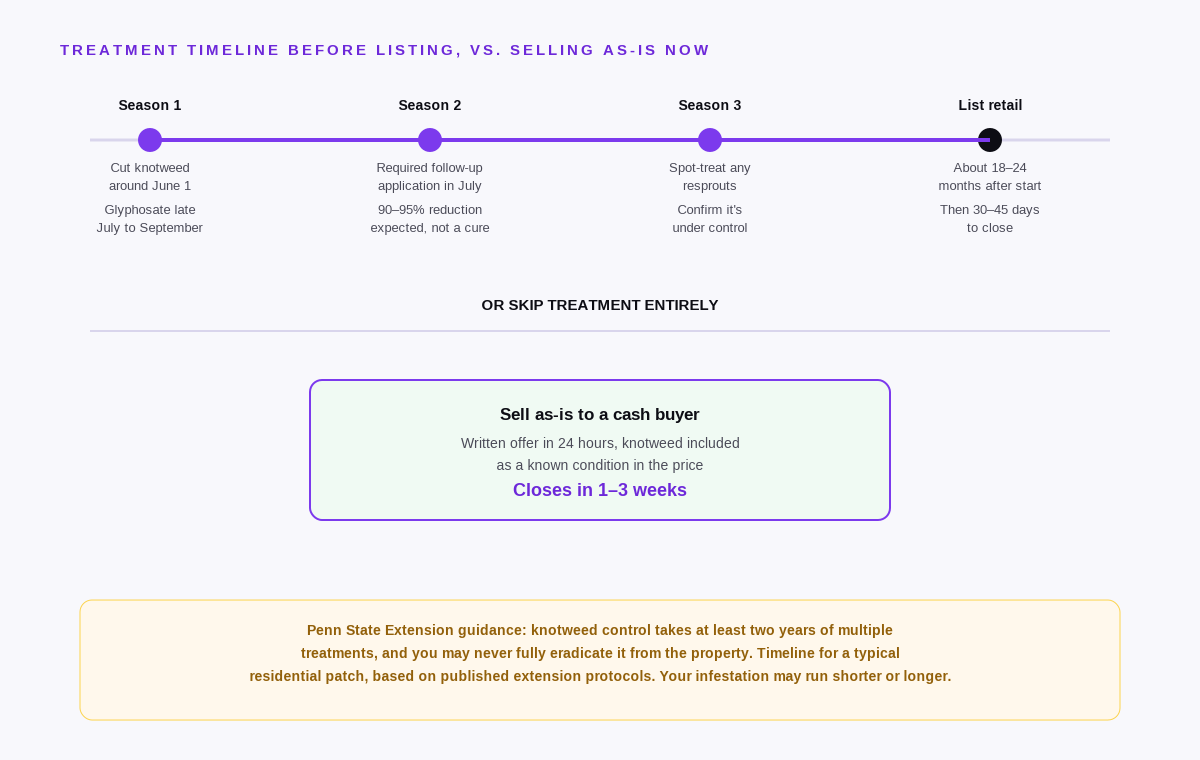
Path one: treat it, then list. Penn State Extension's management guidance calls for a late-summer glyphosate application the first year, a required follow-up the second year, and ongoing spot treatment after that, noting you may never fully eradicate it. Cost-data sources for residential knotweed treatment put herbicide programs in the range of $500 to $1,500 per visit; four to five visits across two growing seasons puts a typical program around $4,000. Carrying the house for the roughly 18 months it takes to get through that cycle before listing with confidence, at an estimated $1,500 a month in taxes, insurance, utilities, and upkeep, adds about $27,000. Then comes a retail sale at $240,000, minus roughly 7% in commission and closing costs ($16,800).
Path two: sell as-is to a cash buyer now. No treatment cost, no 18-month wait, and a lower offer that reflects the as-is condition, say $204,000. Closing costs on a cash sale are typically around 1% ($2,040), since there's no commission.
| Treat first, then list retail | Sell as-is for cash now | |
|---|---|---|
| Target sale price | $240,000 | $204,000 |
| Herbicide treatment (2+ seasons) | −$4,000 | $0 |
| Holding costs (about 18 months) | −$27,000 | $0 |
| Commission + closing costs | −$16,800 (7%) | −$2,040 (1%) |
| Net proceeds | $192,200 | $201,960 |
| Time before cash in hand | 18–24 months, then 30–45 days to close | 1–3 weeks |
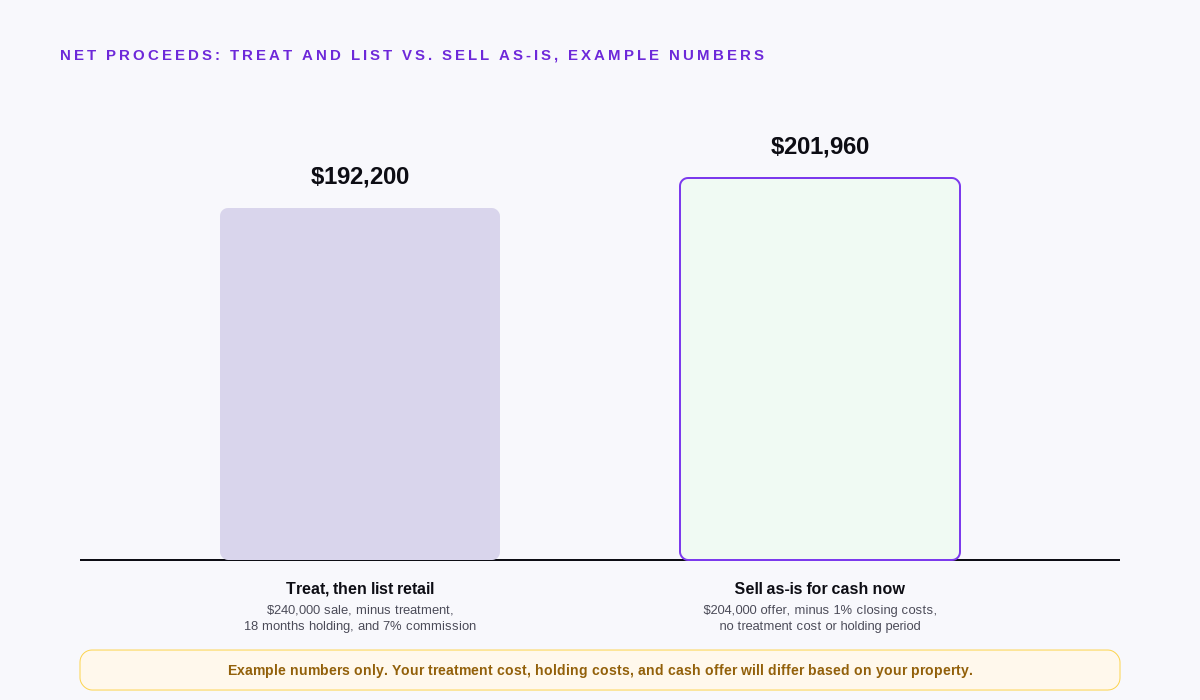
In this example, selling as-is nets about $9,760 more and skips a year and a half of carrying costs, with no guarantee a lender or buyer treats a "treated" yard any differently than an untreated one. If you have no mortgage, low carrying costs, or a market where buyers pay a real premium for a knotweed-free yard, the math can tilt the other way. Run your own numbers with your actual property taxes, insurance, and local comps before deciding.
Treat it, then list. Best if you're not in a hurry, the infestation is small, and you want to try for full retail value. Budget real time, at least one full growing season and usually two, and get a treatment plan from a licensed applicator rather than doing a single spray and calling it done.
Disclose it and list as-is with an agent. A middle path. You tell buyers what's there and what, if anything, has been done about it, and price the listing to reflect the work a buyer will still need to do. This keeps the retail buyer pool open while being upfront about the condition.
Sell as-is to a cash buyer. No treatment, no disclosure negotiation back and forth with a financed buyer's lender, no repairs. You get a number that already accounts for the plant, and you close on your schedule.
Whichever you choose, our guide on selling a house with foundation problems is worth reading if there's visible cracking or settling near the affected area, since that's a separate issue from the knotweed itself. And if you're weighing whether to disclose at all, the real cost of not disclosing a known defect walks through what's at stake if it comes out later.
Restar Acquisitions buys houses as-is, knotweed, invasive plants, and all, in 69 markets across 14 states. You get a written cash offer within 24 hours, no commissions, no repairs, and you choose the closing date. If treating the yard and listing with an agent would net you more in your specific case, we'll tell you that.
All guides · Selling a house with foundation problems · The real cost of not disclosing a known defect · Get a cash offer
Step 1 of 5
No obligation, no fees, no repairs. We respond the same day.
You’ll talk to Trevor McAmis, Owner & Acquisitions Lead
(313) 710-6129
Takes about two minutes. Your address is never shared.