Selling as-is or for cash doesn't cancel an unexpired builder's structural warranty by itself. Most builder structural warranties are tied to the house, not the original buyer, and many are built to transfer to a new owner, sometimes with a fee or a paperwork window. Confirm transferability directly with the issuing company before you close.
Step 1 of 5
Send the address. We'll help you figure out what's transferable, confirm with the warranty provider, and put a written cash offer in front of you within 24 hours either way.
You’ll talk to Trevor McAmis, Owner & Acquisitions Lead
(313) 710-6129
Takes about two minutes. Your address is never shared.
Educational only. This explains how these situations generally work. It is not legal, tax or financial advice, and the rules differ by state. Talk to an attorney or CPA about your own situation before you act on any of it.
Before going further, it's worth separating two products that get confused constantly because they share the word "warranty."
A builder's structural warranty comes from the construction of the house itself. It's issued, directly or through a third-party program like 2-10 Home Buyers Warranty or RWC Warranty, when the home was built, and it typically covers workmanship, certain systems, and major structural defects like a failing foundation, for a set number of years from the original closing date.
A home warranty service contract is a completely different product. It's a one-year (renewable) plan you can buy, or offer a buyer as a closing concession, that covers repairs to appliances and systems when they fail from normal wear, on a house of any age. If you're trying to figure out what one of those costs and whether offering one makes sense for your sale, that's covered separately in our guide on the cost of a home warranty when selling a house. That guide is not about what this article covers. This one is about the structural warranty tied to original construction, and what happens to it when you sell before it runs out.
Nothing automatic happens to the warranty just because you sell. A sale doesn't trigger cancellation, and selling as-is or for cash doesn't void coverage by itself. What matters is three separate questions:
Get those three right and an unexpired structural warranty passes to the next owner cleanly. Skip them and a transferable warranty can lapse anyway, not because the sale killed it, but because nobody told the warranty company it changed hands.
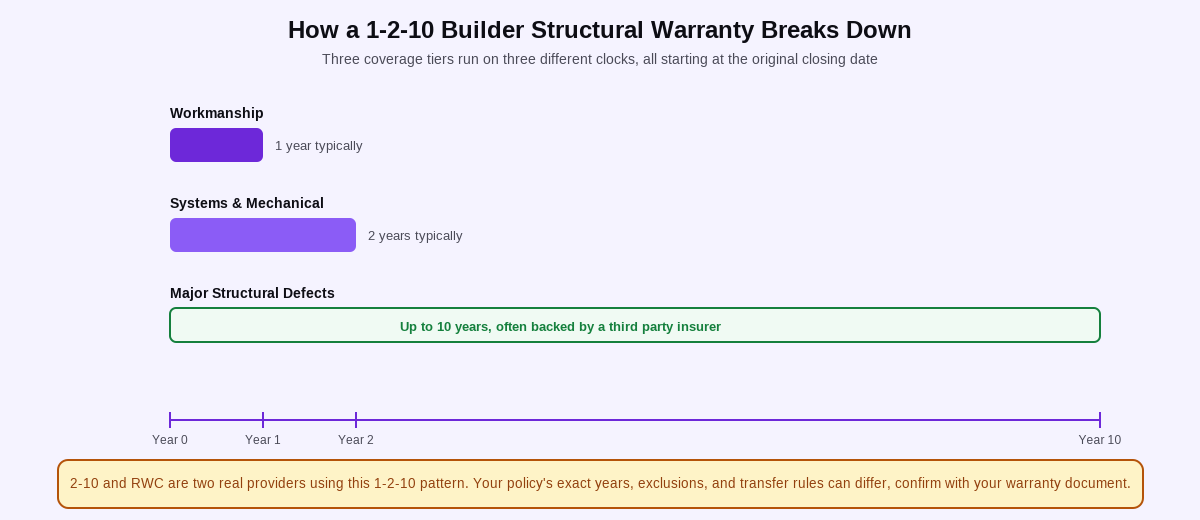
Builder structural warranties are commonly sold in tiers, and the most common shorthand in the industry is "1-2-10." According to 2-10 Home Buyers Warranty's own builder FAQ page, a standard structural warranty provides "1 year of coverage for workmanship, 2 years of coverage for distribution systems and a full 10 years of third-party insurance-backed coverage for qualifying structural defects."
RWC Warranty describes the same general pattern on its builder materials, calling it "the traditional 1-2-10 warranty" that is "designed to cover a wide range of items while limiting builder liability to just two years," while noting the company offers "over 75 different warranty options," so the exact years and exclusions depend on which specific program was placed on the home.
Those are industry-standard numbers from two of the larger third-party providers, not a universal rule. Some states build their own floor into the picture regardless of which private program a builder uses. New York, for example, has a statutory "housing merchant implied warranty" under General Business Law section 777-a that applies to new homes by default: one year that the home was built in a skillful manner, two years covering plumbing, electrical, heating, cooling, and ventilation systems, and six years against material defects, a shorter structural window than the 10-year term many private programs advertise. That statute can't be excluded by contract unless the builder offers a qualifying limited warranty in its place. If your home is in a state with its own implied warranty statute, check the terms, because they don't necessarily match whatever private warranty booklet came with the house.
Bottom line: confirm the actual years and coverage categories on your specific warranty document or policy number. Don't assume 1-2-10 applies to your house just because it's the most common structure.
This is where providers differ in real, verifiable ways, so don't assume your policy works like your neighbor's.
2-10 Home Buyers Warranty: the company's builder FAQ page states, "Yes. We offer fully transferable warranties. If the original home buyer sells their home before the 1, 2 or 10-year coverage is complete, this protection can be transferred to the new owner." That page doesn't post a transfer fee or deadline, so confirm the current process, any paperwork, and any fee directly with 2-10 before closing.
RWC Warranty: the company's homeowner page takes the opposite approach to friction, stating its "Limited Warranty automatically transfers to subsequent buyers throughout the warranty term," adding "there are no fees to pay or forms to complete." The warranty is tied to the home's address rather than to a specific owner, with one named exception: a foreclosure may void the warranty.
Two real providers, two different transfer mechanics, both verifiable on their own public pages. Terms vary by warranty provider and policy, so the only safe move is to call the number on your warranty document and confirm, in writing, what your specific policy requires before you rely on it transferring.
Selling as-is for cash, instead of listing with repairs and a financed buyer, doesn't by itself forfeit a transferable structural warranty. The warranty's terms don't care how the sale happened or whether the buyer financed it. What a cash sale does change is the checklist you need to run through before closing:
None of that is unique to a cash sale. It's the same checklist whether you sell to an investor, a cash buyer, or a financed retail buyer. The only difference is that a traditional listing often runs through more hands (an agent, a buyer's lender, a buyer's inspector) who may independently ask warranty-transfer questions during underwriting or inspection, which can add back-and-forth to an already longer closing timeline.
An unexpired, verifiably-transferable structural warranty is a real asset on a relatively new home, and it's one a lot of sellers don't realize they're sitting on. A buyer who knows a house still has six or eight years of structural coverage left, backed by a named third-party provider, is buying some real protection against the most expensive kind of repair a house can need. That's worth mentioning to any buyer, cash or financed, and worth confirming before you list or sell so you're not giving away value you didn't know you had, or promising a transfer that turns out to require paperwork nobody filed.
This is the scenario the structural tier of these warranties is built around. Both 2-10 and RWC separate the builder's short-term liability from the long-term structural coverage for exactly this reason.
2-10's builder page describes the insurance backing this way: "The insurance backing allows builders to transfer their liability to a warranty insurer, so they aren't on the hook for expensive structural repairs." The company names its reinsurers as Swiss Re and SCOR Re, "two of the world's largest reinsurers," and states it has paid out more than $300 million in structural defect claims over the life of the program.
RWC's builder materials describe a similar split: the builder is "limited to 1 year of liability," while "structural coverage is provided by RWC's insurer beginning on day 1," meaning the insurer's obligation doesn't depend on the builder still being around at year eight.
That structure matters precisely when a builder closes shop, which happens more often in a market downturn than homeowners expect. If the structural portion of your warranty is backed by a named third-party insurer rather than just a promise from the builder, a builder going out of business shouldn't by itself kill your coverage, though you should still confirm directly with the provider that your specific claim is being handled by the insurer and not routed through a defunct builder's office.
| Builder Structural Warranty | Resale Home Warranty Service Contract | |
| What it covers | Workmanship, certain systems, and major structural defects tied to original construction | Repairs to appliances and systems that fail from normal wear, regardless of the home's age |
| Typical length | Tiered, commonly around 1 year workmanship, 2 years systems, up to 10 years structural (varies by provider and policy) | One year, renewable annually |
| Who backs it | Often a named third-party insurer underwriting the structural piece, separate from the builder | The home warranty company itself |
| Transferability | Varies by provider and policy; some transfer automatically, some require a request, fee, or window; confirm directly | Not really "transferred"; a new contract is typically purchased for or by the next owner |
| Tied to | The property's original construction date | Whoever holds the current active contract period |
Example: a house was built four years ago and still carries roughly six years left on its original 10-year structural warranty, confirmed transferable with the issuing provider. It's worth about $345,000 fixed up and needs around $8,000 in paint, carpet, and light staging to list at that price.
Listing with an agent: after the $8,000 in prep, a 5.5% commission, and 1.5% in closing costs, plus 60 to 90 days to find a buyer and another 30 to 45 days to close (call it 3 to 5 months total), during which the buyer's lender or inspector may ask warranty-transfer questions that add a round or two of paperwork to the process.
| List With an Agent | Cash Sale As-Is | |
| Sale price | $345,000 (post-prep) | $298,000 (as-is) |
| Prep/staging | −$8,000 | $0 |
| Agent commission (about 5.5%) | −$18,975 | $0 |
| Closing costs (about 1.5%) | −$5,175 | $0 |
| Net to seller | $312,850, in 3–5 months | $298,000, in 1–2 weeks |
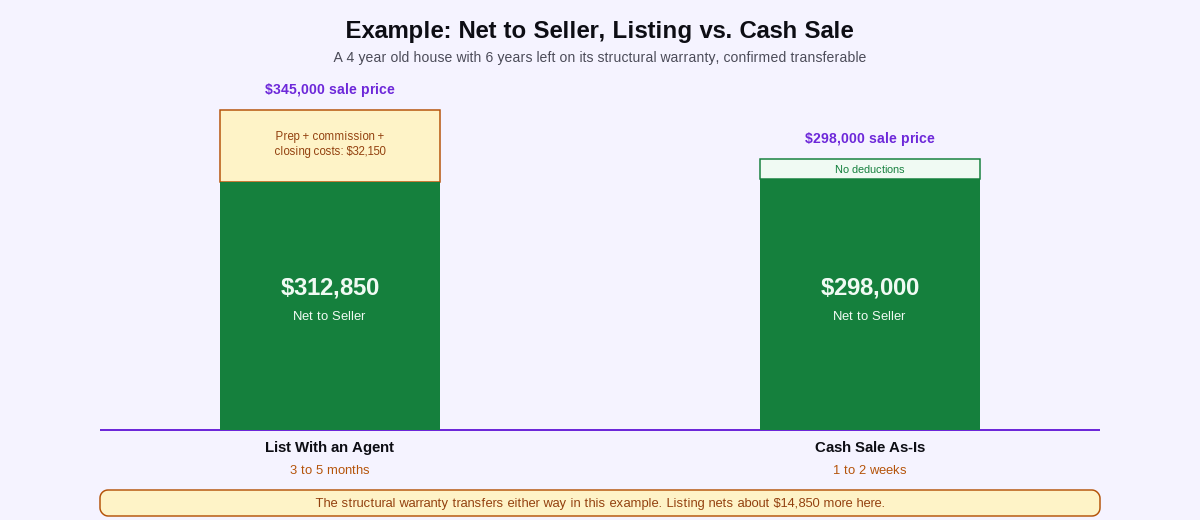
In this example, listing nets roughly $14,850 more. That's the real number, and it's the likely outcome on a house in good condition that doesn't need real repair money, where the warranty itself is a selling point rather than a complication. The math shifts the other way on a house that needs real repairs, has a tighter timeline, or where the seller would rather take a firm number next week than carry a listing for several months. Run your own numbers; our cash offer vs listing net proceeds breakdown walks through how to do that on your specific property.
If you're selling a house with a structural warranty still in effect, we'll run the numbers both ways with you. We buy houses as-is for cash, put a written offer in front of you within 24 hours, cover standard closing costs, charge no commissions, and let you pick the closing date. If listing nets you more, as it does in the example above, we'll tell you that too.
All guides · Cost of a home warranty when selling a house · Cash offer vs listing net proceeds · Sell my house fast
Step 1 of 5
No obligation, no fees, no repairs. We respond the same day.
You’ll talk to Trevor McAmis, Owner & Acquisitions Lead
(313) 710-6129
Takes about two minutes. Your address is never shared.