Most sellers assume an old pool fence has to be brought up to current code before they can sell, and in most states that's simply not true — existing pools are grandfathered to the code in effect when they were built. What actually matters is disclosure, whether a buyer's lender or insurer flags it, and your own liability while you still own the house. This page covers what Florida, Arizona, Georgia and Texas actually require, what really drives the decision to fix it anyway, and the honest math on a repair that's usually cheap enough to be worth doing.

Step 1 of 5
Tell us about the pool and the fence. We buy houses with pools as-is, fence included.
You’ll talk to Trevor McAmis, Owner & Acquisitions Lead
(313) 710-6129
Takes about two minutes. Or call (313) 710-6129 — we answer.
Educational only. This explains how these situations generally work. It is not legal, tax or financial advice, and the rules differ by state — talk to an attorney or CPA about your own situation before you act on any of it.
In most states, an existing pool's fence or gate does not have to meet the current safety code to sell the house — it's grandfathered to the code in effect when it was built. What actually forces the issue is disclosure, a buyer's lender or insurer flagging it, or your own liability exposure while you still own the house. Bringing an older barrier up to current code typically costs $1,500–$10,000, averaging around $6,500. A cash sale skips the negotiation over who fixes it and when; listing it disclosed and unfixed usually costs less than people assume, as long as you're upfront about it.
General information, not legal advice. Pool barrier requirements are set by state and often by county or city, and they change. Confirm your specific jurisdiction's current rule with a local pool contractor or your city's building department before relying on anything here.
The federal Virginia Graeme Baker Pool and Spa Safety Act (VGB Act), effective December 19, 2008, is the law most people have half-heard of when they think about pool safety and assume it applies to their backyard. It doesn't, directly. Per Pool Safely, the CPSC's own consumer-safety campaign, VGB “mandates new requirements for public pools and spas” — a mandatory anti-entrapment drain-cover standard — plus a grant program that funds state and local enforcement and education, not a direct federal mandate on a private backyard pool.
That distinction matters because it means the rule that actually applies to you varies a lot by state, and in most of our operating states, existing pools are grandfathered: the barrier only has to meet the code that was in force when the pool was built or last permitted, and current code is triggered by new construction or a permit application — not by a sale.
The state-by-state picture varies more than most sellers expect, and none of it works quite the way the federal VGB Act might lead you to assume.
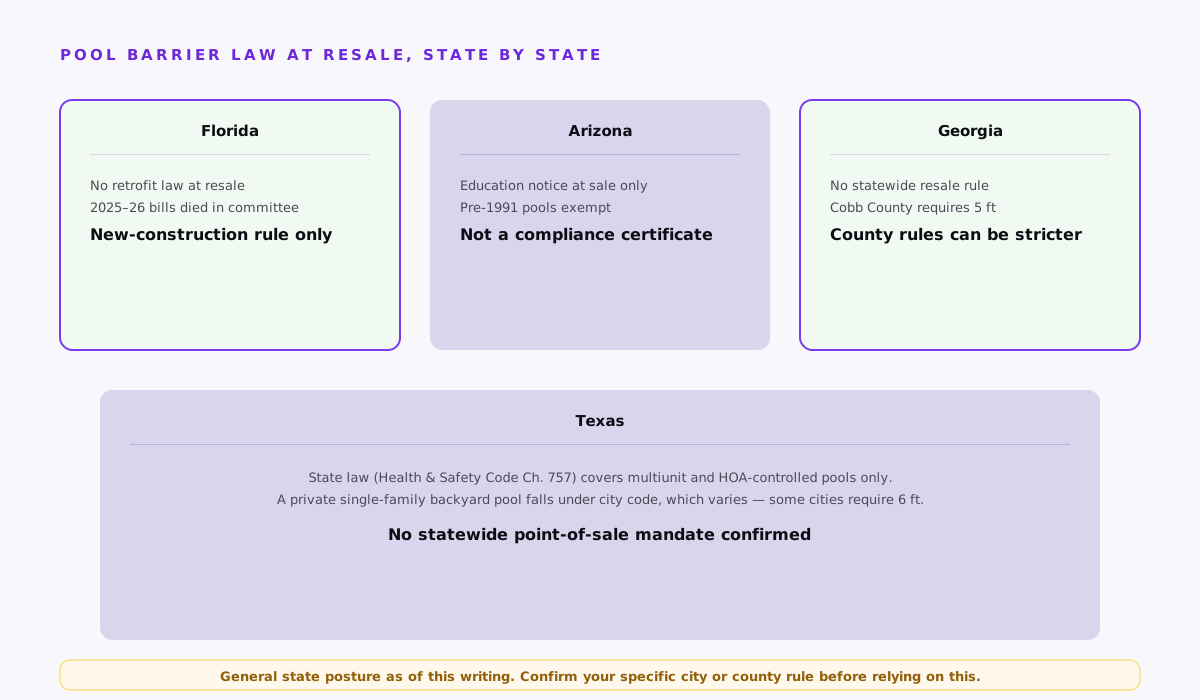
Florida (Chapter 515, the Residential Swimming Pool Safety Act) sets specific requirements for new pools — a barrier at least 4 feet high, gates that open outward, self-close and self-latch — but this applies to new pool construction, not the resale of an existing home. There is currently no Florida law requiring an existing home's pool barrier be brought to current code, or requiring any compliance certification, at the sale of the house. Bills that would have created exactly that requirement were filed in 2025 and 2026 and died in committee both times — so if you've heard this is coming, it hasn't arrived yet.
Arizona (A.R.S. §36-1681) has one of the more specific statutes: a 5-foot exterior barrier or a 4-foot isolation fence between the house and the pool, with self-closing, self-latching gates. Pools built or permitted before June 1, 1991 are exempt from the barrier mandate. What Arizona does require at a sale is narrower than a retrofit: anyone selling, renting or leasing a home with a pool must give the buyer or renter a state-approved pool-safety education notice — informational, not a compliance certificate.
Georgia made the International Swimming Pool and Spa Code mandatory statewide in 2017 (48-inch barrier, self-closing and self-latching gates, no gaps wider than 4 inches), but we found no statewide requirement tying an existing pool's compliance to a home sale — worth checking directly if you're near one of our Georgia markets. Some counties are stricter than the state minimum — Cobb County, for instance, requires a 5-foot barrier — so a county-level check matters more than the state code here.
Texas regulates pool enclosures at the state level only for multiunit rental and HOA-controlled pools (Health & Safety Code Chapter 757); a private single-family backyard pool falls under whatever your specific city requires, and that varies — some of our Texas markets, including Waco, require 6 feet rather than the more common 4-to-5-foot standard. There is no statewide point-of-sale mandate we could confirm.
The pattern across every state we checked is consistent: existing pools are grandfathered, current-code compliance is triggered by new construction or a permit, and none of our operating states requires a retrofit or compliance certificate simply because you're selling.
If it's not a legal retrofit requirement in most of our states, why does this show up as a real problem at closing anyway? It comes down to three separate mechanisms that have nothing to do with the retrofit statute itself, and any one of them can slow down or reshape your sale.
Disclosure. Even where there's no retrofit mandate, most states require sellers to disclose known material defects, and a barrier you know doesn't meet current safety standards — a gate that doesn't self-latch, a gap wide enough for a small child, a missing alarm where local custom expects one — is the kind of thing a buyer's inspector will flag and a plaintiff's attorney would ask about if something ever happened after closing. Disclose what you know.
Insurance. Insurers “almost always” require a functioning fence and a locking gate around a residential pool, per the Insurance Information Institute, and its absence can trigger a short cure period, a coverage exclusion, or non-renewal. A buyer who can't get an affordable homeowners policy has a financing problem even if no law technically required the fence.
Liability while you still own it. Per the CDC, drowning is the leading cause of death for children ages 1–4 nationally, and CPSC's 2025 annual drowning report, covering 2020–2022 data, found an average of 357 children under 15 died annually in pool or spa incidents, 85% of them at a residential property. That's not a reason to fear-monger a sale — it's the actual reason insurers and buyers care about this detail more than the statute technically requires, and it's worth fixing regardless of when you sell.
Take a Georgia house with an in-ground pool, repaired value $215,000, no mortgage, carrying costs $700 a month. The existing chain-link fence is 42 inches with a gate that doesn't self-latch — grandfathered under state law, not required to be fixed to sell, but flagged by a buyer's inspector and a concern to at least one lender's appraiser on a prior showing. A licensed fence contractor quotes $4,800 for a code-compliant mesh fence with self-closing, self-latching gate hardware and a pool alarm.
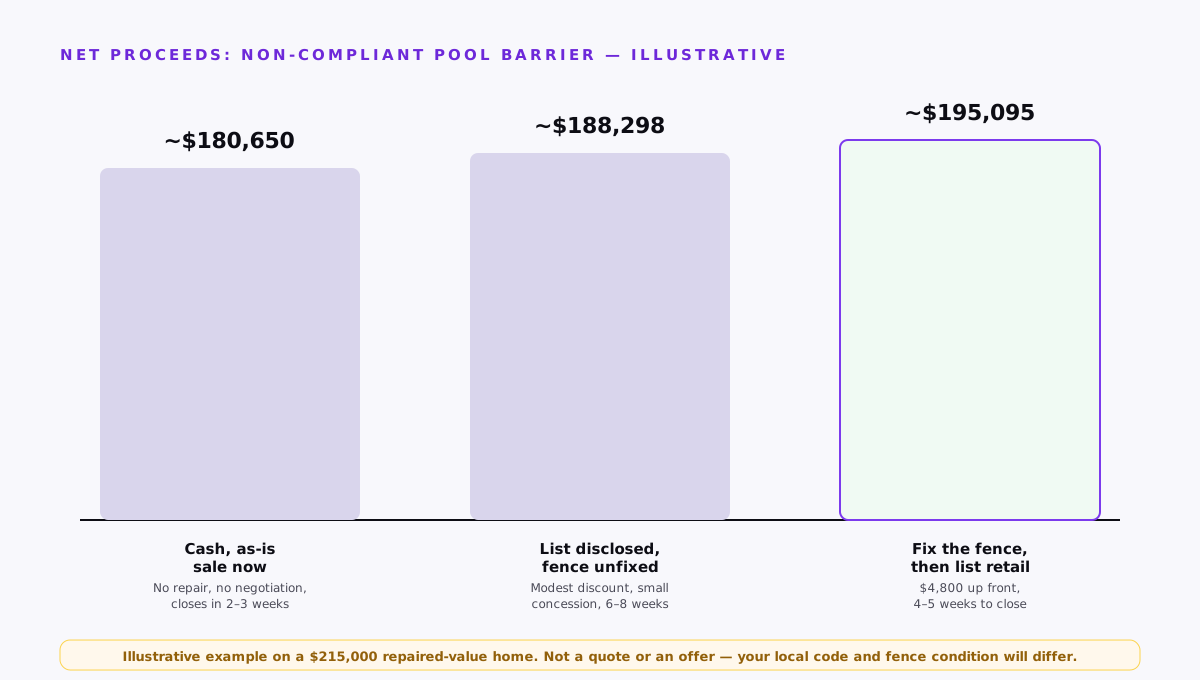
| Route | Fix the fence, then list | List disclosed, unfixed | Sell as-is for cash |
|---|---|---|---|
| Sale price | $215,000 | $206,000 | $181,000 |
| Fence and gate repair | −$4,800 | — | — |
| Agent commission | −$11,825 | −$11,330 | — |
| Seller closing costs | −$2,580 | −$2,472 | covered |
| Holding costs | −$700 | −$1,400 | −$350 |
| Buyer concessions | — | −$2,500 | — |
| Net proceeds | $195,095 | $188,298 | $180,650 |
| Time and cash needed | 4–5 weeks, $4,800 up front | 6–8 weeks, nothing up front | 2–3 weeks, nothing up front |
An illustration on one hypothetical house, not a quote and not a prediction. Your local code, insurance situation and fence condition will differ.
This is a case where fixing it clearly wins, and it's cheap enough that it should win for most sellers — $195,095 versus $180,650 for a cash sale, a $14,445 gap, against a repair that costs under $5,000 and takes about a week. That's the opposite pattern from a large structural repair, where should I repair before selling shows the math can genuinely go either way. The honest reason to skip the repair and sell as-is isn't the dollar gap here; it's that a $4,800 fix that pushes your closing out by a month doesn't fit every seller's timeline, or the house is vacant and you don't want liability exposure between now and closing, or you'd rather not manage a contractor at all. Those are legitimate reasons. The math itself favors the fix on a repair this small.
Check your actual city or county rule before assuming either that you must fix the fence or that you're automatically exempt — local ordinances vary more than the state statute does. If the repair is small, as it usually is, fixing it before you list is the better math on most houses. If the timeline, the liability exposure, or just not wanting to manage a contractor doesn't fit your situation, send us the property and we'll make you a written offer that skips the repair and the negotiation entirely.
On most houses this repair is small enough that fixing it before you list is the better math. But if the timeline, the liability, or just managing a contractor doesn't work for you, we'll make you a written offer that skips it entirely.
Send us the property here. Get a fence quote too — on a repair this size, you may find fixing it is worth doing regardless of who you sell to.
All guides · Should I repair before selling? · Cash offer vs listing net proceeds · We buy houses in Cape Coral, FL
Step 1 of 5
No obligation, no fees, no repairs. We respond the same day.
You’ll talk to Trevor McAmis, Owner & Acquisitions Lead
(313) 710-6129
Takes about two minutes. Or call (313) 710-6129 — we answer.
