A short-term rental license almost never transfers when the house sells — every city and county ordinance we checked requires the buyer to reapply from zero, often under stricter current rules than the seller operated under. HOA bans add a second layer: some states let existing short-term rental owners keep operating under a grandfather clause, but that protection dies the moment the deed transfers to a new owner. None of this automatically blocks financing on a standalone single-family house, but it changes who can buy it and how.
Step 1 of 5
Tell us about the property and its rental history. We'll give you a straight read on what it's worth and whether a licensed buyer pool is realistic in your market.
You’ll talk to Trevor McAmis, Owner & Acquisitions Lead
(313) 710-6129
Takes about two minutes. Or call (313) 710-6129 — we answer.
Educational only. This explains how these situations generally work. It is not legal, tax or financial advice, and the rules differ by state — talk to an attorney or CPA about your own situation before you act on any of it.
No, in every jurisdiction we checked. Austin's STR ordinance states licenses are “valid for two years and may not be transferred” — a buyer has to meet the city's current distance and density rules, not whatever rules applied when the seller got licensed. Columbus, Ohio is explicit that “any transfer of ownership voids it.” St. Louis County, Missouri requires “a new permit with a new fee” the moment a property sells. Asheville, North Carolina's homestay permits work the same way — buying a house with an active, legal short-term rental history doesn't hand you the permit; the new owner applies as if none of that history existed.
Savannah, Georgia has the one real exception worth knowing: its ordinance gives a new owner a 6-month grace window to apply for a new certificate without getting blocked by the ward's STR cap, if the parcel already carried a certificate. Miss that window, and the cap-exemption is gone permanently — a genuine, time-sensitive value point if you're marketing a licensed STR house to an investor buyer in a capped market.
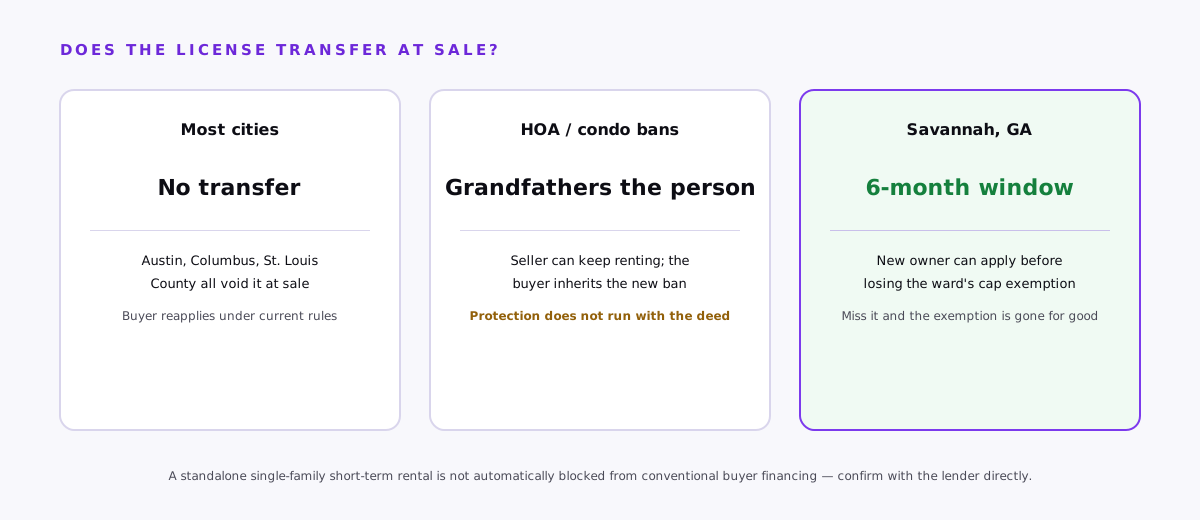
Florida law creates a specific, honest trap worth understanding if your market has HOA-governed properties. Under Florida Statute 718.110(13), a condo association that later passes a short-term rental ban can only apply it to owners who consent or who buy after the ban takes effect — an owner already renting short-term when the amendment passes is personally grandfathered. Florida's HOA statute, 720.306(1)(h), works the same way for non-condo HOAs.
The catch: that protection belongs to the person, not the property. Florida's HOA statute lets an association cap rentals at 3 times a year or bar stays under 6 months, and — for any such restriction adopted after July 1, 2021 — the law states it “applies only to a parcel owner who acquires title to the parcel after the effective date.” That means a seller can legally keep renting short-term right up until closing, and the buyer still inherits a building where short-term rentals are now banned outright. The Community Associations Institute's own policy research confirms this pattern is common and the enforceability of STR bans generally holds up in court when properly adopted — courts have split mainly on whether a simple majority or a supermajority vote is required to pass the ban in the first place, not on whether a ban can exist at all.
It depends almost entirely on whether the property is a standalone house or a unit in a condo/HOA project — and this distinction matters enough that it's worth stating plainly rather than letting it blur together.
Fannie Mae's Selling Guide excludes a project from standard financing eligibility if it's “operated or managed as a hotel, motel, or similar commercial entity,” or if it's “primarily transient in nature” — daily rentals, central registration, mandatory rental-pooling arrangements. Freddie Mac applies a similar standard to what it calls a “condominium hotel.” FHA goes further and writes a bright-line rule directly into federal law: 12 U.S.C. § 1731b statutorily prohibits FHA-insured mortgages on property rented “for transient or hotel purposes,” defining transient as any rental period under 30 days.
A standalone single-family short-term rental house isn't automatically caught by any of this — these exclusions target project-level characteristics (a condo building's HOA rules, mandatory rental pooling, hotel-style operations), not an individual homeowner renting their detached house on Airbnb. A buyer of that standalone house can generally still get conventional financing, as long as the HOA or deed doesn't itself impose condotel-style rules. A buyer of a unit inside a building that's crossed into “primarily transient” territory is a different story, and may be pushed into non-QM or DSCR specialty financing — higher rates, larger down payments, a smaller buyer pool.
There's no single named statute requiring “short-term rental history” disclosure — this falls under the same general material-defect disclosure law that applies to nearly every home sale. What's squarely covered: a known pending license revocation or non-renewal, any open code-enforcement action tied to the short-term rental use (noise, parking, occupancy complaints), and any HOA rule change the seller already knows about that would affect the buyer's intended use. Treat these the way you'd treat any other known material fact — because that's exactly what they are.
This is the part sellers running a short-term rental consistently misjudge. Appraisers default to the sales-comparison approach for 1–4 unit residential property — comparing your house to nearby non-short-term-rental sales — which means short-term rental income generally doesn't raise the appraised value on its own. Even lenders who do consider rental income typically pull Fannie Mae's standard Form 1007 rent schedule, which uses long-term lease comps, not nightly rates — systematically understating what the house actually earns as a short-term rental.
The result is a real, honest gap: what the house is worth as a house (comps-based) and what it's worth as an income stream (occupancy and nightly-rate based) can diverge sharply, and a retail buyer's lender will almost always anchor to the lower, comps-based number regardless of what the listing's income statement says.
Say the house comps out at $310,000 as an ordinary single-family home — that's what a retail lender's appraisal will support, regardless of the $42,000 a year it's actually grossing as a short-term rental, because the appraisal doesn't credit that income.
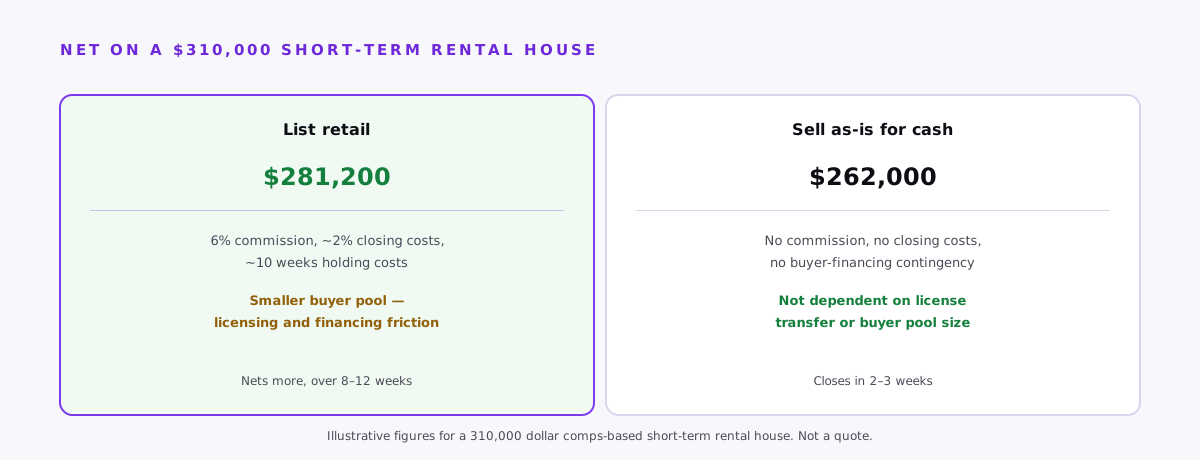
| List retail | Sell as-is for cash | |
|---|---|---|
| Comps-based value | $310,000 | $310,000 |
| Agent commission (6%) | −$18,600 | $0 |
| Seller closing costs (~2%) | −$6,200 | $0 |
| Holding costs, ~10 weeks (smaller buyer pool) | −$4,000 | $0 |
| As-is cash offer | — | $262,000 |
| Net to seller | $281,200 | $262,000 |
| Timeline | 8–12 weeks | 2–3 weeks |
Listing nets about $19,200 more here — the honest number, and the right answer if you have the time and your buyer pool isn't choked by condotel-style financing restrictions. A cash sale is the faster, financing-contingency-free option, not the bigger number, and it matters more in markets where the standard buyer pool is genuinely smaller — a non-transferable license, an HOA rental ban, or project-level financing exclusions all shrink who can realistically buy.
List retail to an owner-occupant buyer. Usually nets the most, since the price is anchored to comps regardless of rental income, and the buyer pool is the full ordinary market.
Market specifically to an STR-investor buyer. Can command a premium tied to the income, but narrows the buyer pool to those who can get specialty financing and are willing to reapply for a license with no guarantee of approval.
Sell as-is for cash. Skips the financing-contingency risk and the license-transfer uncertainty entirely. Send us the property here and we'll walk you through the numbers.
This article is general educational information, not legal advice. Short-term rental licensing, HOA rules, and disclosure obligations are set locally and by your governing documents, and change often — confirm your specific situation with your municipality, HOA, and a real estate attorney before you list.
If your short-term rental license won't transfer and your realistic buyer pool just got smaller, we can make a cash offer that doesn't depend on a buyer getting relicensed or approved for specialty financing.
Send us the property here and we'll walk you through the numbers.
All guides · Selling a rental property with tenants · Cash offer vs. listing net proceeds · Seller closing costs
Step 1 of 5
No obligation, no fees, no repairs. We respond the same day.
You’ll talk to Trevor McAmis, Owner & Acquisitions Lead
(313) 710-6129
Takes about two minutes. Or call (313) 710-6129 — we answer.
