Selling a house in receivership for code violations means a judge has already put someone else in charge of your property's repairs and costs. You can still sell it, but most courts require approval first, and the receiver's certificate usually gets paid from the proceeds before your mortgage does. Here's how that plays out and what it costs.
Step 1 of 5
Tell us about the property and the receivership status. We'll tell you what a cash sale looks like and whether listing after paying off the certificate would net you more.
You’ll talk to Trevor McAmis, Owner & Acquisitions Lead
(313) 710-6129
Takes about two minutes. Your address is never shared.
Educational only. This explains how these situations generally work. It is not legal, tax or financial advice, and the rules differ by state. Talk to an attorney or CPA about your own situation before you act on any of it.
An ordinary code violation is a fine, maybe a lien if you don't pay it. Receivership is a different animal. The city, a nonprofit housing group, or sometimes a neighbor or tenant sues you in housing court over violations you haven't fixed. If the judge agrees the building is a public nuisance or a dangerous building, the court appoints a receiver, often a nonprofit or a licensed contractor, who takes legal control of repairs and sometimes the building itself. You don't get to decide the repair scope or the contractor anymore. The receiver borrows money or uses city funds to do the work, then bills you for it through a certificate that attaches to the property as a lien.
This is a step past what our guide on selling a house with code violations and our code violations situation page cover. Those deal with fines and ordinary liens. Receivership is a court case with a judge and an appointed stranger running your repairs.
Three of our markets see this often. Baltimore, Maryland runs one of the most active receivership programs in the country under Baltimore City Code §§ 118 and 121. Ohio cities including Cleveland, Akron, Canton, Cincinnati, Columbus, Dayton, Lorain, Toledo, and Youngstown use Ohio Revised Code § 3767.41. Michigan cities including Detroit, Flint, Grand Rapids, Kalamazoo, Lansing, and Saginaw can use the Housing Law of Michigan at MCL 125.535.
The path is similar across states, with differences in who can bring the case. In Ohio, a municipal corporation, a township, a neighbor, a tenant, or a nonprofit housing organization can petition the court directly under R.C. 3767.41. In Baltimore, the city's Building Official petitions the District Court once a vacant structure has outstanding rehabilitation or demolition orders under the city code. In Michigan, the enforcing agency brings a suit under the Housing Law of Michigan, and the court appoints a receiver as part of that case under MCL 125.535.
In every version, you get notice of the violation first and a chance to fix it. Receivership shows up after that chance has passed and the property is still non-compliant. Once the judge appoints a receiver, the receiver can take possession, collect rent if the property is occupied, borrow against the property to pay for repairs, and in some states even demolish the structure if repair isn't realistic.
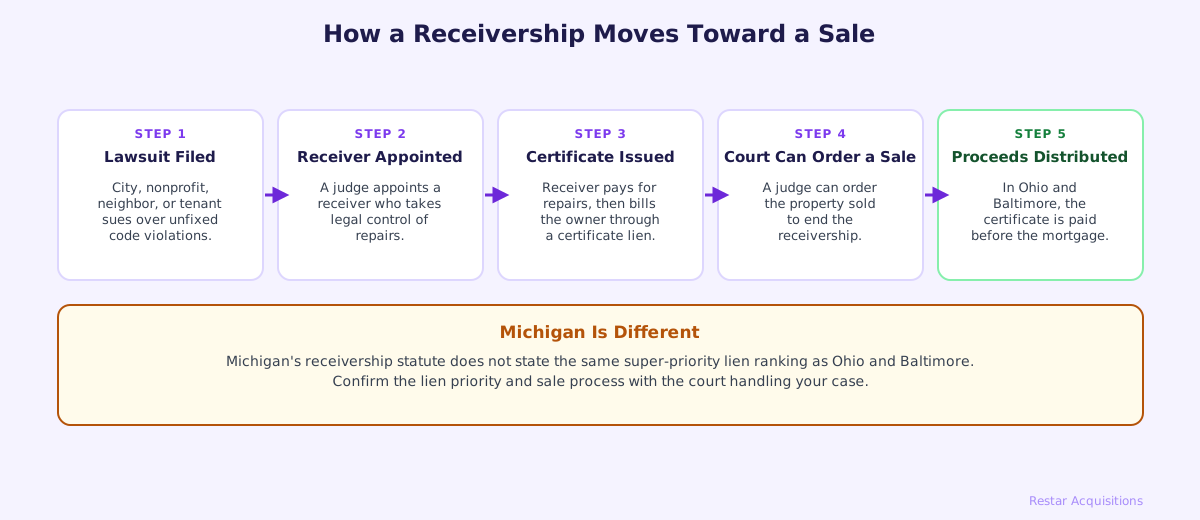
Once a receiver is appointed, you lose a lot of the control you'd normally have as owner. You typically cannot sell, refinance, or sometimes even enter the property without the receiver's or the court's cooperation. That doesn't mean a sale is off the table. In Ohio and in Baltimore, the statutes specifically contemplate selling the property as part of ending the receivership. A judge can order the receiver to sell once repairs are certified or once the parties agree a sale is the better path, and the sale proceeds get distributed in a set order: receiver's notes and certificates, receiver's expenses, delinquent taxes, then mortgages and other liens by their own priority.
Michigan's statute is less specific on this point. MCL 125.535 says the receivership "terminates at the discretion of the court" but doesn't lay out the same sale and distribution mechanics that Ohio and Baltimore spell out. If your property is in a Michigan market, a local housing attorney needs to confirm with the specific court how a sale during an open receivership would actually work there.
The lien priority question is the one that matters most if you have a mortgage, because it decides whether sale proceeds pay off the receiver first and leave less for the mortgage, or the other way around.
| State / City | Statute | Who Can Petition | Receiver's Lien Priority | How It Ends |
|---|---|---|---|---|
| Ohio (Cleveland, Akron, Canton, Cincinnati, Columbus, Dayton, Lorain, Toledo, Youngstown) | R.C. 3767.41 | Municipality, township, neighbor, tenant, or nonprofit housing organization | First lien, superior to prior and subsequent liens and encumbrances, including taxes, once recorded with the county recorder within 60 days | Nuisance abated and all receivership costs, fees, and certificates paid or holders consent to discharge |
| Baltimore, Maryland | Baltimore City Code §§ 118, 121 | City Building Official | Priority over all other liens and encumbrances except taxes or other government assessments | Rehab completed and receiver discharged, or property sold and court-ratified with final accounting filed |
| Michigan (Detroit, Flint, Grand Rapids, Kalamazoo, Lansing, Saginaw) | MCL 125.535 (Housing Law of Michigan) | Party that brought the underlying enforcement suit | Lien authorized, but the statute does not state it beats a prior mortgage. (By contrast, Michigan's separate non-receiver abatement lien under MCL 125.541 explicitly does not outrank prior recorded liens.) | "At the discretion of the court," no fixed statutory trigger stated in the section itself |
The takeaway: in Ohio and in Baltimore, the receiver's bill jumps ahead of your mortgage by statute. In Michigan, the receivership statute itself doesn't say either way, so you can't assume the same super-priority applies there without checking with the court handling your case.
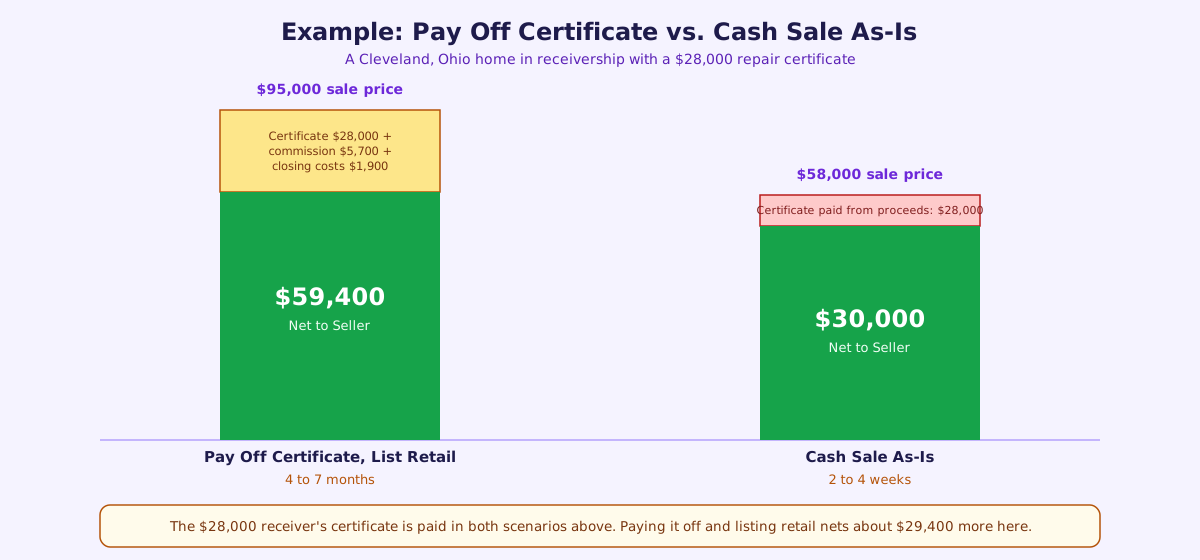
Example: A single-family home in Cleveland, Ohio is in receivership. The receiver has issued a certificate of about $28,000 for roof, plumbing, and electrical repairs required to clear the violations. The home would be worth roughly $95,000 on the retail market once those repairs are done and the receivership is closed.
If the owner pays off the certificate and lists the home retail after repairs are complete: sale price $95,000, minus the $28,000 certificate payoff, minus a 6% agent commission ($5,700), minus closing costs around 2% ($1,900), nets about $59,400. Timeline runs 4 to 7 months once you count paying the certificate, waiting for repair sign-off, then listing and closing.
If the owner sells as-is for cash while the receivership is still open: a cash offer around $58,000, with the $28,000 certificate paid out of the closing proceeds under court supervision rather than by the seller upfront, nets about $30,000 to the seller. Timeline runs 2 to 4 weeks, including the time needed for the court to approve the sale.
| Pay off certificate, list retail | Sell as-is for cash | |
|---|---|---|
| Sale price | $95,000 | $58,000 |
| Repairs / certificate payoff | -$28,000 | Paid from closing proceeds |
| Agent commission (6%) | -$5,700 | $0 |
| Closing costs (~2%) | -$1,900 | $0 |
| Net to seller | ~$59,400 | ~$30,000 |
| Timeline | 4-7 months | 2-4 weeks |
Cash nets less here, by a real margin. If you have roughly $28,000 available and four to seven months to carry the property through repairs and a retail listing, paying off the certificate and listing retail is the better move financially. If you don't have that cash, don't have that time, or the actual repair needs run deeper than what the certificate covers, a cash sale as-is is the simpler path even though it nets less up front.
A cash sale isn't the only move here, and it isn't always the right one.
You can negotiate a repair plan directly with the receiver or the city's housing court. In some cases, showing the court you're actively working toward compliance can shorten the receivership or reduce the certificate amount, especially if you can do some of the work yourself under the receiver's oversight.
You can pay off the certificate before listing retail, as shown in the math above, if you have the cash and the time.
You should talk with a local housing or real estate attorney about your specific receivership before deciding anything. Whether a sale can happen while the case is still open, what the receiver will require at closing, and how the certificate gets handled all depend on the court and the state. This article is general education, not legal advice for your situation. See our cash offer vs. listing net proceeds guide for a broader breakdown of that tradeoff outside of receivership specifically.
We buy houses as-is, including homes with open code violations or an active receivership, in the Ohio, Michigan, and Maryland markets this article covers, like Cleveland. We give a written offer within 24 hours, we don't charge commissions, and you pick the closing date. We don't ask you to make repairs first.
A sale while receivership is open still needs the court's and often the receiver's sign-off, and the certificate typically gets settled out of the closing proceeds rather than out of your pocket upfront. We coordinate that directly with the receiver and the court as part of getting to closing. If paying off the certificate and listing retail would actually net you more once you run your own numbers, we'll tell you that instead of pushing you toward a cash sale anyway.
We give a written offer within 24 hours, we don't charge commissions, and you pick the closing date. We don't ask you to make repairs first. A sale while receivership is open still needs the court's and often the receiver's sign-off, and the certificate typically gets settled out of the closing proceeds rather than out of your pocket upfront. We coordinate that directly with the receiver and the court as part of getting to closing. If listing after paying off the certificate would net you more, we'll tell you.
All guides · Selling a house with code violations · Cash offer vs. listing net proceeds · We buy houses in Cleveland, Ohio
Step 1 of 5
No obligation, no fees, no repairs. We respond the same day.
You’ll talk to Trevor McAmis, Owner & Acquisitions Lead
(313) 710-6129
Takes about two minutes. Your address is never shared.