Every market page publishes the numbers behind its offer. See the math
Home › Guides › Selling a House in Arizona: No Redemption, No Transfer Tax
Guide
Selling a House in Arizona: No Redemption, No Transfer Tax
Selling a house in Arizona runs on rules that surprise people who learned the basics from a different state. Foreclosure here is a trustee's sale, not a lawsuit, and it moves on a fixed statutory clock with no waiting around for a judge. Once that sale happens, there is no redemption period afterwards — the auction is the end of it, full stop, which is the opposite of how Alabama or several other states handle the same moment. Most owner-occupants who bought the house they live in are shielded from being chased for a deficiency afterwards. And Arizona charges no transfer tax on a sale at all, which is unusual enough to be worth knowing before you assume your closing costs will look like everyone else's.
Takes about two minutes. Or call
(313) 710-6129 — we answer.
Educational only. This explains how these situations generally work. It is not legal, tax or financial advice, and the rules differ by state — talk to an attorney or CPA about your own situation before you act on any of it.
Selling a house in Arizona: the short answer
Selling a house in Arizona means dealing with a non-judicial trustee's sale process that cannot happen sooner than 91 days after the notice is recorded, and that carries no right of redemption once the sale is complete. Most owner-occupied purchase-money loans are protected from a deficiency judgment. There is no state real estate transfer tax.
This is general educational information, not legal or tax advice. Arizona foreclosure timing, anti-deficiency protection and disclosure duties all turn on facts specific to your loan, your deed and your property. Talk to an Arizona real estate attorney and a CPA about your own situation before relying on any of it.
Foreclosure moves fast, and it does not reverse afterwards
Most Arizona mortgages are secured by a deed of trust rather than a straight mortgage, which routes foreclosure through a trustee's sale instead of a courtroom. Under A.R.S. 33-807, the trustee records a notice of sale and then cannot exercise the power of sale before the ninety-first day after that recording — a hard 91-day floor, with no lawsuit, no judge and no hearing required to get there.
The part that catches people who have dealt with foreclosure somewhere else before: once the trustee's sale happens, A.R.S. 33-811 states that the trustee's deed conveys the property to the winning bidder "without right of redemption." There is no post-sale window to reclaim the house by paying up, the way there is in Alabama for up to a year or in a judicial-foreclosure state for a matter of months. In Arizona, the date on the notice of sale is the actual deadline — not a deadline you can still fix after it passes.
That makes the calendar the single most important fact in an Arizona pre-foreclosure situation. Everything — reinstatement, a loan modification, forbearance, a short sale, or listing and closing before the trustee's sale date — has to happen before the auction, because nothing meaningful is available to you after it. The CFPB's mortgage help pages lay out what a servicer has to consider, and the CFPB's directory of HUD-approved housing counsellors is free. Our guide to selling a house in foreclosure covers those routes in more detail; in Arizona, read it with the 91-day clock in mind rather than the more forgiving timelines some other states allow.
Most owner-occupants cannot be chased for the shortfall — but read the exceptions
This is the piece of Arizona law that gives people in a genuinely bad spot real relief, and it is worth understanding precisely rather than approximately.
A.R.S. 33-729 bars a lender from getting a deficiency judgment after foreclosing a mortgage that secures the purchase price, or a loan to pay all or part of the purchase price, of a parcel of real property of two and one-half acres or less, limited to and utilized for either a single one-family or single two-family dwelling. If your situation fits that description, the lender's lien does not extend to any other property you own, and no general execution can be issued against you to collect the gap between what you owed and what the house sold for at auction.
Three qualifications matter and they are exactly the ones that trip people up. First, this protects purchase-money debt, not every mortgage. A cash-out refinance or a home equity loan taken out after you bought the house is generally not purchase-money, and the statute's protection does not automatically extend to it — ask an Arizona attorney which category your specific loan falls into. Second, it is capped at 2.5 acres and one or two dwelling units; a larger parcel or a small multifamily property outside that description is not covered. Third, mortgages originated after 31 December 2014 lose the protection if the dwelling on the property was never substantially completed or never actually used as a dwelling — aimed at speculative construction loans, not an ordinary occupied home.
None of this erases the foreclosure itself or protects your credit. What it does is remove, for most ordinary homeowners, the worst-case fear that drives people into a bad decision under pressure: that losing the house could also mean owing money on top of it. Know which category your loan falls into before you decide anything else.
Disclosure: not caveat emptor, but not a state-mandated form either
Arizona sits between the two extremes covered in our other state guides. It is not a caveat-emptor state the way Alabama is — Arizona courts have long required a seller to disclose known material facts that significantly affect the property's value or desirability and that a buyer could not reasonably discover for themselves, and staying silent about a defect you know about does not protect you from a fraud or concealment claim. But it is also not a statutory form requirement the way Indiana's two-form system is.
In practice, disclosure in Arizona runs through the standard Arizona REALTORS purchase contract, which calls for a Seller's Property Disclosure Statement covering the structural and mechanical systems, known environmental hazards, and property history. It is a contractual document tied to that standard form rather than a freestanding statute, which matters if you are selling without an agent or on a different contract — the underlying common-law duty to disclose known material defects applies regardless of which paperwork you use. A house built before 1978 also carries the federal lead-based paint disclosure obligation on top of anything Arizona requires.
The practical takeaway is the same one that shows up in every state on this point: disclose what you actually know. A completed disclosure that says plainly what is wrong with the house heads off the far more expensive outcome of a post-closing lawsuit alleging you knew and hid it.
What Arizona does and does not charge at closing
This is the pleasant surprise for people used to a percentage-based transfer tax. Arizona charges no real estate transfer tax on a sale, full stop — the state constitution bars any new tax, fee or stamp on conveying an interest in real property, and none has been created since. Compare that to the four-figure conveyance or transfer tax bill you would see in many other states on the same sale price.
What you do file is an Affidavit of Legal Value, required on most recorded transfers under A.R.S. 11-1133. It is a disclosure form for the county assessor, not a tax, and the recorder collects only a small flat filing fee for it. A handful of transfers — gift deeds, transfers between spouses, and a few others — are exempt from filing it at all.
Property tax works in your favor too, and for a reason people rarely check. Owner-occupied primary residences fall into Class 3, and residential rentals or non-primary homes fall into Class 4 — and under current Arizona law both classes are assessed at the same 10% of Limited Property Value. That is unlike a number of states that tax a rental noticeably harder than an owner-occupied home, which matters directly to the tired landlords and out-of-state heirs who make up a large share of the people reading this page.
Closing itself: escrow-run, and often not same-day money
Arizona closes through escrow and title companies rather than attorneys, and settlement agents operate under the state's good-funds law, A.R.S. 6-843, which bars disbursing money that has not actually been collected. In practice that means Arizona commonly runs as what the industry calls a dry closing: documents record first, and disbursement follows — often one to two business days after you sign, not the same afternoon. Our guide to when do you get your money after closing covers exactly why that gap exists and what to ask your escrow officer to avoid a surprise.
The honest math on a Phoenix-area house
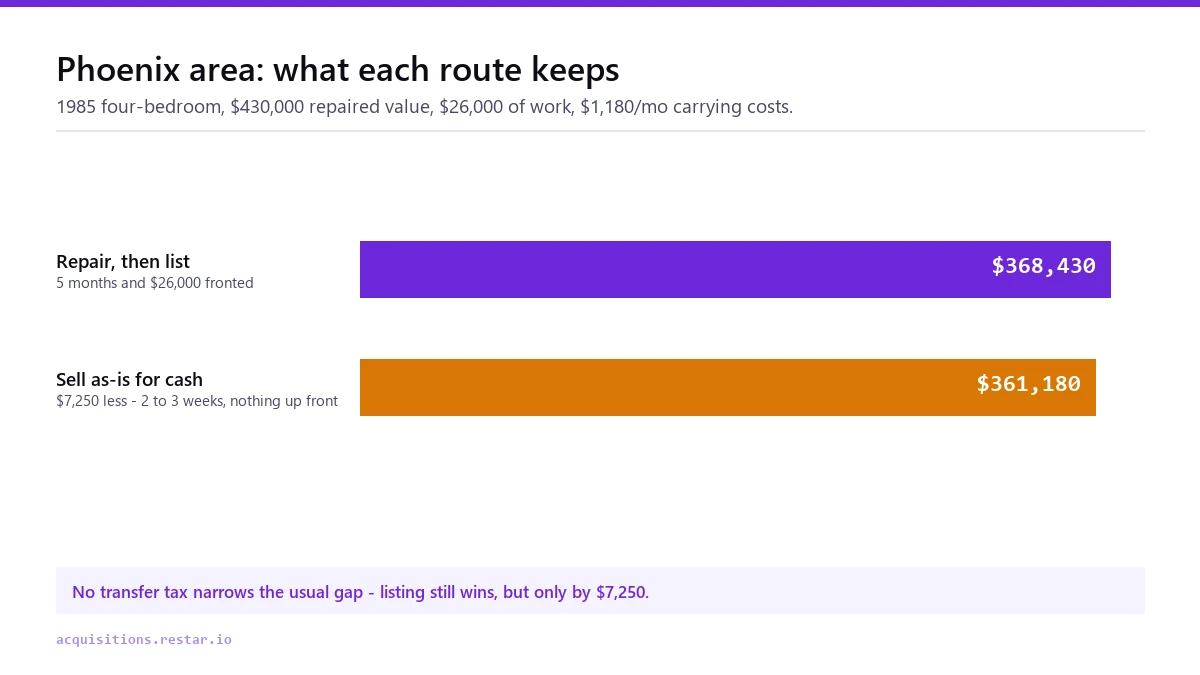
Take a 1985 four-bedroom in the Phoenix suburbs, worth $430,000 repaired, needing about $26,000 of work — a dated kitchen, one failing HVAC unit and a roof with a few years left rather than none. Holding runs roughly $1,180 a month: tax, insurance, utilities and a bit of upkeep on an empty house.
Line
Repair, then list
Sell as-is for cash
Sale price
$430,000
$362,000
Repairs
−$26,000
$0
Agent commission (5%)
−$21,500
$0
Seller closing costs (title, escrow, no transfer tax)
−$3,870
$0 — we cover standard closing costs
Buyer concessions (1%)
−$4,300
$0
Holding while it happens
−$5,900 (5 months)
−$820 (3 weeks)
You keep
$368,430
$361,180
Phoenix area: what each route keepsRestar Acquisitions · worked example from this page
A worked illustration on one hypothetical property. Not a quote, not a prediction about your house, and not a fixed formula we apply.
Listing wins here by $7,250 — a real but modest gap, mostly because Arizona's absence of a transfer tax and its comparatively low closing costs shrink the retail side's usual disadvantage. That gap widens fast if the repairs run over budget, if the house sits longer than five months, or if a trustee's sale date is already on the calendar and speed stops being optional. It narrows or reverses if you can do the work yourself, wait out a slower market, or are not the one paying the holding costs. Where none of those pressures apply, list it.
Selling a house in Arizona without a repair budget or a spare five months is exactly the situation a cash sale is built for — and it is worth saying plainly that this worked example is the case for listing, not against selling to us. We would rather point you to the $7,250 than pretend it isn't there.
Common questions
Is there a right of redemption after a foreclosure sale in Arizona?
No. Under A.R.S. 33-811, a trustee's deed conveys the property to the winning bidder at auction without right of redemption. Once the trustee's sale happens, there is no statutory window afterwards to get the house back by paying the debt, unlike states such as Alabama that allow redemption for months after the sale. Everything has to happen before the sale date, not after.
Can a lender come after me for the difference if my Arizona house sells for less than I owe?
Usually not, if the loan was used to buy the house and the property is 2.5 acres or less with a single one-family or two-family dwelling. A.R.S. 33-729 bars a deficiency judgment in that situation. It generally does not cover a cash-out refinance or home equity loan, and mortgages from 2015 onward lose the protection if the home was never actually completed or occupied. Confirm which category your loan falls into with an Arizona attorney.
Does Arizona require a seller disclosure form?
Arizona is not a caveat-emptor state; courts have long required sellers to disclose known material facts that significantly affect a property's value and that a buyer could not reasonably discover. In practice this runs through the Seller's Property Disclosure Statement built into the standard Arizona REALTORS purchase contract rather than through a separate state statute. Houses built before 1978 also require the federal lead-based paint disclosure.
What transfer taxes does Arizona charge when you sell a house?
None. Arizona's constitution bars any new tax, fee or stamp on conveying real property, so there is no state real estate transfer tax at all. You do file an Affidavit of Legal Value with the county recorder under A.R.S. 11-1133, but that is a disclosure filing with a small flat fee, not a tax on the sale.
Are rental properties taxed higher than owner-occupied homes in Arizona?
Not at the assessment level. Owner-occupied primary residences (Class 3) and residential rentals or non-primary homes (Class 4) are both currently assessed at 10% of Limited Property Value under Arizona law, so the classification itself does not penalize a rental the way it does in some other states. Local millage rates still vary by jurisdiction.
Why don't I get my money the same day I close in Arizona?
Arizona closes through escrow and title companies operating under the state's good-funds law, A.R.S. 6-843, which prohibits disbursing funds that have not actually been received. Many Arizona closings record documents first and disburse afterwards, commonly one to two business days later, rather than paying out the same afternoon as signing.
Send us the address and we will put a written, no-obligation figure in front of you within 24 hours, with the comparable sales behind it.
On the worked example below, repairing and listing keeps $7,250 more than a cash sale. If you have the time, the cash to front the work and nothing forcing your hand, that is the right route and we will tell you so. Where a trustee's sale date is already set, redemption is not coming afterwards the way it does in some states — the date on the notice is the actual deadline. Send us the property here.
Every offer on this site is underwritten by a person, not a form. If the
numbers do not work for you, say so and I will tell you what would.
Also from Restar
Want the data behind all of this?
Restar Acquisitions is the acquisitions arm of Restar — a housing-market analytics
platform tracking 180+ metrics across every U.S. market, with composite scores and 12-month
price forecasts. The numbers on this page come from the same work.