Selling a house in an age-restricted community is not legally restricted by buyer age — a 2024 appellate ruling confirmed age rules can govern who occupies a home, not who owns it. What can get complicated is an heir under 55 who inherits the house: the community's occupancy covenant still applies the moment anyone moves in.

Step 1 of 5
Tell us about the HOA and whether anyone's planning to move in. We'll give you a straight answer, including when listing normally nets more than a fast cash sale.
You’ll talk to Trevor McAmis, Owner & Acquisitions Lead
(313) 710-6129
Takes about two minutes. Or call (313) 710-6129 — we answer.
Educational only. This explains how these situations generally work. It is not legal, tax or financial advice, and the rules differ by state — talk to an attorney or CPA about your own situation before you act on any of it.
Selling a house in an age-restricted community means selling a property covered by the Housing for Older Persons Act of 1995 (HOPA), which exempts qualifying communities from the Fair Housing Act's protection against discrimination based on familial status — normally a community cannot refuse to sell or rent to a family with children. The exemption is codified at 42 U.S.C. §3607(b)(2)(C). (42 U.S.C. §3607)
To keep that exemption, a community has to clear three bars, set out in the implementing regulations at 24 CFR Part 100, Subpart E:
Acceptable proof of age under 24 CFR §100.307 includes a driver's license, birth certificate, passport, or a signed affidavit from an adult household member. The 80% occupancy threshold set by the Housing for Older Persons Act of 1995 is a federal floor, not a ceiling — plenty of communities' own governing documents require 100% age-qualifying occupancy, stricter than what federal law demands.
Florida — one of the states Restar buys in — writes the identical exemption into its own Fair Housing Act at Fla. Stat. §760.29(4), including a good-faith defense for anyone who reasonably relied on the exemption. (Fla. Stat. §760.29)
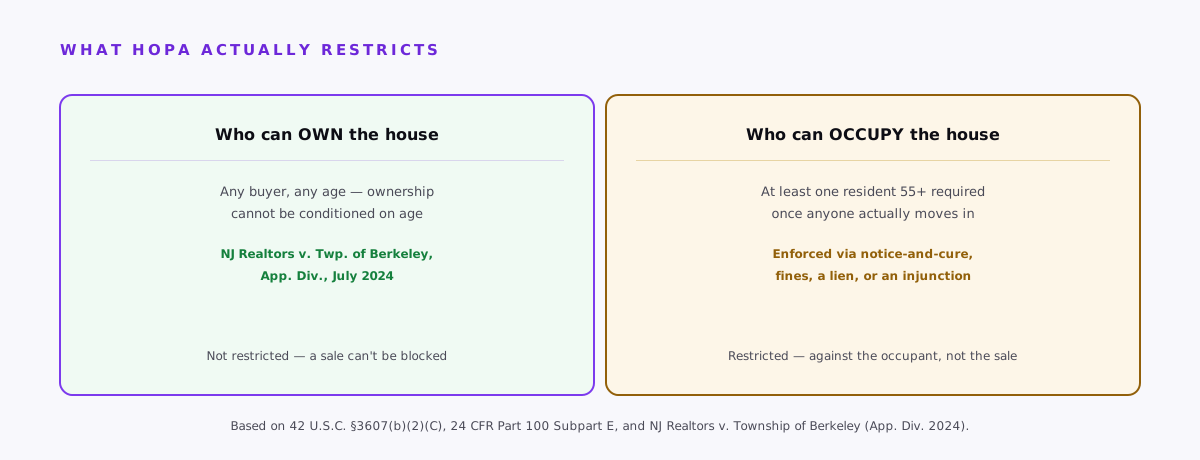
HOPA lets a community restrict who lives there. It does not let a community restrict who owns the title. A New Jersey appellate court made this explicit in July 2024, striking down a municipal ordinance that tried to condition home ownership itself, not just occupancy, on buyer age — the court held that HOPA authorizes age-restricted occupancy, not age-restricted ownership.
That's why nobody — not the HOA, not a title company, not a lender — can refuse to close your sale because the buyer is 40. What the HOA can do is enforce its occupancy covenant against whoever actually lives in the house once someone moves in. If an investor buys the house and rents it to a family with young children and no 55+ occupant, that's a covenant violation the HOA can pursue through its normal enforcement remedies — a notice-and-cure period, fines, a lien, or an injunction — against the occupant, not by unwinding the sale.
The scenario that actually generates disputes is an heir who inherits a house in a 55+ community and either moves in or leaves it occupied informally. There is no federal "heir's exception" written into HOPA — whatever flexibility exists is whatever the individual community's own governing documents happen to provide, which is exactly why these end up contested rather than resolved by a clear rule.
A currently unresolved case out of Jacksonville, Florida illustrates it directly. Bethany Michel, 28, inherited her father's home in the Arbor Mill community after he died in 2023. In July 2026 the HOA sued to remove her, citing the requirement that at least one resident of each occupied home be 55 or older, and its board approved a $155,000 special assessment — roughly $1,000 per household — to fund the litigation. Her attorney argues the community is nowhere near its 80% threshold regardless, and that Arbor Mill's own governing documents contain a hardship exception the HOA isn't invoking. The case was still pending at last report. (News4JAX, July 15, 2026)
The other direction of risk — a community that restricts families without having actually earned the exemption — is just as real. The Department of Justice settled a case against a Santa Rosa, California HOA and the city in 2012 after finding neither had done the required biennial age verification, despite believing in good faith that the community qualified. The HOA and city each paid a $5,000 civil penalty, and the HOA paid $44,000 in damages. The lesson cuts both ways: an HOA's sincere belief that it's "55+" doesn't matter if the paperwork isn't current, and an heir's sincere belief that an exception should apply doesn't matter unless the governing documents actually say so.
This is educational information, not legal advice. Whether a hardship or heir exception applies in your specific community depends entirely on that community's own governing documents — a real estate attorney who has read your HOA's CC&Rs can tell you what you're actually working with.
Nothing about HOPA itself slows down a cash closing — the statute governs occupancy, not transactions. Where paperwork can add time: Florida requires an HOA estoppel certificate before closing, confirming dues, assessments, and any board-approval requirements, and that certificate has a 30-day effective period if delivered personally or electronically, 35 days if sent by regular mail. (Fla. Stat. §720.30851) If an HOA is mid-litigation over an occupancy dispute — like the special assessment in the Arbor Mill case — that assessment becomes a payoff item at closing the same way any other HOA lien would.
Disclosure requirements for age-restricted status vary by state and generally aren't a dedicated checkbox. North Carolina's own disclosure statute, G.S. §47E-4, lists six required disclosure categories — water/sewer, structural, mechanical, wood-destroying organisms, zoning/covenants, and environmental hazards — and age-restricted community status isn't one of them. (N.C.G.S. §47E-4) That doesn't mean the HOA's own restrictions disappear — a buyer still inherits the community's covenants on title — it just means most states don't require you to flag "this is 55+" as its own disclosure line item the way they would, say, a known roof leak.
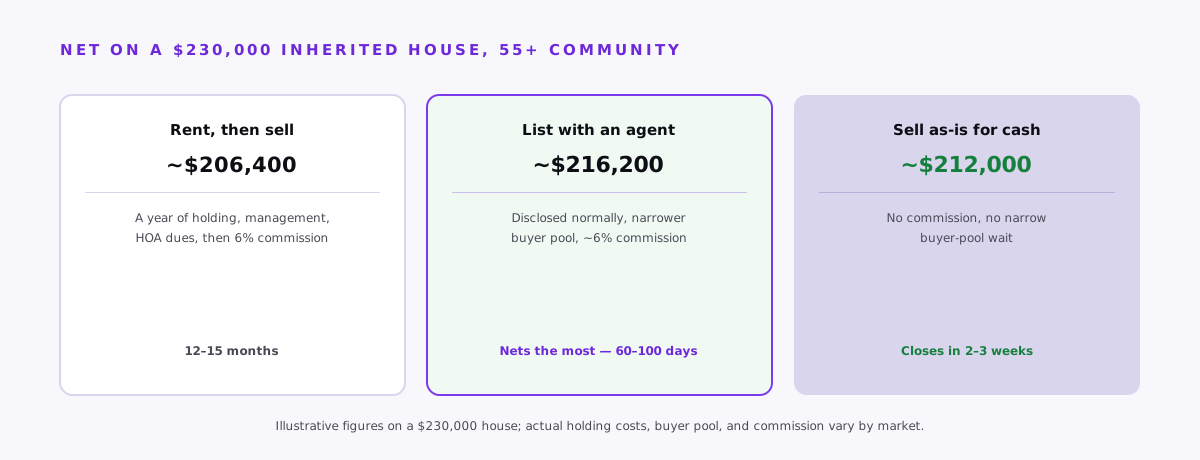
Worked on a $230,000 house in a Florida 55+ community, inherited by a 32-year-old heir who does not plan to live there:
| Route | Gross price | Holding/resolution cost | Commission | Net to seller | Timeline |
|---|---|---|---|---|---|
| Rent to a 55+ qualifying tenant for a year, then sell | $230,000 | ~$9,800 (insurance, HOA dues, taxes, ~8% property management, one year) | ~6% (−$13,800) | ~$206,400 | 12-15 months: finding a qualifying tenant, a year of holding, then listing |
| List with an agent, disclosed normally, marketed to buyers who'll install a qualifying occupant | $230,000 | $0 | ~6% (−$13,800) | ~$216,200 | 60-100 days: a narrower buyer pool than a non-restricted listing, but no structural delay |
| Sell as-is to a cash buyer now | $212,000 | $0 | $0 | ~$212,000 | 2-3 weeks |
Listing normally nets the most here, because nothing about HOPA actually blocks a sale — the narrower buyer pool (someone who will occupy or rent to a 55+ resident) slows a sale down somewhat but doesn't require you to spend money fixing anything. Holding the house for a year to rent it out first rarely pencils out once property management and a full year of carrying costs are counted. A cash sale makes sense specifically when the heir can't carry a vacant house's HOA dues and insurance for 60-100 days, is already in a dispute with the HOA over occupancy, or simply doesn't want to manage a listing process for a house 1,000 miles away.
Nothing about HOPA blocks a sale to a buyer of any age — if you can wait out a narrower buyer pool, listing normally usually nets more. We'd tell you that directly.
Where a cash sale earns its place is when you can't carry HOA dues and insurance on a vacant house, or you're already in a dispute with the HOA over occupancy. Send the address and we'll send a written offer within 24 hours. No cost, no obligation.
All guides · Selling an inherited house · Selling a house held in a trust · Cash offer vs listing net proceeds
Step 1 of 5
No obligation, no fees, no repairs. We respond the same day.
You’ll talk to Trevor McAmis, Owner & Acquisitions Lead
(313) 710-6129
Takes about two minutes. Or call (313) 710-6129 — we answer.