A mechanic's lien sitting on your title is one problem. A mechanic's lien foreclosure lawsuit is a different, bigger one: the contractor didn't just record a claim, they filed suit asking a court to order your house sold to pay it. This guide covers what happens once that suit is filed, the deadline that forced it, and the real choices you have now.

Step 1 of 5
Send the address and what's been filed. We'll tell you what we'd pay, and whether fighting it out nets you more.
You’ll talk to Trevor McAmis, Owner & Acquisitions Lead
(313) 710-6129
Takes about two minutes. Your address is never shared.
Educational only. This explains how these situations generally work. It is not legal, tax or financial advice, and the rules differ by state. Talk to an attorney or CPA about your own situation before you act on any of it.
A mechanic's lien foreclosure lawsuit means a contractor has sued to force a court-ordered sale of your house over an unpaid bill. A lis pendens gets recorded, you generally have 20 to 30 days to answer, and the case ends in a settlement, a payoff, a bond that frees the title, or a judgment ordering a sale.
This is educational information, not legal advice. Court procedure, deadlines and sale rules differ by state and by the specific facts of your case. Talk to a real estate or construction litigation attorney promptly once you've been served.
Three different pages on this site cover three different stages of the same problem, and sellers mix them up constantly.
If a contractor recorded a lien against your house but hasn't sued, you're not here yet. See selling a house with a mechanic's lien for the four ways to clear a recorded lien before it escalates.
If you've been served with any lawsuit and a generic notice of pending litigation shows up on your title, not specifically a construction lien suit, see selling a house with a lis pendens for how that notice behaves and the five ways it comes off.
This page is for the narrower, later stage: the contractor has filed a judicial foreclosure suit over the lien, naming your property and probably you personally, because the lien was about to expire or they simply decided to escalate. That's a lawsuit with a court date, not a bill sitting on a title report.
Every state gives a lien a shelf life. A mechanic's lien isn't permanent once it's recorded, it has to be enforced by an actual lawsuit within a statutory window, or it expires and the contractor is left with an unsecured debt instead of a claim against your house. That's the “use it or lose it” clock, and it's the single biggest reason a contractor who has sat quiet for months suddenly files suit: the deadline is close, and doing nothing means losing the lien entirely.
Once that suit is filed, three things happen that didn't happen when the lien was just recorded.
A lis pendens gets recorded as part of the filing. Filing a lawsuit that affects title to a specific property triggers the same recorded notice our lis pendens guide covers in general. A title company that runs a search now finds active litigation, not just a lien with a number attached, and that is what freezes a financed buyer's closing.
You're served, and a clock starts on your answer. Civil procedure varies by state, but the pattern is consistent: Texas gives a defendant until the Monday following the 20th day after service, and Florida's rule sets the same 20-day window. Most states land somewhere in that 20-to-30-day range. Miss it, and the contractor can ask the court for a default judgment without you ever having argued your side.
The case now has an endpoint: a judgment, and potentially a court-ordered sale. If the suit isn't settled, paid off, or the lien bonded off, it proceeds like a mortgage foreclosure in structure, just triggered by an unpaid contractor instead of a lender. The court enters judgment on the lien, and can order a judicial sale of the property to satisfy it, with any surplus after the lien, costs and other liens returned to you.
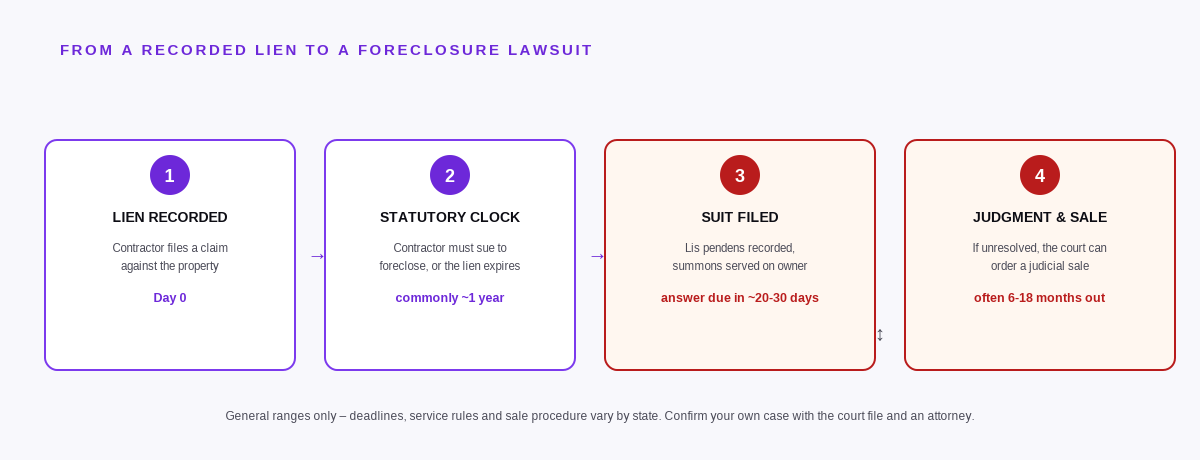
The exact clock differs by state, and it's worth knowing the one that applies to your property, because it tells you how much runway the contractor had and whether they're at the edge of it.
Texas sets the deadline in Property Code Section 53.158. Under the current statute, suit to foreclose the lien must be brought no later than the first anniversary of the last day the claimant could have filed the lien affidavit. That deadline can only be pushed to the second anniversary if, before it expires, the contractor gets the current owner to sign a written extension agreement and records it with the county clerk. There's no owner-side shortcut to force it faster in Texas, the clock just runs, and runs out.
Florida sets its deadline in Florida Statutes Section 713.22. A lien does not continue for longer than one year after the claim of lien was recorded unless an action to enforce it is commenced within that year. The same section lets an owner force the issue sooner: serve the contractor with a Notice of Contest of Lien, and they have only 60 days from service to file suit or the lien is gone for good.
Ohio sets its deadline in Revised Code Section 1311.11. Left alone, a lien stays enforceable for six years after the affidavit is filed, a far longer runway than Texas or Florida. But an owner can serve a notice to commence suit, and once served, the contractor has just 60 days to sue or the lien is void and the property is wholly discharged from it.
The pattern worth remembering: Florida and Ohio both let you, as the owner, force a slow-moving contractor's hand with a notice that starts a 60-day clock. Texas doesn't give you that tool, its one-year deadline runs on its own and can only be extended, not shortened, and only with your agreement. If you're sitting on a recorded lien in limbo and want certainty one way or the other, check whether your state gives you that forcing mechanism before assuming you just have to wait it out.
Sometimes, and this is the detail that makes lenders and title insurers treat mechanic's liens more cautiously than almost any other debt on a house. In many states, a mechanic's lien's priority relates back to when the contractor's work first began, not when the lien was recorded and not when the foreclosure suit was filed. If work started before your mortgage was recorded, or even in some circumstances during a later-stage renovation loan, the lien can in theory prime a mortgage that came after it in time.
This is not a universal rule, and it is not automatic. Relation-back doctrines, notice requirements, and exceptions for existing mortgages vary significantly from state to state, and the outcome in any real case depends on facts like when the contract was signed, when work visibly started, and what notices were sent and when. Don't assume your lender is automatically behind the contractor, and don't assume they're automatically ahead either. This is a priority fight that turns on the actual dates in your file, not something a general guide can resolve for your specific title.
You have four real paths once suit is filed, and they're the same four tools available before a lawsuit, just with less time and higher stakes.
Settle or pay before trial. If the debt is legitimate, or close to it, paying it or negotiating it down and getting a dismissal with a recorded lien release is the fastest way back to a clean title. Contractors facing months of litigation to collect a disputed balance often take less than the full claim rather than pay a lawyer to chase it.
Bond off the lien and keep the underlying fight going. You, through a closing agent or attorney, post a surety bond, commonly for somewhere around one and a half to two times the lien amount, with a licensed surety company. The bond substitutes for the house as the thing the lien attaches to. The property is freed for sale, but the lawsuit itself doesn't go away, it just continues against the bond instead of your title.
Contest the lien as defective or overstated. If the required notice was never sent, a filing deadline was missed, or the amount includes work that was never done, an attorney can move to have the lien discharged or reduced. This takes longer and costs more than settling, and it only works when the lien fails on its facts, not merely because you disagree with the bill.
Pay it off in full. The cleanest and most expensive option when the debt isn't really in dispute. The contractor dismisses the suit, records a release, and the matter ends.
| Path | What happens to the suit | Rough cost | Timeline |
|---|---|---|---|
| Settle or pay before trial | Dismissed, lien release recorded | Negotiated amount + $1,000-$2,500 attorney fee | 4-8 weeks once both sides want it done |
| Bond off, keep fighting | Title freed, claim moves to the bond | Bond premium + roughly $1,200-$2,000 attorney/court cost | 2-4 weeks to clear title; underlying case can run months more |
| Contest it, go to judgment | Resolved only if the challenge succeeds | $8,000-$20,000+ in attorney fees, no guarantee | 6-18 months, longer if appealed |
If you go to judgment and lose, the court can order the house sold at a judicial sale to satisfy the lien, with costs and attorney fees often added to what you owe. That's the real downside of the third path, and it's why most sellers with a real dispute on their hands settle or bond off rather than ride it to a verdict, unless the amount is large enough, or the claim weak enough, to justify the risk.
Example: a $255,000 house with a $140,000 mortgage balance. A contractor has filed suit to foreclose a $12,000 mechanic's lien over a disputed addition, right before Florida's one-year clock ran out.
Route one: sell to a cash buyer now, settle the lien at closing. A cash offer of $204,000, with the lien negotiated down to a $9,000 settlement paid from proceeds and a $900 attorney fee to review the settlement and dismissal at closing. Mortgage payoff of $140,000 comes off the top.
Route two: fight or settle the lawsuit while carrying the house, then list it retail once it's resolved. Carrying costs during the typical six-month timeline to settle or get through a contested motion run $1,163 a month: about $758 in mortgage interest on the $140,000 balance, $140 in homeowners insurance, and $265 in property tax. Add $7,000 in legal fees to defend and negotiate the case, and a $9,500 settlement, slightly higher than route one's quick number since there's no closing pressure pushing the contractor to take less.
| Line | Cash sale now | Fight/settle, then list |
|---|---|---|
| Price | $204,000 | $255,000 |
| Mortgage payoff | −$140,000 | −$140,000 |
| Settlement paid | −$9,000 | −$9,500 |
| Legal fees | −$900 | −$7,000 |
| Holding during the suit (6 mo) | $0 | −$6,978 |
| Commission (5.5%) | $0 | −$14,025 |
| Seller closing costs (1.5%) | $0 | −$3,825 |
| Buyer concession (1%) | $0 | −$2,550 |
| Holding while marketing (3 mo) | $0 | −$3,489 |
| Net to you | $54,100 | $67,633 |
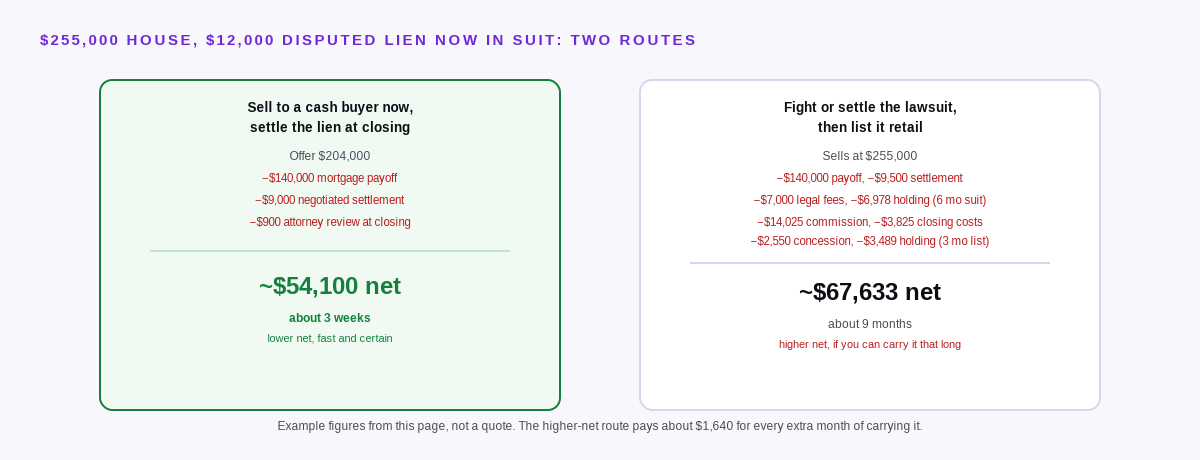
Fighting or settling the suit and listing afterward nets $13,533 more here, for roughly eight and a quarter extra months of carrying a lawsuit. That's about $1,640 for every extra month it takes, which is a real number worth weighing against your own patience and your own cash position, not a universal answer. If you can fund the legal fees and the monthly carrying cost, and the claim is worth defending, route two wins on these numbers. If you can't front $7,000 in legal fees, or six more months of payments on a house tied up in litigation isn't realistic, route one is the one you have.
The number that moves the most in either direction is the settlement amount. A contractor with a weak claim facing a homeowner who can walk away to a cash closing in three weeks often settles for far less than one staring down six months of litigation with nothing forcing their hand.
Send us the address and what's been filed. We'll put a written cash offer in front of you within 24 hours, as-is, no repairs and no commissions. The lien gets settled, bonded, or paid at closing either way, whether you sell to us or list once the lawsuit is behind you.
If you can carry the house through the lawsuit and the numbers say listing afterward nets you more, we'll tell you that, the worked example on this page shows exactly when that's the case. Send us the property here.
All guides · Selling a house with a mechanic's lien · Selling a house with a lis pendens · Cash offer vs listing net proceeds
Step 1 of 5
No obligation, no fees, no repairs. We respond the same day.
You’ll talk to Trevor McAmis, Owner & Acquisitions Lead
(313) 710-6129
Takes about two minutes. Your address is never shared.