Yes, a non-borrowing spouse on a reverse mortgage can, in many cases, stay in the house after the borrowing spouse dies without selling or paying off the loan, through a federal protection called the deferral period. It isn't automatic. You have to notify the loan servicer within 30 days of the borrower's death and meet specific conditions. This guide walks through where that protection for a non-borrowing spouse came from, who qualifies, and what happens if you don't.
Step 1 of 5
A HUD-approved housing counselor can tell you for free. If it turns out you do need to sell later, send us the address and we'll walk through the real numbers with you.
You’ll talk to Trevor McAmis, Owner & Acquisitions Lead
(313) 710-6129
Takes about two minutes. Your address is never shared.
Educational only. This explains how these situations generally work. It is not legal, tax or financial advice, and the rules differ by state. Talk to an attorney or CPA about your own situation before you act on any of it.
A non-borrowing spouse may be able to defer a reverse mortgage's due-and-payable status and continue living in the house after the borrowing spouse dies, without repaying the loan, as long as specific eligibility conditions are met and the servicer is notified within 30 days. This is a real federal protection, not a workaround, but it depends entirely on meeting the conditions below. If you don't qualify, the standard reverse mortgage rules for heirs apply instead.
This is educational information, not legal or financial advice. Reverse mortgage servicing is procedural and the deadlines are real. Talk to a HUD-approved housing counselor or an attorney about your specific situation before you make a decision.
Before 2014, HECM (Home Equity Conversion Mortgage) rules required every spouse to be a co-borrower to keep occupancy rights after the borrower died. A spouse who wasn't a co-borrower, often because they married the borrower after the loan closed or weren't required to sign on under older program rules, could face the loan coming due immediately on their spouse's death, even though they still lived in the house.
That policy was challenged in federal court. In Bennett v. Donovan, the U.S. District Court for the District of Columbia ruled in September 2013 that HUD's regulations conflicted with the actual text of the HECM statute, which requires the loan to stay deferred until the death of both the borrower and the spouse, not just the named borrower (Bennett v. Donovan, 4 F. Supp. 3d 5 (D.D.C. 2013), via CourtListener). HUD has issued a series of policies since then to bring its rules in line with that ruling.
HUD's current policy is Mortgagee Letter 2021-11, which applies to HECM case numbers assigned on or after August 4, 2014 and is codified at 24 CFR § 206.55. It lets an eligible non-borrowing spouse defer the loan's due-and-payable status and remain in the home. (A separate, earlier policy called the Mortgagee Optional Election Assignment covers case numbers assigned before August 4, 2014, and works differently, so if your loan is older, the exact process may not match what's described here. A HUD counselor can tell you which policy applies to your loan.)
To qualify as an eligible non-borrowing spouse under ML 2021-11, you generally need to show that you:
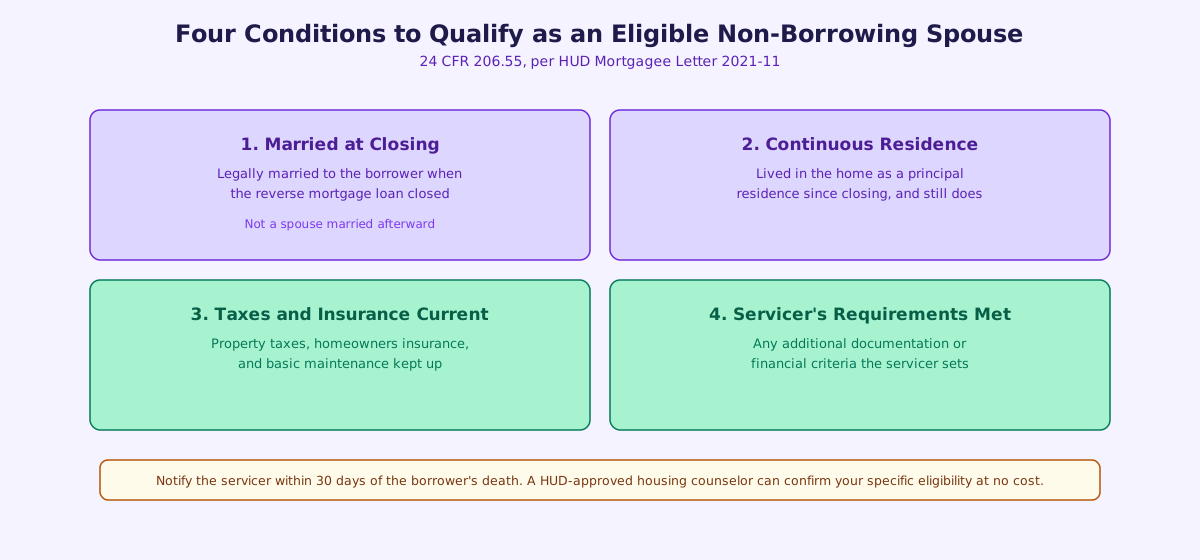
One important point: this protection generally does not extend to a spouse who married the borrower after the loan already closed. If that's your situation, talk to a HUD counselor directly rather than assuming the deferral applies, since the standard heir rules described below are more likely to govern your case.
The clock starts the day the borrowing spouse dies, and 30 days is the deadline to notify the servicer and begin the certification process (HUD Mortgagee Letter 2021-11). In practice:
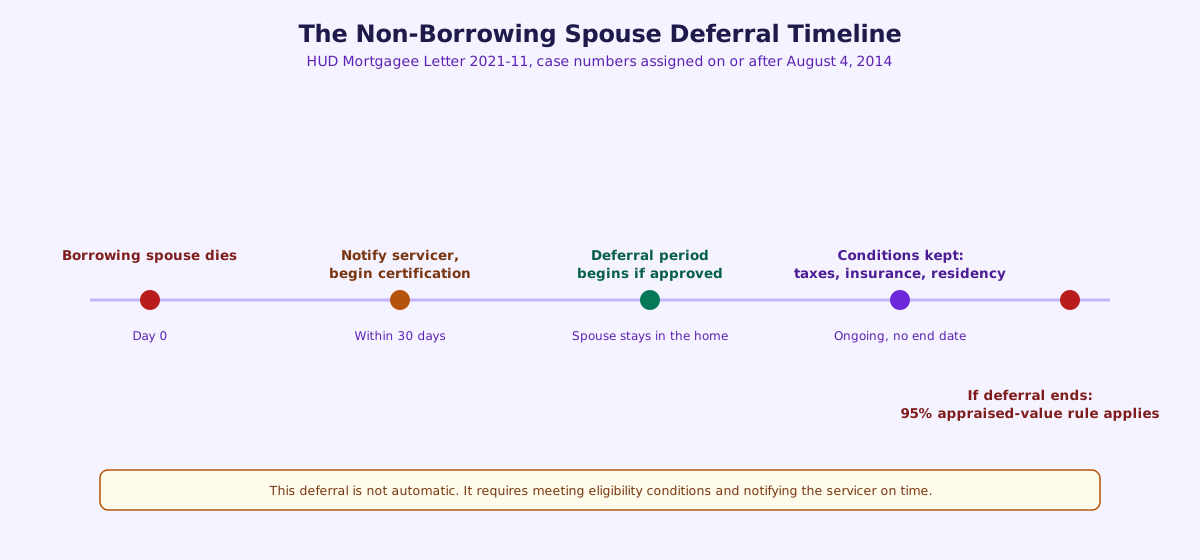
The deferral isn't permanent. It ends if the surviving spouse moves out, dies, or stops meeting the conditions above (for example, falling seriously behind on property taxes). At that point, the loan becomes due and payable, and the standard non-recourse HECM rules take over: the estate or heirs owe the lesser of the loan balance or 95% of the home's current appraised value, with FHA mortgage insurance covering any shortfall beyond that (CFPB: what happens to a reverse mortgage when the borrower dies). Our guide to selling a house with a reverse mortgage walks through that math in detail, including when a cash sale makes sense and when listing nets more.
If you're a surviving spouse who just learned your name wasn't on the loan, the single most valuable thing you can do right now isn't call a cash buyer or a real estate agent. It's call a HUD-approved housing counselor and find out whether you qualify for the deferral. If you do, you may not need to sell anything at all, and no written offer from us or anyone else changes that. We'd rather you know that before you talk to us than find it out after.
If it turns out the deferral doesn't apply to your situation, or it eventually ends, that's when the questions in selling a house with a reverse mortgage and selling an inherited house become relevant, and we're glad to walk through the real numbers with you then.
If the deferral doesn't apply to you, or it ends down the road, we'll give you a written offer within 24 hours, and if listing with an agent would net the estate more, we'll tell you that.
All guides · Selling a house with a reverse mortgage · Selling an inherited house · Inherited property
Step 1 of 5
No obligation, no fees, no repairs. We respond the same day.
You’ll talk to Trevor McAmis, Owner & Acquisitions Lead
(313) 710-6129
Takes about two minutes. Your address is never shared.
