If you are a nonresident alien, foreign corporation, foreign trust, or foreign estate selling a US house, federal law requires the buyer to withhold part of the price at closing and send it to the IRS. The standard rate is 15%, sometimes 10% or 0%, and it is a prepayment against your tax bill, not the final bill.

Step 1 of 5
Tell us about the property. We will give you a written offer within 24 hours and walk through how FIRPTA withholding factors into your numbers before you sign anything.
You’ll talk to Trevor McAmis, Owner & Acquisitions Lead
(313) 710-6129
Takes about two minutes. Your address is never shared.
Educational only. This explains how these situations generally work. It is not legal, tax or financial advice, and the rules differ by state. Talk to an attorney or CPA about your own situation before you act on any of it.
FIRPTA, the Foreign Investment in Real Property Tax Act, lives in 26 U.S.C. section 1445. The IRS defines a foreign person for FIRPTA purposes as "a nonresident alien individual or foreign corporation that has not made an election under section 897(i) of the Internal Revenue Code to be treated as a domestic corporation, foreign partnership, foreign trust, or foreign estate" (IRS, Definitions of Terms and Procedures Unique to FIRPTA). A resident alien is not a foreign person for this purpose. The statute itself defines a foreign person as any person other than a United States person, with narrow exceptions (26 U.S.C. section 1445, via Cornell Legal Information Institute).
The estate and heir situation comes up constantly and it deserves a straight answer. If you are a US citizen or green card holder and you inherited a house from a foreign-national relative, you are generally not subject to FIRPTA yourself when you sell, because you are a US person selling in your own name. FIRPTA withholding applies to the seller's status, not the decedent's. Where this gets complicated is when the estate itself is still the legal seller, when a foreign trust holds title, or when you are selling alongside a co-heir who is still a nonresident alien. In any of those cases, the sale can trigger FIRPTA withholding on the foreign person's share even though your own share is clean. If you are not certain which category your estate or trust falls into, that is a question to resolve with whoever is handling the estate before you sign a contract, not after.
This is the detail that surprises the most sellers: the buyer, called the transferee in the statute, is the one legally required to withhold and remit the money, not you. The IRS states it directly: "In most cases, the buyer (transferee) is the withholding agent" (IRS, FIRPTA Withholding). If the buyer fails to withhold the correct amount, the buyer, not the seller, can be held liable for the tax, penalties, and interest.
This means you need to tell the buyer and the closing or escrow agent that you are a foreign person early, not at the closing table. Most title and escrow companies use a standard FIRPTA affidavit, and if you are foreign, you cannot sign the "I am not a foreign person" version. The closing agent needs time to set up the withholding, the Form 8288 filing, and, if you are pursuing one, a withholding certificate request.
The rate depends on the sale price (the "amount realized") and whether the buyer intends to use the property as a personal residence. Both the IRS FIRPTA Withholding page and 26 U.S.C. section 1445 lay out the same structure.
| Amount Realized | Buyer's Intended Use | Withholding Rate |
|---|---|---|
| $300,000 or less | Buyer or buyer's family has definite plans to live in the property at least 50% of the days it is used, in each of the first two 12-month periods after transfer | 0%, no withholding required |
| $300,001 to $1,000,000 | Same residence-use test, met | 10% |
| Any amount | Buyer will not use the property as a residence | 15% |
| Over $1,000,000 | Regardless of buyer's intended use | 15% |
Sources: IRS, FIRPTA Withholding; 26 U.S.C. section 1445, via Cornell LII.
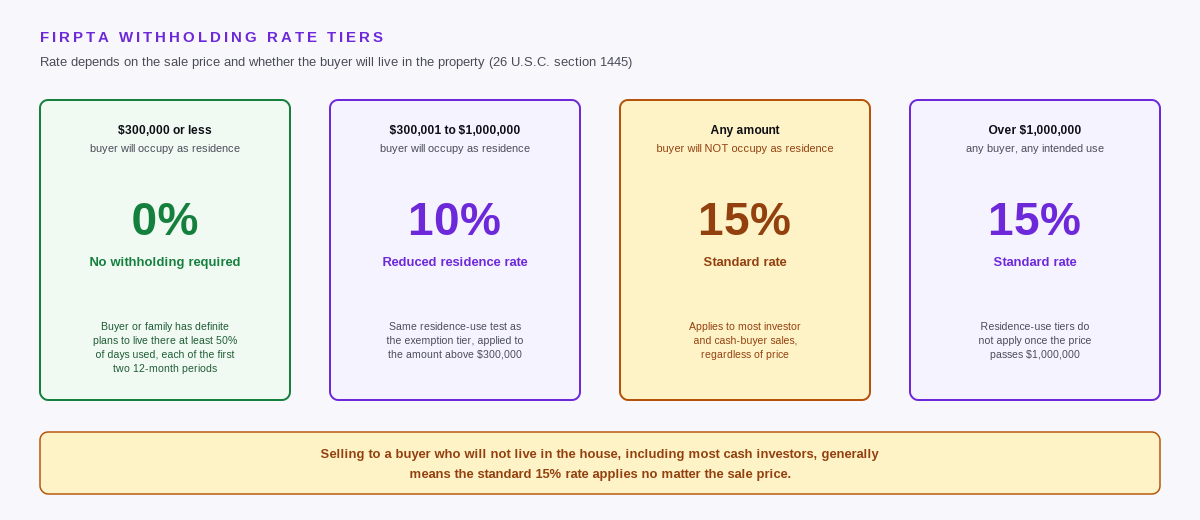
The detail sellers consistently miss is that the lower tiers depend on what the buyer plans to do with the house, not on anything about you. If you are selling to an investor or a cash buyer who will rent, renovate, and resell the property rather than live in it, the residence-use exemption and the 10% tier generally do not apply no matter the price, and standard 15% withholding applies instead. A retail buyer who is going to move in is the only kind of buyer who can unlock the $300,000 exemption or the 10% rate.
If the standard withholding would pull far more cash out of your closing than your actual tax bill will turn out to be, you can apply for a withholding certificate on IRS Form 8288-B, "Application for Withholding Certificate for Dispositions by Foreign Persons of U.S. Real Property Interests" (IRS, About Form 8288-B). The certificate, once approved, authorizes the buyer to withhold based on your actual expected tax liability instead of the full statutory percentage of the sale price.
The timing matters and it is easy to get wrong. Per the IRS instructions for Form 8288, "the IRS will normally act on an application by the 90th day after a complete application is received" (IRS, Instructions for Form 8288). The buyer still must withhold the full statutory amount at the time of transfer even if your application is already pending with the IRS. What changes is that the buyer does not have to send that money to the IRS until the 20th day after the IRS mails a copy of the certificate or a notice of denial. In practice, closing agents commonly hold the withheld funds rather than forwarding them immediately, and once the IRS responds, only the approved amount goes to the IRS while the rest comes back to you, instead of making you wait for next year's tax return to get it back.
If you want the benefit of a lower withholding certificate reflected at or soon after closing, file Form 8288-B as early as you have a signed contract and a real sale price, not after you are already scheduled to close in two weeks. A CPA who has worked FIRPTA dispositions before can prepare the application and estimate your gain so the number the IRS reviews is defensible.
Two more forms carry this through to your tax return. The buyer files Form 8288 to report and remit the withheld amount to the IRS. The buyer also files Form 8288-A for your disposition, and a stamped copy comes back to you as proof of the withholding. You need that stamped Form 8288-A when you file your own US tax return, because it is what lets you claim credit for the amount already withheld against your actual tax liability.
This changes how sellers should think about the number withheld at closing: FIRPTA withholding is an estimate collected up front, not a final tax assessment. Your real liability is whatever capital gain you owe tax on, calculated on your US tax return (Form 1040-NR for an individual, Form 1120-F for a foreign corporation). If your actual gain is small, or if you have losses or deductions that offset it, you can recover most or all of the withheld amount, but only by filing a US tax return and claiming the credit shown on your Form 8288-A. Sellers who assume the withheld amount is simply gone, and never file, leave real money with the IRS permanently.
If the property is in Alabama, there is a second, completely separate withholding to plan for. Alabama Code section 40-18-86 requires the buyer to withhold state tax from a nonresident seller: 3% of the purchase price when the buyer is an individual, 4% when the buyer is a corporation, partnership, or unincorporated association, unless the seller files an Affidavit of Seller's Gain (Form NR-AF2) to have the withholding calculated on the actual gain instead of the full price (see our Alabama seller's guide). That is a state tax rule under Alabama law. FIRPTA is a federal rule under 26 U.S.C. section 1445. They are not the same withholding, they do not offset each other, and a foreign seller closing on an Alabama property can have both the federal FIRPTA percentage and the Alabama state percentage withheld from the same closing at the same time. Budget for both separately when you're estimating your cash at closing.
Here is how the mechanics play out with real numbers. Assume a nonresident alien seller with a $240,000 basis in the property, selling for $320,000 (an $80,000 gain), to a cash buyer who will not occupy the house.
Because the buyer is not going to use the property as a residence, the 10% and 0% tiers do not apply regardless of price, and standard 15% withholding applies: 15% of $320,000 is $48,000 withheld at closing.
| Path | Sale Price | Withholding Rate | Withheld | Commission / Closing Costs | Cash at Closing | Refund After Filing | Eventual Total |
|---|---|---|---|---|---|---|---|
| Cash sale, standard withholding | $320,000 | 15% | $48,000 | $1,800 | $270,200 | ~$36,000 | ~$306,200 |
| Cash sale, withholding certificate obtained before closing | $320,000 | ~Actual tax rate | $12,000 | $1,800 | $306,200 | ~$0 | ~$306,200 |
| Listing with an agent, owner-occupant buyer | $345,000 | 10% | $34,500 | $27,600 | $282,900 | ~$18,750 | ~$301,650 |
Numbers assume a flat 15% estimate of actual federal tax on the gain for illustration of the mechanics only. Your own bracket, basis, and deductions will differ, so run your own figures before relying on this example.
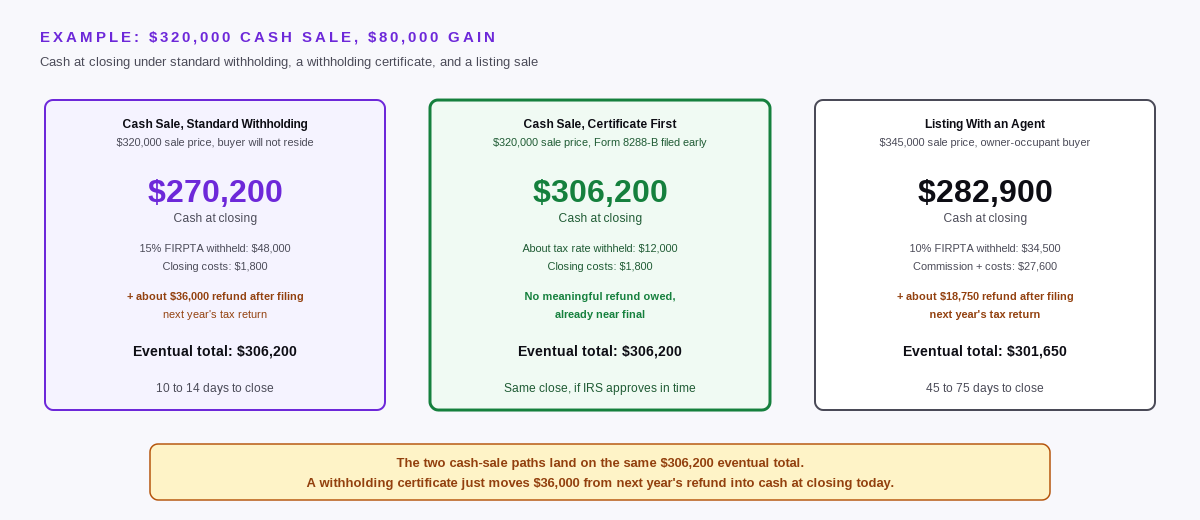
The two cash-sale rows land on the same eventual total, about $306,200, because FIRPTA withholding does not change what you owe. It only changes when you get access to the difference between what was withheld and what you owe. Standard withholding ties up an extra $36,000 until you file a return the following year. A withholding certificate obtained before closing, if the IRS approves it in time, puts that same $36,000 in your hand at closing instead. The listing path lands lower here, about $4,550 less, because the higher sale price does not cover the added commission and closing costs. Your own numbers could come out differently depending on your market, your basis, and what a listing would fetch for your property, which is why comparing cash offer net proceeds against listing net proceeds on your own numbers matters more than any example.
Apply for a withholding certificate before you have a closing date. Starting Form 8288-B as soon as you have a signed contract, rather than after, is the single biggest lever you control over how much cash is tied up at closing.
Use a closing or escrow agent who has handled a FIRPTA disposition before. Not every title company deals with this often. One that has will know how to hold funds correctly, file Form 8288 and 8288-A on time, and avoid penalties for late remittance.
If you list instead of selling for cash, pick an agent who has closed a FIRPTA transaction. The withholding mechanics do not disappear because you listed; the buyer in a listed sale still withholds under the same rules if you are a foreign person, so the agent and the title company both need to know how to handle it.
Get the eventual US tax return handled by someone who works with nonresident sellers. That return is what reconciles the withholding against your real gain and releases any excess back to you.
We buy houses for cash, as-is, with a written offer within 24 hours, no repairs and no commissions, and you pick the closing date. If you are a foreign seller, or an heir coordinating a sale where a co-seller or trust is a foreign person, FIRPTA withholding still applies because it is tied to the seller's status, not to who the buyer is.
Because we buy as an investor rather than someone who will occupy the house, the lower withholding tiers tied to a buyer's residence use typically will not apply to a sale to us, so standard withholding is the number to plan around unless you pursue a withholding certificate first. We will walk through that math with you before you sign anything, and if listing nets you more once commissions and the withholding math are accounted for, we will tell you that directly.
All guides · Capital gains on inherited property · Cash offer vs. listing net proceeds · Selling a house in Alabama
Step 1 of 5
No obligation, no fees, no repairs. We respond the same day.
You’ll talk to Trevor McAmis, Owner & Acquisitions Lead
(313) 710-6129
Takes about two minutes. Your address is never shared.