Buying out a sibling's share of an inherited house usually costs the appraisal, roughly $350 to $600, plus refinance closing costs if you need a new loan to raise the cash, roughly 2% to 6% of the loan amount, on top of paying each sibling their share of the house's value. It's almost always cheaper and faster than a partition lawsuit, and because inherited property gets a stepped-up tax basis, the siblings being bought out usually owe little or no tax on what they receive. This is the buyout math for when everyone basically agrees, one of you wants to keep the house and the others want cash.
Step 1 of 5
Send the address. We will give every sibling a fast, clean number to compare against a buyout.
You’ll talk to Trevor McAmis, Owner & Acquisitions Lead
(313) 710-6129
Takes about two minutes. Your address is never shared.
Educational only. This explains how these situations generally work. It is not legal, tax or financial advice, and the rules differ by state. Talk to an attorney or CPA about your own situation before you act on any of it.
Every other number in this article depends on getting a real, defensible value for the house. Don't skip this step or guess at a number to keep peace between siblings, because an undervalued buyout can create a tax problem down the road that a proper appraisal would have avoided entirely.
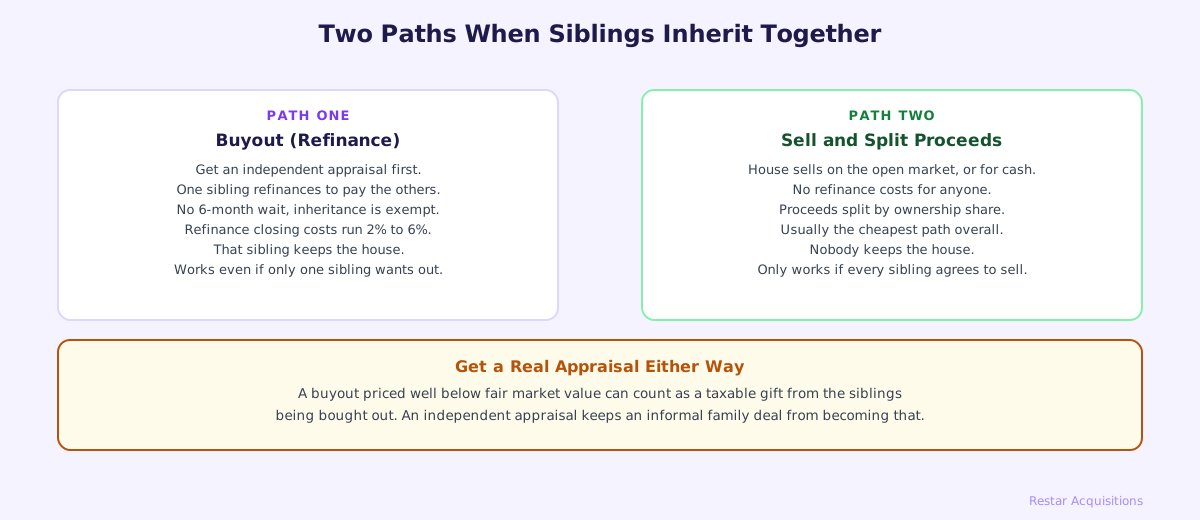
Get an independent licensed appraisal, not a listing agent's opinion of value. A standard residential appraisal typically runs $350 to $600, depending on your market and the loan type involved. If the estate already had the house appraised for probate or estate-tax filing purposes shortly after the death, that same appraisal can often serve as your starting point for the buyout, since it was already done at date-of-death value by a licensed appraiser.
From there, the arithmetic is simple: take the appraised value, subtract any mortgage balance or other liens against the property, and that's the equity being divided. Each heir's buyout share is their percentage of that equity, not their percentage of the sale price before debt.
Sellers understandably want to skip this step and just agree on a number among themselves. The problem is the IRS, not family trust. If you buy out your siblings for materially less than fair market value, the shortfall between what you paid and what the house was really worth counts as a gift from them to you under federal gift tax rules.
The annual gift tax exclusion is $19,000 per recipient for 2026, and gifts to multiple people can each use their own exclusion separately. Amounts above that from any one sibling to you don't necessarily trigger tax owed, but they do trigger a filing requirement on IRS Form 709. A real appraisal is what keeps an informal family deal from accidentally becoming a gift-tax filing nobody expected.
Here's the part that surprises most heirs: when you inherit property, your tax basis isn't what the original owner paid for it decades ago. Under Internal Revenue Code Section 1014, your basis in inherited property is generally its fair market value on the date of death, or on an alternate valuation date up to six months later if the estate specifically elects that option. The IRS describes this directly in Publication 551, Basis of Assets.
This is why a buyout completed reasonably soon after the death, at or near that same date-of-death value, usually produces little or no taxable gain for the siblings being bought out. Their basis stepped up to close to what they're being paid, so there's not much gain left to tax. This is different from selling a house you've owned for thirty years, where the gap between your original purchase price and today's value can be enormous. An inherited house usually doesn't carry that gap, at least not right after the death.
Most people buying out siblings don't have $150,000 in cash sitting around, so they refinance instead. A new mortgage on the house, sized to cover both the buyout and any existing loan balance, is how most of these deals get paid for in practice.
Fannie Mae's Selling Guide, Section B2-1.3-03, specifically waives the standard waiting period that normally applies before a cash-out refinance: there's no waiting period required when the lender documents that the borrower acquired the property through inheritance. That exception exists because lenders normally require you to own a property for six months before pulling cash out of it, a rule written for people flipping houses, not people who just inherited one and need to pay off their siblings quickly.
In practice this means the heir keeping the house takes out a new mortgage sized to cover the existing loan balance (if any) plus enough extra cash to pay each sibling their share, then that cash goes directly to the siblings being bought out. Refinance closing costs on this kind of loan typically run 2% to 6% of the new loan amount, covering the appraisal, title work, lender fees and recording costs, according to both Bankrate and NerdWallet's refinance cost breakdowns. That's a general refinance range, not something specific to inheritance buyouts, but it's the right number to budget against.
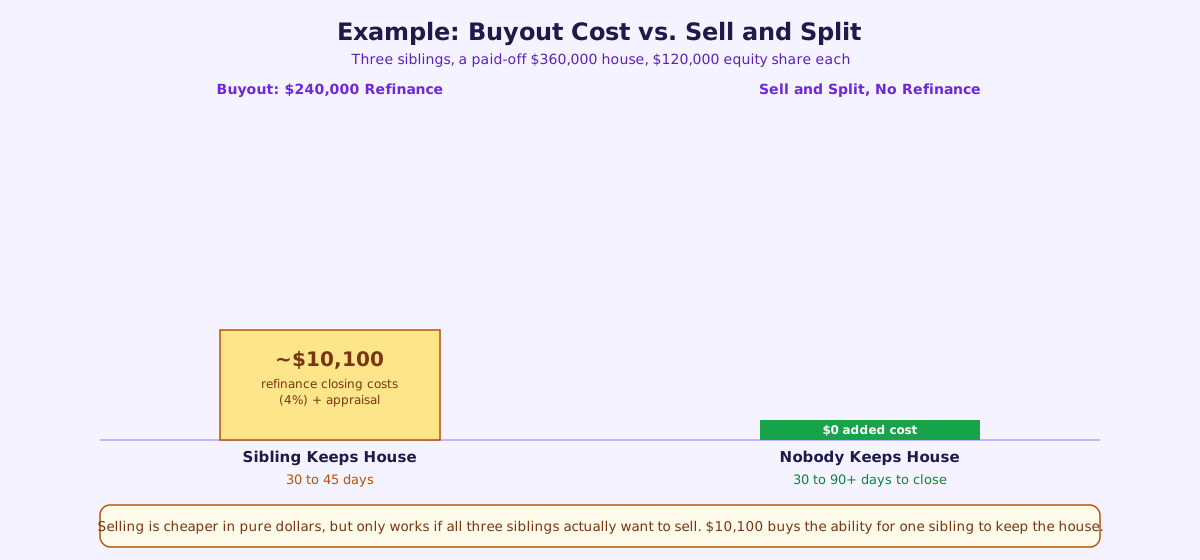
Example: three siblings inherit a paid-off house appraised at $360,000. One sibling wants to keep it; the other two want cash. Equity is the full $360,000 since there's no mortgage, split three ways: each sibling's share is $120,000.
The sibling keeping the house refinances, taking out a new $240,000 mortgage, which covers the $120,000 owed to each of the other two siblings. Refinance closing costs at 4% of the new loan run about $9,600. Add the $500 appraisal (or reuse the estate's existing appraisal if it's recent and done by a licensed appraiser), and the total cost of staying in the house, beyond paying the siblings their actual share, runs roughly $10,100.
| Buyout (refinance) | Sell the house, split proceeds | |
|---|---|---|
| What each sibling nets | $120,000 (equity share) | Roughly $120,000 minus 1/3 of agent commission and closing costs if listed retail |
| Extra cost to the sibling keeping it | ~$10,100 (appraisal + refinance closing costs) | None, house just sells |
| Who keeps the house | The buying sibling | Nobody, it's sold |
| Typical timeline | 30–45 days for a standard refinance | 30–90+ days to find a retail buyer and close |
| Tax exposure if done near date-of-death value | Minimal for the siblings bought out | Minimal for all three if sold soon after death |
Selling outright and splitting the proceeds three ways is usually the cheapest path in pure dollar terms, since nobody pays refinance costs. But it only works if all three siblings want to sell. The moment one wants to keep the house, a buyout is the mechanism that lets that happen without forcing a sale nobody fully wants, and $10,100 is a modest price for that outcome compared to the $10,000 to $30,000-plus a contested partition action can run when siblings can't agree at all.
Sell the house and split the cash three ways. If nobody wants to keep it, this avoids refinance costs entirely and is usually the simplest path.
Use a personal loan or savings instead of a refinance, if the amount owed to siblings is small enough. This skips refinance closing costs but isn't realistic for a full buyout in most cases.
Agree to an installment buyout, where the sibling keeping the house pays the others over time rather than all at once through a refinance. This needs a written agreement and carries real risk if the paying sibling's circumstances change, so put it in writing with a real estate attorney, not a handshake.
Sell to a cash buyer and split proceeds, if nobody wants the house and speed matters more than the last few percent of value, such as when the house needs repairs none of the siblings want to fund, or when siblings live in different states and want to close the whole thing out quickly rather than carry a joint property for months. See our cash offer vs. listing net proceeds guide for that comparison.
Restar Acquisitions buys houses as-is, for cash, in 69 markets across 14 states. If all the siblings agree to sell rather than buy each other out, we'll give a written offer within 24 hours and close on a timeline that works for everyone, with no repairs and no commissions. If a buyout or a retail listing nets more for your situation, we'll say so. For more on the broader inherited-property process, see our guide on selling an inherited house.
This article is for general educational purposes only and is not legal, tax, or financial advice. Basis rules, gift tax thresholds, and lending requirements can change and vary by situation. Talk to a CPA and a real estate attorney before finalizing a buyout.
If every sibling agrees to sell rather than buy each other out, we will give a written offer within 24 hours and close on a timeline that works for everyone. We will also say so if a buyout or a retail listing would net more for your situation.
All guides · Selling an inherited house · When heirs cannot agree to sell · Cash offer vs listing net proceeds
Step 1 of 5
No obligation, no fees, no repairs. We respond the same day.
You’ll talk to Trevor McAmis, Owner & Acquisitions Lead
(313) 710-6129
Takes about two minutes. Your address is never shared.
