Every market page publishes the numbers behind its offer. See the math
Home › Guides › Wholesaler or Cash Buyer? What an Assignment Fee Costs You
Guide
Wholesaler or Cash Buyer? What an Assignment Fee Costs You
Two people knock on the door of a distressed house and both say the same sentence: we buy houses for cash. One of them intends to own it. The other intends to sell your contract to somebody who will, and to be paid a fee for doing so. That fee is an assignment fee, it is entirely legal in most states, and it comes out of the gap between what you agreed to and what the end buyer was willing to pay. This page shows you the arithmetic, the contract language that gives it away, and the five questions that settle it in about ninety seconds.
Takes about two minutes. Or call
(313) 710-6129 — we answer.
Educational only. This explains how these situations generally work. It is not legal, tax or financial advice, and the rules differ by state — talk to an attorney or CPA about your own situation before you act on any of it.
What an assignment fee is: the short answer
An assignment fee is what a wholesaler charges to transfer their purchase contract to the investor who actually closes. It is paid from the spread between your contract price and the end buyer's price, so it comes out of money that could have been negotiated to you.
General information, not legal advice. Whether wholesaling requires a license, and what must be disclosed, varies by state and has been changing. Ask a local real estate attorney or your state's real estate commission about your situation before you sign.
How an assignment actually works
A real estate purchase contract is, among other things, a valuable right: the right to buy a specific property at a specific price. Unless the contract says otherwise, contract rights are generally transferable — the basic legal concept is assignment, and it is ordinary commercial law rather than anything exotic.
The wholesale version runs like this. Someone signs a contract to buy your house for a set price, usually with a long inspection or option period and a small deposit. They do not intend to close it themselves. During that period they market the contract to a list of investors and landlords. One of them agrees to step into the contract, and pays the wholesaler an assignment fee to do it. At closing, the buyer on the settlement statement is that investor. You convey the house once, you receive your contract price, and you are done.
None of this is hidden in a technical sense — the assignment is a document, and in a single closing it usually appears on the settlement statement. But by the time you see it, the price is set. The information arrives after the moment it would have been useful.
Where the assignment fee comes from
This is the part worth understanding properly, because the common explanations are wrong in both directions. It is not theft, and it is not free.
The end buyer has a maximum — the most this property is worth to them given the repairs, their resale or rental plan, and their required margin. Call it their ceiling. The wholesaler's job is to sign you at a price low enough that a workable gap exists between your number and that ceiling. The assignment fee is that gap.
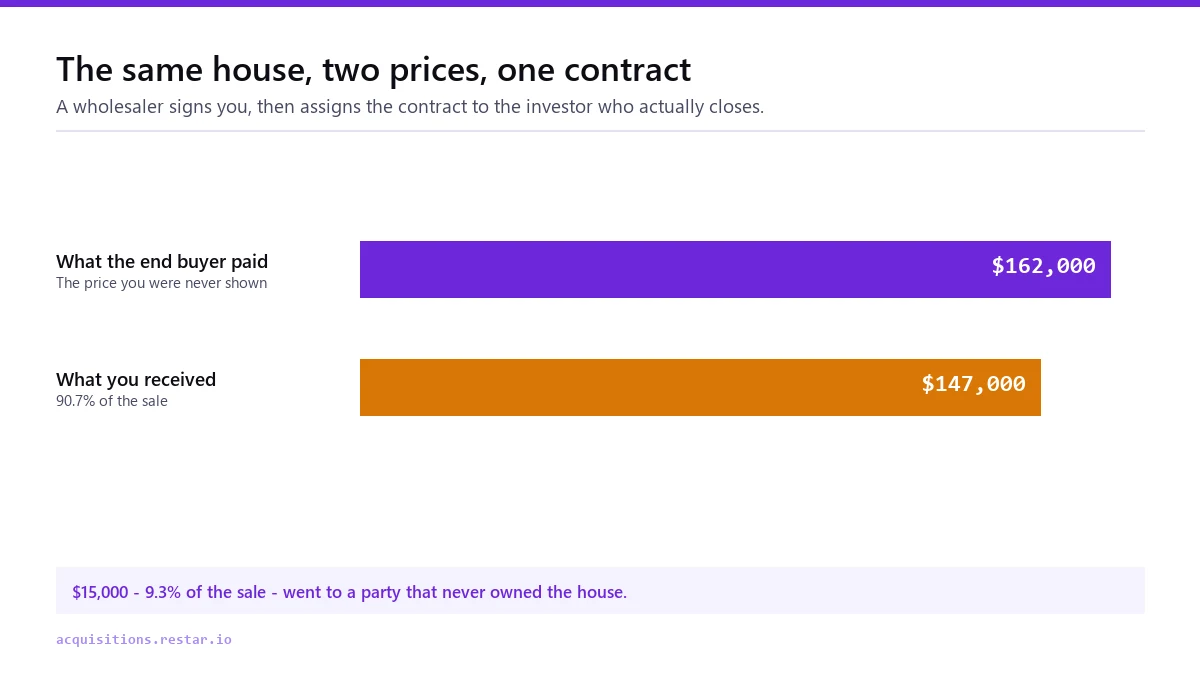
The same house, two prices, one contractRestar Acquisitions · worked example from this page
Work it through. An investor will pay $162,000 for your house. A wholesaler signs you at $147,000 and assigns the contract for $15,000. Every party is satisfied: the investor paid within their ceiling, the wholesaler earned a fee for finding the deal, and you sold the house you needed to sell.
Amount
Share of the sale
What the end buyer paid
$162,000
100%
What you received
$147,000
90.7%
Assignment fee
$15,000
9.3%
An illustration, not a quote and not a claim about any particular company. Fees vary enormously — a few thousand dollars is common, and so is more than this.
Now the honest part, because the obvious conclusion is not quite right. You would not automatically have received $162,000 by dealing with the investor directly. The investor's ceiling is not their opening offer; they would have started lower and negotiated, exactly as the wholesaler did. And if that investor would never have found your house, the wholesaler created the transaction rather than taxing it.
What is true, and what matters, is narrower and firmer: there is a second price in this deal and you cannot see it. You are negotiating against a number that has been hidden from you, and the gap is real money — here, 9.3% of the sale, which is more than most agents charge to run a full marketing campaign. Compare that with our guide to how cash home buyers calculate offers, where the same components are laid out openly.
The five questions that settle it
Ask these directly. A straightforward operator answers all five without hesitating; evasion on any of them is itself the answer.
“Will you be the buyer on the deed, or will you assign this contract?” The whole thing in one sentence. Ask it before price.
“Can you show me proof of funds in the name of the entity signing?” A principal buyer has funds under their own name. A statement in a third party's name, or a “partner’s” letter, tells you who is actually closing.
“How much earnest money, and when does it become non-refundable?” The single most informative question. Someone intending to close puts up meaningful money and lets it go hard reasonably quickly. A $500 deposit refundable for 30 days is an option on your house, not a commitment to buy it.
“How long is the inspection or option period, and what ends it?” A buyer who knows their own repair numbers needs days. A long period is time to find someone else.
“Will you record anything against the property before closing?” Get a no. See below.
Put the answers in writing. If someone says they are the end buyer, a clause naming them as buyer with assignment only on your written consent costs nothing to add — and a genuine principal buyer will not object to it, because it describes what they already intend to do.
The contract language that gives it away
“and/or assigns” after the buyer's name. The classic marker. It is not sinister on its own — investors use entities and sometimes reassign between their own — but it is explicitly reserving the right to hand your contract to someone else.
Nominal earnest money. $10, $100, $500 on a six-figure house. Low deposits mean low cost to walk away. Our guide to earnest money in a cash sale covers what is normal.
A long, freely exercisable inspection or option period. Especially where it can be extended unilaterally.
A memorandum of contract, or any recorded notice. This puts a cloud on your title so the property cannot be sold to anyone else while it stands. If the deal then dies, you may need a release — and sometimes a quiet title action — to clear it. Refuse this. There is no benefit to you in it whatsoever.
No walkthrough. A buyer who never looks at the house is not buying it for themselves.
Assignment or marketing language buried in the body. Read the paragraphs on assignment, marketing rights and access. That is where the intent is written down.
Double closing: when you never see the second number
There is a variant where two closings happen back to back — the wholesaler buys from you, then immediately sells to the end buyer, often funded by the end buyer's money through the title company. Two separate settlement statements, two separate transactions.
From your side it looks like an ordinary sale and you receive your contract price. The difference from a single closing with an assignment is that the wholesaler's profit never appears on your settlement statement. You do not see it, and you have no way to know it existed.
Double closings are legal in most states and are often used for genuine reasons — some lenders and some sellers will not permit assignments at all. But it is worth knowing the mechanism exists, because it is the reason “there was no assignment fee on my closing statement” is not proof that nobody made a spread on your house.
Is wholesaling legal?
In most states, assigning a purchase contract you legitimately hold is legal. The regulatory picture has been tightening, though, and it now varies enough that a general answer is not much use.
Several states have moved to require a real estate license for people who wholesale repeatedly, or to require the wholesaler to disclose in writing that they hold an equitable interest and intend to assign rather than to purchase. Others treat marketing a property you do not own as unlicensed brokerage. Some cities have their own ordinances on top. The rules have changed more than once in recent years, and they differ between neighboring states.
So check rather than assume. Your state real estate commission — the Texas Real Estate Commission is an example of the kind of body that publishes consumer guidance on this — and your state attorney general are the two places to ask. If someone is operating in breach of your state's rules, both are also where a complaint goes.
A fair word in the other direction: legality is not the same as harm. A licensed agent can serve you badly and an unlicensed wholesaler can treat you decently. The tests that matter to you are whether you were told the truth about who was buying, and whether you had enough information to judge the price.
What this means for your decision
If your house is in saleable condition and you have a few months, none of this is your problem — list it with an agent. An agent markets to the whole buyer pool, including the investors a wholesaler would have approached privately, and the retail market pays more than any of them. The commission buys you competition, and competition is what a hidden second price removes.
If a direct sale genuinely fits your situation, then the useful move is not avoiding wholesalers on principle. It is getting more than one offer. A single number cannot be evaluated. Three can. If a wholesaler brings you the strongest one, take it — they will have earned their fee by finding a buyer the others did not.
Where we would tell you to slow down is a deal with tiny earnest money, a long option period, a request to record something against your title, and pressure to sign today. That combination is not a purchase. It is a free option on your house, and it can quietly cost you the weeks in which you had other choices.
Restar Acquisitions buys in its own name. We say that here because it is the specific claim this page is about, and you should hold us to the same five questions as everyone else — in writing, in the contract.
Alternatives to consider
List it with an agent — the highest-net route for any house that can be shown, and the one that creates real competition for it.
Get three direct offers — the cheapest protection available. Ask each one whether they will be on the deed.
Ask for a non-assignment clause — or assignment only with your written consent. A genuine principal buyer will sign it.
Require meaningful, quickly non-refundable earnest money — the fastest way to separate buyers from optioners.
Have an attorney read the contract — a few hundred dollars against a six-figure sale, and in several states an attorney is at the closing anyway.
Sell to the end buyer yourself — local landlords and flippers are findable through public records and local investor groups, if you want to skip the middle.
Accept the assignment — a perfectly reasonable choice when the number is the best you have been offered and you know what it is.
Common questions
What is an assignment fee in real estate?
It is the amount a wholesaler charges to transfer their purchase contract to the investor who actually closes on the property. The wholesaler never owns the house; they sell the right to buy it. The fee is paid from the difference between your contract price and what the end buyer is willing to pay.
Does the assignment fee come out of my money?
It comes out of the gap between your price and the end buyer's price, so it is money that could have been negotiated toward you but was not. That is not the same as saying you would have received all of it by dealing directly, since the end buyer would also have negotiated. The firm point is that a second price exists and you cannot see it.
How do I know if a cash buyer is a wholesaler?
Ask directly whether they will be the buyer on the deed or intend to assign the contract. Then look for the markers: and/or assigns after the buyer's name, nominal earnest money, a long inspection or option period, no walkthrough, and any request to record a memorandum of contract against your property.
Is a typical assignment fee negotiable?
Not by you, usually, because it is agreed between the wholesaler and the end buyer rather than with you. What you can negotiate is your own price, and the contract terms: requiring your written consent to any assignment, larger and quickly non-refundable earnest money, and a shorter option period.
Is wholesaling houses legal?
In most states, assigning a contract you legitimately hold is legal, but the rules have been tightening and now vary considerably. Several states require a license for repeat wholesaling or written disclosure of the intent to assign, and some cities add their own rules. Check with your state real estate commission or attorney general.
What is a memorandum of contract and should I allow one?
It is a document recorded against your property giving public notice that someone holds a contract on it, which prevents you selling to anyone else while it stands. Sellers generally should not agree to one. If the deal dies you may need a release or even a court action to clear your title, and it offers you no benefit at all.
Every question on this page is one you should put to us as well as to anyone else. We buy in our own name, we will say so in the contract, and we will tell you plainly if a deal is one we would not be closing ourselves.
Send us the property here. And get a second offer — a number you cannot compare to anything is not really a number.
Every offer on this site is underwritten by a person, not a form. If the
numbers do not work for you, say so and I will tell you what would.
Also from Restar
Want the data behind all of this?
Restar Acquisitions is the acquisitions arm of Restar — a housing-market analytics
platform tracking 180+ metrics across every U.S. market, with composite scores and 12-month
price forecasts. The numbers on this page come from the same work.