Every market page publishes the numbers behind its offer. See the math
Home › Guides › Selling a House on Military PCS Orders: What SCRA Actually Protects
Guide
Selling a House on Military PCS Orders: What SCRA Actually Protects
Selling a house on military PCS orders means working against a report date you don't control, often from a different duty station entirely. SCRA caps interest on pre-service debt and adds a court-order requirement before certain foreclosures — it does not let you exit a signed sale contract or stop a foreclosure outright.
Get a no-obligation cash offer before your report date
Tell us about the house and your timeline. We'll give you a written offer within 24 hours, and you pick the closing date — including around a PCS report date.
Takes about two minutes. Or call
(313) 710-6129 — we answer.
Educational only. This explains how these situations generally work. It is not legal, tax or financial advice, and the rules differ by state — talk to an attorney or CPA about your own situation before you act on any of it.
Selling a house on military PCS orders: the short answer
Selling a house on military PCS orders means working against a report date you don't control, often from a different duty station entirely. SCRA caps interest on pre-service debt and adds a court-order requirement before certain foreclosures — it does not let you exit a signed sale contract or stop a foreclosure outright.
This is educational information, not legal advice. Talk to your installation's legal assistance office (JAG) or a real estate attorney about your specific situation.
PCS orders don't work like a civilian relocation offer. A civilian can usually ask a new employer for two more weeks, or push a start date if a house sale runs long. A servicemember with orders has a report date set by someone else, and missing it isn't a scheduling inconvenience — it's a military obligation. On top of that fixed date, the person selling the house is frequently not even in town: they've already left for the new post, or they're deployed and running the sale by phone and power of attorney. That combination — a hard deadline plus a distance sale — is the actual shape of the problem, and it's worth being precise about what federal law does and doesn't do about it.
What actually makes a PCS sale different from a civilian relocation
The mechanics of listing a house are the same whether you're PCSing or taking a corporate transfer: price it, list it, show it, negotiate, wait on a buyer's financing, close. What's different is the exposure around the edges. A civilian relocation usually has some flexibility built in — a later start date, a temporary living stipend, or the option to fly back for a closing. A PCS report date typically doesn't bend, and if a servicemember is already at the new duty station, they're relying on someone else — a spouse, a property manager, a real estate agent, or a power of attorney holder — to handle showings and paperwork on a house they can't walk through.
Markets built around large installations add a second layer. Around bases like Fort Hood (now Fort Cavazos) in Killeen, Texas, or Fort Bragg (now Fort Liberty) in Fayetteville, North Carolina, a large share of local housing turnover is driven by PCS cycles rather than the usual mix of job changes, retirements, and life events seen in a typical metro. When a whole cohort gets orders around the same time, local inventory and buyer demand can swing together, which means someone who bought near a local peak can find themselves with less equity than they expected right when orders force a sale. None of that is a legal issue — it's a market timing issue — but it's part of why a PCS sale feels different from an ordinary move, and it's worth understanding before assuming a federal statute will smooth it over. For a broader look at how job-driven moves and relocation sales generally work, see our guide on selling a house for a job relocation.
What SCRA actually protects — the interest rate cap and foreclosure rule
The Servicemembers Civil Relief Act (50 U.S.C. §§ 3901–4043) gives real protections, but they're narrower and more procedural than most people assume. Two provisions matter for someone selling a house.
The 6% interest rate cap (50 U.S.C. § 3937). This caps interest above 6% on debt a servicemember incurred before entering military service, for as long as they're on active duty, and for mortgage debt specifically, for one additional year after service ends. It forgives interest above the cap — it does not touch principal, and it does not apply to debt taken on during service (a mortgage refinanced while already in uniform, for example, isn't covered). It's also not automatic: the servicemember generally has to request it in writing and provide a copy of their orders. Once the house sells and the mortgage is paid off, there's no remaining debt for the cap to apply to — it becomes moot at closing, not a factor in the sale itself.
Foreclosure and sale protection (50 U.S.C. § 3953). For a mortgage that originated before military service, a foreclosure, sale, or seizure for a breach that occurs during service, or within one year after, is invalid unless a court issued the order first. Non-judicial foreclosure without that court order is a criminal offense. A court can also stay the proceeding or adjust the loan terms if it finds that military service materially affected the servicemember's ability to keep up with payments. That's a meaningful protection against being foreclosed on without judicial review — but it's conditional on a court finding, not a blanket suspension of a lender's rights.
The Department of Justice maintains a plain-language overview of servicemembers' financial and housing rights that's worth reading before assuming how any of this applies to a specific loan: justice.gov/servicemembers.
What SCRA does not do — correcting the biggest misconception
The most consequential mistake in this whole area is assuming SCRA gives a servicemember a way to back out of a sale they've already agreed to. It doesn't. SCRA's early-termination right (50 U.S.C. § 3955) is written for rental leases — it lets a servicemember break an apartment or rental housing lease early because of PCS or deployment orders. It has no counterpart for someone who owns a house and has signed a listing agreement or a purchase contract. If a servicemember lists a home, accepts an offer, and signs a purchase agreement, SCRA does not create an exit ramp from that contract. Getting out of a signed real estate contract, if that's ever necessary, runs through the contract's own contingencies and state contract law — not SCRA.
A few other things SCRA does not do, stated plainly: it does not cap all debt at 6% — only pre-service debt, only while a required request is on file, and only for the periods described above. It does not stop foreclosure unconditionally — it requires a prior court order and, for the payment-adjustment relief, a showing that military service materially affected the servicemember's ability to pay. And it does not apply to any debt or obligation taken on after entering service. Treating SCRA as a general shield against selling-related financial pressure will lead to bad assumptions at exactly the moment precision matters most. For the statutory text itself, see 50 U.S.C. § 3937 and 50 U.S.C. § 3953.
VA loan assumption on a PCS sale
If the house carries a VA loan, one option worth understanding is assumption. VA loans are assumable by any creditworthy buyer — the assuming buyer does not have to be a veteran (38 U.S.C. § 3714). The process runs through VA Form 26-6381, "Application for Assumption Approval and/or Release from Personal Liability," and the loan servicer still underwrites the assuming buyer's credit and finances; assumption is not automatic just because the loan type allows it.
Two details matter for the seller specifically: if the assuming buyer isn't a veteran substituting their own entitlement for yours, your VA entitlement stays tied to that loan until it's paid off, which can limit your ability to use a new VA loan on your next home. And sellers should insist on a formal Release of Liability at closing so they're not still on the hook if the assuming buyer later defaults. Details on the form and process are on the VA's site: va.gov/forms/26-6381.
The military capital gains extension
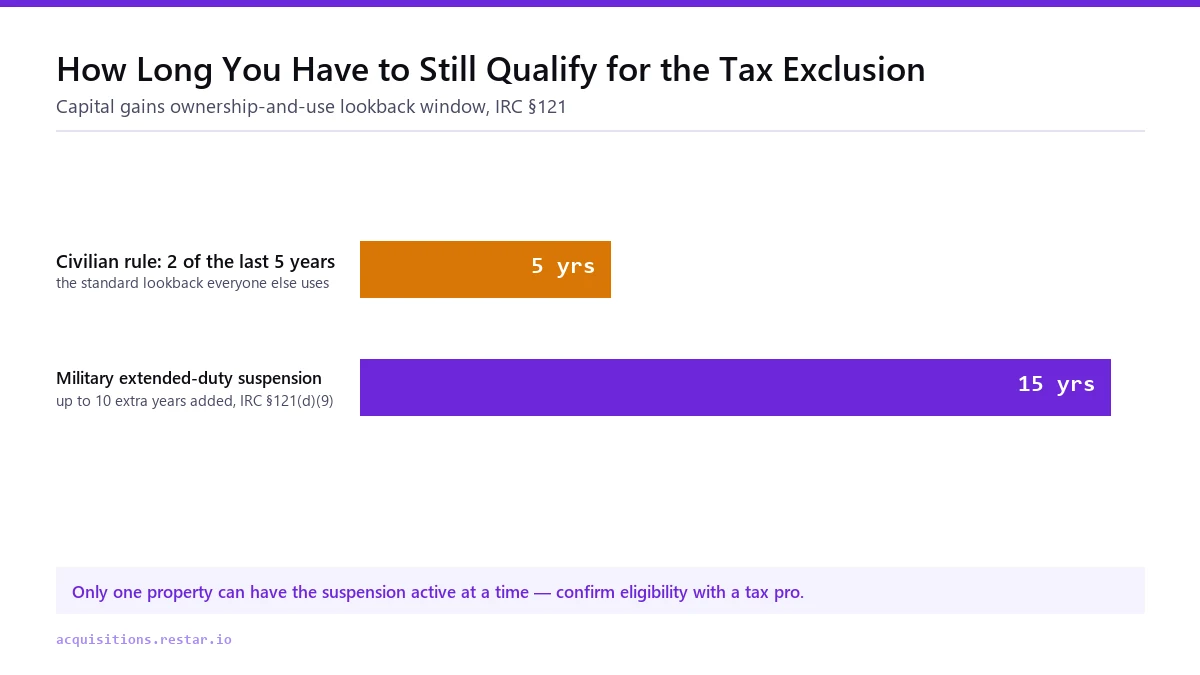
Ordinarily, the capital gains exclusion under IRC § 121 requires that you owned and used the home as your main residence for at least 2 of the 5 years before the sale. Servicemembers get a real, separate mechanic here, not just a variation on the ordinary rule: under IRC § 121(d)(9), a servicemember (or spouse) on "qualified official extended duty" — active duty for more than 90 days or for an indefinite period, serving 50 or more miles from the home or living in government quarters under orders — can elect to suspend that 5-year lookback period for up to 10 years. That stretches the combined test period to as long as 15 years. Only one property can have a suspension in effect at a time, and the election can be revoked.
How long you have to still qualify for the tax exclusionRestar Acquisitions · only one property can have the suspension active at a time — confirm eligibility with a tax professional.
The IRS lays this out in Publication 523, under "Members of the Uniformed Services": irs.gov/publications/p523. This is a question for a tax professional or JAG, since eligibility depends on your specific service history and property. Our general primer on the standard rules is here: capital gains tax when you sell your house.
The honest tradeoff: listing against a report date versus a cash sale
Here's the actual risk a PCS timeline creates, and it's a scheduling risk, not a legal one. A traditional listing's closing date is tied to a buyer's financing, inspection contingencies, and general market conditions — none of which move to match a report date. If the sale doesn't close before you have to report, you can end up carrying a mortgage on the old house and housing costs at the new post simultaneously, and no SCRA provision or PCS entitlement reimburses that overlap. That's the real cost of a listing running long against a fixed date.
A cash sale to a buyer who can close on a date the seller picks removes that specific timeline risk — the closing can be set to land before the report date, with no financing contingency to fall through. But that certainty isn't free: it typically comes at a lower price than a well-marketed listing might bring given enough time on the open market. That's a legitimate trade of price for certainty, not a claim that a cash sale nets more money — it usually doesn't. A servicemember with real runway before their report date, or someone who can manage a listing remotely through a trusted agent or property manager, may well come out ahead listing the conventional way. The right call depends on how much time is actually on the calendar and how much oversight you can put on a listing from a distance — including markets like Killeen, TX and Fayetteville, NC, where PCS-driven turnover is a normal part of the local market. If you want to see what a no-obligation cash offer looks like for comparison against a listing timeline, our overview is here: sell my house fast.
Common questions
Does SCRA let me get out of a home sale I already agreed to?
No. SCRA's early-termination right (50 U.S.C. § 3955) applies to rental leases — it lets a servicemember break an apartment lease on PCS or deployment orders. There's no equivalent provision for a signed home sale contract or listing agreement. If you need to exit a real estate contract, that runs through the contract's own contingencies and your state's contract law, not SCRA. Talk to a real estate attorney or your JAG office before assuming any exit exists.
Does SCRA stop my house from being foreclosed on while I'm PCSing?
Not automatically. For a mortgage that originated before you entered service, SCRA requires a court order before a foreclosure, sale, or seizure for a breach during service (or within one year after) — non-judicial foreclosure without that order is a criminal offense. A court can stay the case or adjust terms if service materially affected your ability to pay, but that's a conditional protection decided by a court, not a blanket ban on foreclosure.
Can I get my mortgage rate capped at 6% under SCRA?
Only under specific conditions. The cap in 50 U.S.C. § 3937 applies to debt you incurred before entering military service, while you're on active duty, and for mortgage debt specifically, for one additional year after service ends. It doesn't apply to debt taken on during service, doesn't reduce principal, and generally requires a written request with a copy of your orders to your lender. It also becomes irrelevant once the loan is paid off at sale.
Can someone who isn't a veteran assume my VA loan?
Yes. VA loans are assumable by any creditworthy buyer, not just veterans, under 38 U.S.C. § 3714, using VA Form 26-6381. The lender still has to approve the assuming buyer's credit. If that buyer isn't a veteran substituting their own entitlement, your VA entitlement stays tied to the loan until it's paid off, and you should get a formal Release of Liability at closing.
Do I get more time before capital gains taxes apply because I'm in the military?
Potentially, yes, and it's a distinct rule, not just an extension of the normal one. Under IRC § 121(d)(9), qualifying service on official extended duty lets you suspend the standard 5-year ownership-and-use lookback for up to 10 years, for a maximum 15-year combined period. Only one property can have this suspension active at a time. Confirm your eligibility with a tax professional, since it depends on your specific duty status and dates — see IRS Publication 523 for the underlying rules.
A PCS report date doesn't move for a home sale, and neither SCRA nor any other federal provision reimburses you for carrying two households if a listing runs long. If you want to compare a fixed, seller-chosen closing date against your listing timeline, we can give you a written cash offer within 24 hours with no repairs and no commissions.
This is general information, not legal or tax advice — for anything specific to your orders, loan, or contract, talk to your installation's legal assistance office or a real estate attorney.
Every offer on this site is underwritten by a person, not a form. If the
numbers do not work for you, say so and I will tell you what would.
Also from Restar
Want the data behind all of this?
Restar Acquisitions is the acquisitions arm of Restar — a housing-market analytics
platform tracking 180+ metrics across every U.S. market, with composite scores and 12-month
price forecasts. The numbers on this page come from the same work.