Every market page publishes the numbers behind its offer. See the math
Home › Guides › Selling a House Facing Eminent Domain or Condemnation
Guide
Selling a House Facing Eminent Domain or Condemnation
Most guides on eminent domain either scare you or oversimplify. The truth sits in between: a government agency almost certainly gets your property if the public-use case is real, but the amount you walk away with is negotiable, and how fast you want that resolved is entirely your call. Here is the process, the money, and the honest tradeoff between fighting for the full number and taking cash now.
Tell us about the property and where the case stands. We'll give you a straight cash number within 24 hours so you have something concrete to weigh against the agency's offer.
Takes about two minutes. Or call
(313) 710-6129 — we answer.
Educational only. This explains how these situations generally work. It is not legal, tax or financial advice, and the rules differ by state — talk to an attorney or CPA about your own situation before you act on any of it.
Selling a House Facing Eminent Domain: The Short Answer
Selling a house facing eminent domain means a government agency has told you it intends to acquire your property for a public project. You're entitled to “just compensation” — generally fair market value — and you can negotiate or contest that amount, but you generally cannot block a taking that serves a valid public purpose.
This is educational information, not legal advice. Eminent domain procedure, deadlines, and homeowner protections are set by each state, and the details below vary considerably from one state to the next. Talk to a condemnation attorney licensed where the property sits before you respond to any notice or offer.
What Eminent Domain Actually Is
The Fifth Amendment lets a government take private property for public use, provided it pays just compensation, and every state constitution carries its own version of the same guarantee. The power is broad — roads, utility corridors, schools, airports, and in some cases redevelopment projects — and courts have historically read “public use” generously. In Kelo v. City of New London (2005), the U.S. Supreme Court upheld a taking for private economic development, holding that a taking rationally connected to a conceivable public purpose satisfies the public-use requirement. See Cornell Legal Information Institute, Wex: Eminent Domain. That decision was controversial enough that many states have since passed statutes narrowing what their own agencies can take for redevelopment, so what counts as a valid public use in your state may be narrower than the federal floor.
The practical result: once an agency shows a legitimate public purpose and follows its statutory process, homeowners can almost never stop the taking itself. Nearly the entire fight — negotiation, hearings, and if it comes to that, trial — is about the size of the check, not whether the government gets the property.
The Process: Notice, Appraisal, Offer, and What Happens If You Don't Agree
The general sequence looks like this, though the specific steps, deadlines, and terminology differ by state:
Notice. The condemning agency — a state DOT, a city, a utility, a school district, a transit authority — notifies you it needs some or all of your property for a specific project.
Appraisal. The agency orders an appraisal to establish fair market value, and on a partial taking, the effect on what's left.
Written offer. The agency presents a formal purchase offer, generally required to be based on that appraisal. Some states build in specific owner protections here — Texas, for example, requires the agency to deliver a Landowner's Bill of Rights describing the right to an independent appraisal and to counsel before a final offer is made.
Negotiation. You can counter, commission your own independent appraisal, and bring in a condemnation attorney — many take these cases on contingency, paid a percentage of whatever they recover above the agency's opening number.
If no agreement: a formal condemnation lawsuit. The agency files a court case. Texas procedure includes recording a Notice of Lis Pendens against the property, putting any future buyer on notice that a case is pending — see TxDOT's Right of Way Eminent Domain Manual.
An initial valuation hearing, in states that use one. Texas routes disputed cases through a panel of three court-appointed special commissioners before a full trial. Other states go straight to a judicial proceeding or use a different administrative step.
Possible “quick-take.” In many, but not all, states, the agency can deposit its estimated compensation with the court and get an order of possession, letting project work begin before final compensation is resolved.
Trial on just compensation, if it isn't settled first. By this stage public use and necessity are essentially conceded in the large majority of cases; the trial is almost always about valuation only.
Because this sequence, its deadlines, and which steps exist at all vary meaningfully by state, treat any specific timeline you're quoted as an estimate for your case, not a universal script.
Just Compensation: What You're Actually Owed
The constitutional standard is fair market value — what a willing buyer would pay a willing seller, neither one under pressure, both reasonably informed about the property. Sentimental value, or what the house means to your family, isn't part of the calculation.
Where the agency is taking only part of a parcel — a strip for a road widening, an easement for a utility line — compensation typically has two components: the value of the piece actually taken, plus severance damages, which compensate for any drop in value to what remains. A taking that removes your driveway apron, part of your front yard, or a buffer of mature trees along a busy new road can measurably reduce what the rest of the property is worth, even though nothing was taken from that remaining part directly. Whether severance damages are available, and how they're calculated, is set by state law, so don't assume a specific formula applies to your case.
Relocation Assistance: the Uniform Relocation Act, and Its Real Limit
If you're displaced by a taking, you may be entitled to relocation assistance under the federal Uniform Relocation Assistance and Real Property Acquisition Policies Act (the URA), codified at 42 U.S.C. § 4601 and following, and implemented through regulations at 49 CFR Part 24. Where it applies, the URA can cover moving expenses and, for homeowner-occupants, a replacement housing payment — generally the difference between what you were paid for your home and the cost of a comparable replacement dwelling, plus certain increased mortgage-interest and closing costs. HUD administers this jointly with the Federal Highway Administration; see HUD's relocation assistance page.
Here is the caveat that matters most: the URA only applies when the acquisition involves federal financial assistance — a federally funded highway project, for example, or a HUD-funded redevelopment. A great many state- and city-funded takings — many ordinary road projects, many utility acquisitions, many school district land purchases — are not required to provide URA relocation benefits at all, unless your state happens to have passed its own comparable law. Many haven't. Before you assume relocation assistance is coming, find out whether the specific project taking your property has federal money behind it.
The Tax Side: Deferring Gain Under Section 1033
Compensation for a taking is generally taxable as a sale, but the tax code gives you a way to defer that gain. Under IRC § 1033, if you reinvest condemnation proceeds into property “similar or related in service or use” within a set replacement period, you don't recognize the gain immediately — it carries over into the basis of the new property instead. See the IRS's own plain-language explainer, Involuntary Conversions: Real Estate Tax Tips. The general replacement period is two years after the close of the tax year in which you realize any part of the gain, but for condemned real property held for productive use in a trade or business or for investment, the period extends to three years. That distinction matters: a taken rental or investment property gets meaningfully more runway to find a replacement than a taken primary residence does, which may also separately qualify for the ordinary home-sale gain exclusion under IRC § 121.
Again, this is general information about how the deferral mechanism works, not tax advice for your situation — talk to a CPA before you decide how to handle the proceeds, since the correct replacement period and what counts as “similar” property depend on facts specific to your case.
What You Can Negotiate, and What You Can't Stop
You can almost always negotiate the amount. Get your own independent appraisal rather than relying solely on the agency's — appraisers routinely reach different conclusions on the same property, especially on severance damages. Many condemnation attorneys work on contingency, taking a percentage only of what they recover above the agency's original offer, which limits your out-of-pocket risk to pursuing a better number.
You generally cannot stop a taking that serves a legitimate public purpose and follows the required process. Challenging whether a project qualifies as a public use is possible in narrow circumstances, but courts apply a highly deferential standard, and most challenges fail. Realistically, plan around negotiating the payout, not preventing the taking.
The Honest Tradeoff: Selling for Cash While Condemnation Is Pending
Once a condemnation case is filed and a lis pendens is recorded, the property carries a cloud on title until the case resolves — a title company won't insure around it cleanly, which limits who will buy it and at what price. Selling to a private buyer is still legally possible, but the buyer takes the property subject to the pending case, effectively stepping into your position for whatever compensation the case eventually yields. That's a real, if unusual, option for someone who wants out now rather than waiting through a year or more of negotiation, but it comes at a price: a buyer who has to absorb that uncertainty and hassle will price it into their offer.
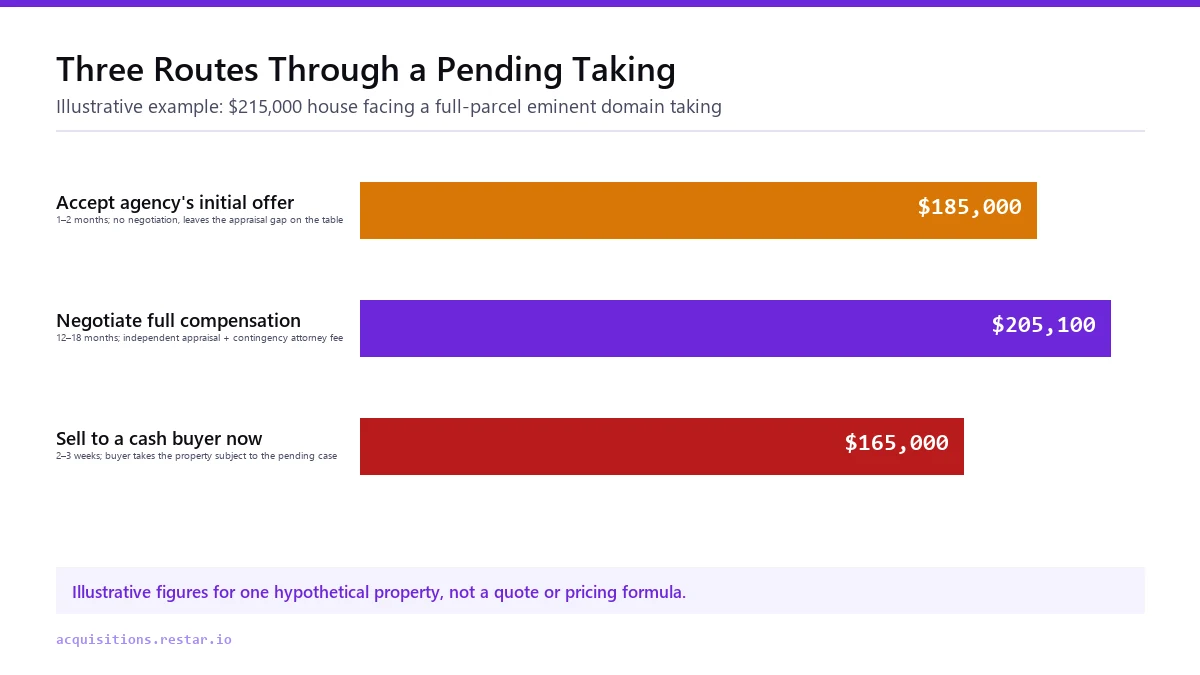
Here's an illustrative example, not a quote, for a $215,000 house facing a full-parcel taking:
Route
What you net
Time
What it requires
Accept the agency's initial offer
$185,000
1–2 months
No negotiation; leaves the appraisal gap on the table
Negotiate for full just compensation (independent appraisal + contingency attorney)
$205,100 (after a 33% contingency fee on the $30,000 increase)
12–18 months
An independent appraisal, a condemnation attorney, and patience through a hearing or trial
Sell your interest to a cash buyer before the case resolves
$165,000 (illustrative)
2–3 weeks
A buyer and title company willing to take on the pending case; you exit immediately and never negotiate with the agency yourself
Three routes through a pending takingRestar Acquisitions · illustrative example, $215,000 house facing a full-parcel taking
In this illustrative example, staying in the fight for a year or more nets roughly $40,000 more than exiting immediately for cash — but it requires an attorney, an independent appraisal, and the ability to wait out a process with a real chance of running past 18 months. Selling now trades that wait, and that uncertainty, for a faster and smaller number. Neither is the “right” answer in the abstract; it depends on how much the wait and the fight are worth to you, and whether you can afford to carry the property and the uncertainty in the meantime.
Your Real Options
Negotiate directly with the agency. Counter the initial offer using your own comparable sales; this costs nothing but time.
Get an independent appraisal. Especially important on a partial taking, where severance damages are the part most often underestimated by the agency's own appraiser.
Hire a condemnation attorney, often on contingency. Worth exploring before you accept an opening offer, particularly on a larger taking.
Wait out the full process for the highest likely number, if you can carry the property and the uncertainty for as long as it takes.
Sell your interest to a cash buyer now, accepting a lower number for speed and certainty, if the wait itself is the bigger problem. See selling a house with a lis pendens for how a title cloud from litigation generally works, and cash offer vs listing net proceeds to run your own numbers.
Sources
Cornell Legal Information Institute, Wex — Eminent Domain
Texas Department of Transportation, Right of Way Eminent Domain Manual — txdot.gov
Yes, if the taking serves a legitimate public use and the agency follows its state's required process. You can negotiate or contest the amount of compensation, but you generally cannot block a valid taking.
What is "just compensation" in eminent domain?
Generally, the fair market value of the property taken — what a willing buyer would pay a willing seller under no pressure. If only part of a parcel is taken, compensation can also include severance damages for the drop in value to what remains.
Do you get relocation assistance if your home is taken by eminent domain?
Only if the specific project has federal funding behind it, which triggers the Uniform Relocation Act's moving-expense and replacement-housing benefits. A purely state- or city-funded taking may not provide comparable assistance unless your state has its own similar law.
Do you pay taxes on eminent domain compensation?
Generally yes, but IRC § 1033 lets you defer the gain if you reinvest the proceeds in similar property within the replacement period — two years generally, three years for condemned business or investment real property. It defers the tax, not eliminates it.
Can you sell your house to someone else while eminent domain is pending?
Yes, but once a case is filed and recorded, a buyer takes the property subject to it, and that uncertainty usually reduces what a buyer will pay. It needs a title company and attorney comfortable handling a property with a pending condemnation case.
A pending taking doesn't have to mean waiting a year for cash
If you can carry the property and the uncertainty, negotiating or litigating for full just compensation is very likely the higher-netting route — and we'd say so before we said anything else. What we can offer is a fast, honest number if the wait itself is the bigger problem: no appraisal contingency, no financing, and a close on your timeline, lis pendens or not.
We buy houses as-is across 30 markets in Alabama, Arizona, Florida, Georgia, Indiana, Maryland, Michigan, New York, North Carolina, Ohio, and Texas. Send us the address and we'll tell you plainly what a pending case does to the number.
Every offer on this site is underwritten by a person, not a form. If the
numbers do not work for you, say so and I will tell you what would.
Also from Restar
Want the data behind all of this?
Restar Acquisitions is the acquisitions arm of Restar — a housing-market analytics
platform tracking 180+ metrics across every U.S. market, with composite scores and 12-month
price forecasts. The numbers on this page come from the same work.