Every market page publishes the numbers behind its offer. See the math
Home › Guides › Seller Concessions vs Price Reduction: Which Actually Nets You More?
Guide
Seller Concessions vs Price Reduction: Which Actually Nets You More?
A buyer asking for $10,000 off the price and a buyer asking for a $10,000 closing-cost credit look like the same request. They aren't. In the seller concessions vs price reduction decision, commission and transfer tax are calculated on the contract price, not on your net proceeds — so a straight price cut almost always leaves you with more money than paying the identical dollar amount as a concession at closing.
Takes about two minutes. Or call
(313) 710-6129 — we answer.
Educational only. This explains how these situations generally work. It is not legal, tax or financial advice, and the rules differ by state — talk to an attorney or CPA about your own situation before you act on any of it.
Seller concessions vs price reduction: the short answer
A $10,000 price reduction and a $10,000 seller concession are not equal: because commission and transfer tax are calculated on the sale price, a straight price cut typically nets a seller a few hundred dollars more than paying the same amount as a closing-cost credit — on a $300,000 sale at 6% commission, the gap is about $650.
This is educational information, not financial or legal advice. Commission rates, transfer tax rates, and loan-program concession limits vary by state, lender, and loan type — confirm the specifics of your deal with your agent and lender.
Why two things that feel identical to a buyer aren't identical to you
To a buyer comparing offers, $10,000 off the price and a $10,000 credit toward their closing costs can look interchangeable — either way, they need $10,000 less cash to get to the closing table. To you as the seller, they aren't interchangeable, because your commission and most transfer taxes are calculated as a percentage of the contract price, not your final net. Lower the price and you lower the base those percentages are calculated on. Keep the price the same and pay a concession instead, and you're paying commission and transfer tax on a higher number, then handing over the concession on top of that.
The math: $10,000 either way, $650 apart
On a $300,000 sale with a 6% commission and a 0.5% combined transfer tax:
Option A: $10,000 price reduction, contract at $290,000
Commission (6% of $290,000)
−$17,400
Transfer tax (0.5% of $290,000)
−$1,450
Net (before other fixed costs)
$271,150
Option B: $10,000 concession, contract stays at $300,000
Commission (6% of $300,000)
−$18,000
Transfer tax (0.5% of $300,000)
−$1,500
Concession paid at closing
−$10,000
Net (before other fixed costs)
$270,500
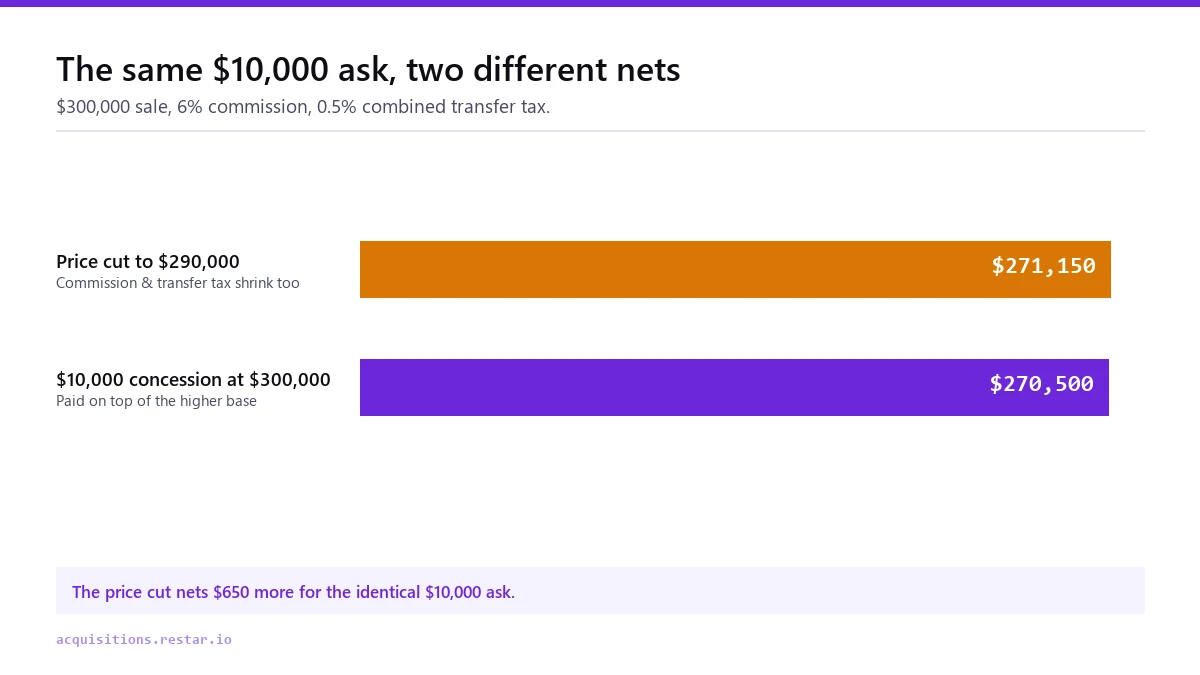
The same $10,000 ask, two different netsRestar Acquisitions · worked example from this page
A worked illustration on one hypothetical property. Not a quote, not a prediction about your house, and not a fixed formula we apply.
The price reduction nets $650 more — $600 of it from the lower commission base, $50 from the lower transfer tax base. It's not a huge number on its own, but it scales: on a $500,000 sale with a $25,000 ask, the same mechanics widen the gap to well over $1,600.
When a concession actually helps more than a price cut
None of this means concessions are always the wrong call. They solve a different problem than a price cut does:
A buyer may be short on cash to close specifically, even though their loan amount and down payment are otherwise fine — a price cut lowers the price, but a concession is what actually hands them cash at the table.
Keeping the contract price higher can help the appraisal and nearby comps, which matters to you if you or a neighbor plan to sell again soon.
A concession funding a rate buydown can make a marginal buyer's monthly payment work when a price cut of the same size wouldn't move their approval at all.
The honest takeaway isn't "never offer concessions" — it's "know that a price cut nets you more for the identical dollar amount, and only choose a concession when it's solving a problem a price cut can't."
The caps you can't negotiate around
Loan programs cap how much of a buyer's closing costs a seller can cover, calculated against the lesser of the sale price or appraised value:
4% of value, for true concessions (VA Lender's Handbook, separate from ordinary closing costs, which have no cap)
Offer more than the applicable cap and the excess simply isn't allowed to count — it doesn't reduce the buyer's cash-to-close at all past that point, which is worth checking before agreeing to a number bigger than the buyer's loan program can actually use. Real estate agent commissions themselves are typically carved out of these caps entirely, as long as they're market-standard and spelled out in the contract, so they don't compete with a buyer's closing-cost credit for the same percentage of room.
How to counter a concession request without just saying no
A flat refusal isn't the only option once you understand why the caps and the math work the way they do. A few practical counters, roughly in order of how often they solve the actual problem:
Offer a smaller concession than asked, sized to just clear the buyer's loan-program cap or their specific cash-to-close shortfall, rather than the round number they opened with.
Convert part of the ask into a price reduction instead, using the math above to show the buyer's agent that a comparable price cut nets you more while still solving the buyer's problem, if their real issue is total cost rather than cash on hand.
Offer to fix or credit for one specific item — a repair identified in inspection, for instance — instead of an open-ended closing-cost credit, which can feel more concrete to a buyer without necessarily costing more.
Ask what the concession is actually funding before countering blind. A concession sized to fund a permanent rate buydown solves a real, ongoing payment problem for the buyer; one sized just to pad their closing reserve is a softer ask you can negotiate down further.
None of this changes the underlying math — a dollar of concession still costs slightly more than a dollar of price cut — but it does mean you're not choosing only between the buyer's opening number and full price with nothing.
The honest tradeoff against a cash sale
A cash sale has no lender in the deal, so there's no commission in most cases, no concession caps to work around, and no appraisal-driven renegotiation. It doesn't automatically beat a clean financed sale on price — a financed buyer paying full price with no concessions and a cooperative appraisal will typically net you more. What a cash sale removes is the negotiation itself: no back-and-forth over who pays what in the seller concessions vs price reduction decision, no loan-program percentage limits, and no risk the concession conversation reopens the price conversation too.
Common questions
Are seller concessions tax deductible?
Concessions generally reduce your amount realized on the sale rather than functioning as a separate deduction, which effectively lowers your taxable gain rather than creating a write-off on its own. Confirm the treatment for your specific sale with a CPA.
Do concessions show up on the appraisal?
Appraisers are generally required to note any seller concessions and can adjust the comparable value accordingly, since a price inflated to cover a concession isn't a clean reflection of market value. This is part of why keeping concessions within normal ranges matters.
Is a rate buydown considered a concession?
Yes — a seller-funded temporary or permanent rate buydown counts toward the same loan-program concession caps as a straightforward closing-cost credit.
Can a seller offer concessions on a cash sale?
There's no lender to set concession caps on an all-cash purchase, so any credit is simply a negotiated term between buyer and seller, not a regulated concession in the mortgage-industry sense.
What happens if I offer more in concessions than my buyer's loan program allows?
The amount above the cap generally isn't usable toward the buyer's closing costs under that loan program, so it doesn't change their cash-to-close beyond the allowed limit. It's worth confirming the buyer's loan type and LTV before agreeing to a specific concession number.
Concessions exist to solve a financed buyer's cash-to-close problem or loan-program limits — neither applies to a cash sale, since there's no lender setting the rules. That doesn't automatically make a cash offer the bigger number; the honest math is below. But if you're tired of the back-and-forth over who pays what, send us the address and we'll show you a real comparison.
Every offer on this site is underwritten by a person, not a form. If the
numbers do not work for you, say so and I will tell you what would.
Also from Restar
Want the data behind all of this?
Restar Acquisitions is the acquisitions arm of Restar — a housing-market analytics
platform tracking 180+ metrics across every U.S. market, with composite scores and 12-month
price forecasts. The numbers on this page come from the same work.