Every market page publishes the numbers behind its offer. See the math
Home › Guides › The FHA 90-Day Flip Rule: What It Costs a Seller
Guide
The FHA 90-Day Flip Rule: What It Costs a Seller
If you resell a house within 90 days of acquiring it, FHA-insured financing isn't available to your buyer at all — no exceptions, no underwriting workaround. Resell between 91 and 180 days at more than double what you paid, and FHA financing is still available, but the lender has to order a second appraisal, paid for by the lender, before the loan can close.
Takes about two minutes. Or call
(313) 710-6129 — we answer.
Educational only. This explains how these situations generally work. It is not legal, tax or financial advice, and the rules differ by state — talk to an attorney or CPA about your own situation before you act on any of it.
The FHA flipping rule: the short answer
FHA's property flipping rule, 24 CFR §203.37a, makes a house ineligible for FHA-insured financing if it's resold 90 days or fewer after the seller's own acquisition date. Resell 91 to 180 days after acquisition at 100% or more above what the seller paid, and FHA financing is still available — but the lender must order a second, independent appraisal, at the lender's expense, to justify the price increase.
This is educational information, not legal or tax advice. If you're reselling a recently acquired property, confirm the current rule and any exemptions with your lender or a real estate attorney — this rule has changed before and can change again.
This isn't a niche rule. It matters to anyone reselling a house fast after inheriting it, buying it at auction, or acquiring it through any transaction where a short hold period followed.
How the rule actually works
The regulation is permanent, currently in force under 24 CFR §203.37a (see eCFR: 24 CFR §203.37a). HUD temporarily waived it from 2010 through the end of 2014 to help absorb post-2008 foreclosure inventory; that waiver expired and was not renewed, so the full rule has applied continuously since January 1, 2015.
0–90 days: the property is categorically ineligible for FHA-insured financing for the next buyer. This is a hard date bar — price doesn't matter, documentation doesn't matter. The clock runs from the seller's own acquisition date (when their deed was recorded) to the date the new sales contract is signed.
91–180 days, resale price under 100% above what the seller paid: FHA financing is available with no extra appraisal requirement.
91–180 days, resale price 100% or more above what the seller paid: FHA financing is available, but the lender must obtain a second, independent appraisal from a different appraiser, paid for by the lender — not the borrower — before the loan can close.
HUD also has narrower, discretionary authority to require extra documentation or a second appraisal outside that 91-180 day window if a resale price exceeds the property's lowest sale price in the prior 12 months by 5% or more — a softer, case-by-case provision, not the headline rule.
The arithmetic: two resales, two very different outcomes
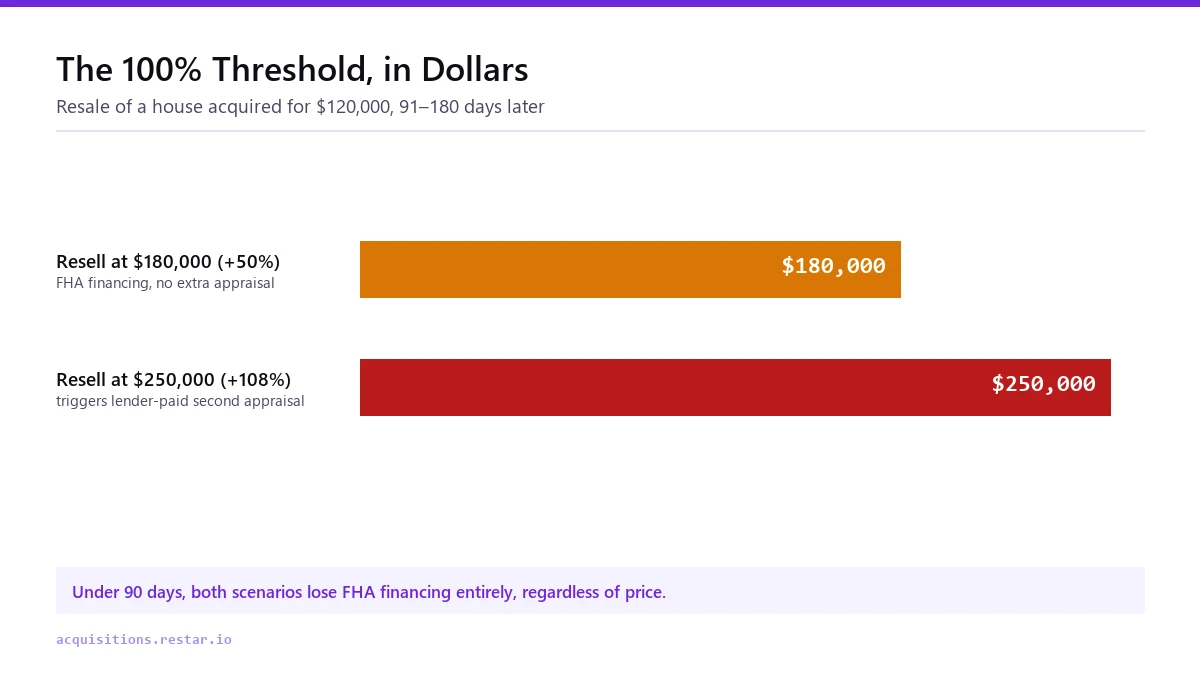
Say you acquired a house for $120,000 — inherited it, bought it at an estate sale, whatever the source — and you're reselling it 120 days later, squarely in the 91-180 day window.
Scenario
Resale price
Increase over your cost
FHA outcome
A
$180,000
50%
FHA financing available, no extra appraisal
B
$250,000
108%
FHA financing available, but lender must order a second appraisal (lender-paid) to justify the price
Scenario A stays under the 100% threshold, so an FHA buyer's loan proceeds through normal underwriting. Scenario B crosses it — the deal can still close with FHA financing, but only after a second appraiser independently reviews the file and the underwriter is satisfied the price increase is justified by documented rehab, market appreciation, or comparable sales. That's real underwriting friction and real time added to a deal that was otherwise ready to close, on top of the appraisal itself introducing a second chance for the number to come in lower than the contract price.
The 100% threshold, in dollarsRestar Acquisitions · 24 CFR §203.37a, 91–180 day resale window
Now move Scenario B ten days earlier — an 80-day resale instead of 120 — and the math above stops mattering entirely: at 90 days or fewer, that $250,000 sale (or a sale at any price) simply cannot use FHA financing at all. The 100% threshold only comes into play once you're past the hard 90-day bar.
Who's exempt — and why this matters if you inherited the house
The rule carves out specific exemptions, and one of them matters directly to a lot of people reading this: properties acquired by the seller through inheritance are exempt from the restriction. Other exemptions include sales by HUD of its own REO inventory, sales by other government agencies, sales by nonprofits approved to buy HUD homes, employer/relocation-agency transfers, sales by financial institutions and GSEs of their own REO, new construction sold by a builder, and properties in a Presidentially Declared Major Disaster Area where HUD has announced a specific exemption (see Federal Register: additional flipping-rule exceptions).
That distinction matters a lot in practice. Someone who inherited a house and is reselling it quickly is very likely covered by the inheritance exemption — meaning the 90-day bar may not apply to their sale at all. Someone who bought a house at auction or an estate sale and is reselling it for a quick profit gets no such exemption; the full 90-day and 91-180-day rules apply to that resale exactly as described above. If you're not certain which category you fall into, ask your title company or a real estate attorney to confirm before you assume either way — it changes who can buy your house. If you're working through the broader mechanics of an inherited sale, see selling an inherited house.
The honest tradeoff: what this actually costs you as a seller
The direct cost isn't a fee you pay — it's buyer-pool exclusion. If you resell within 90 days and you're not covered by an exemption, every buyer in your market who needs FHA financing to qualify simply cannot buy your house, full stop. FHA borrowers skew toward first-time and lower-down-payment buyers — HUD reported that more than 83% of FHA forward-mortgage purchase loans in FY2025 went to first-time homebuyers (see HUD: FY2025 FHA Performance) — which is exactly the segment of buyers a fast resale in that price range is most likely to attract.
In the 91-180 day, 100%-plus window, the cost shows up differently: not exclusion, but delay and appraisal risk. A second, independent appraisal is one more event that can derail an otherwise-agreed sale price if the appraiser doesn't support your number — and that risk sits on top of the normal fall-through risk any financed offer carries. Our guide on cash offer vs financed offer fall-through risk covers that broader risk in more detail.
A cash sale doesn't involve FHA-insured financing at all, so neither restriction applies — not because a cash offer is automatically the better financial outcome, but because it removes financing eligibility as a variable entirely. Whether that tradeoff is worth it depends on your price expectations and your timeline; see how cash home buyers calculate offers for how that number gets built, and weigh it against what a longer marketing period with a larger buyer pool might realistically net you.
Common questions
What is the FHA 90-day flip rule?
It's a HUD regulation, 24 CFR §203.37a, that makes a property ineligible for FHA-insured financing if it's resold 90 days or fewer after the current seller's own acquisition date. The restriction applies regardless of the resale price.
What happens if I resell between 91 and 180 days after I bought the house?
FHA financing is available, but if your resale price is 100% or more above what you paid, the lender must order a second, independent appraisal (paid for by the lender, not the buyer) to justify the price increase before the loan can close.
Does the FHA flipping rule apply if I inherited the house?
No. Properties acquired through inheritance are specifically exempt from the flipping rule's time restrictions. If you inherited the house and are reselling it quickly, the 90-day and 91-180-day rules generally don't apply to your sale — confirm with your title company if you're unsure.
Is the FHA anti-flipping rule still in effect in 2026?
Yes. HUD temporarily waived the rule from 2010 through the end of 2014 to help absorb post-2008 foreclosure inventory. That waiver expired and was not renewed, so the full 90-day and 91-180-day restrictions have applied continuously since January 1, 2015.
Does a cash sale get around the FHA flipping rule?
Yes, in the narrow sense that a cash sale involves no FHA-insured loan, so neither the 90-day bar nor the 91-180-day second-appraisal requirement applies. That's a statement about financing eligibility, not a claim that a cash sale is always the better outcome overall.
Reselling fast? A cash sale isn't affected by FHA's flipping rule
The 90-day and 91-180-day rules only apply to FHA-insured financing. A cash sale involves no FHA loan, so it isn't subject to either restriction — that's a narrow, factual statement about financing eligibility, not a claim that cash always beats a financed offer on price.
We buy houses as-is across 30 markets in Alabama, Arizona, Florida, Georgia, Indiana, Maryland, Michigan, New York, North Carolina, Ohio, and Texas, regardless of when you acquired the property or how long you've owned it.
Every offer on this site is underwritten by a person, not a form. If the
numbers do not work for you, say so and I will tell you what would.
Also from Restar
Want the data behind all of this?
Restar Acquisitions is the acquisitions arm of Restar — a housing-market analytics
platform tracking 180+ metrics across every U.S. market, with composite scores and 12-month
price forecasts. The numbers on this page come from the same work.