Every market page publishes the numbers behind its offer. See the math
Home › Guides › The Cost of an Appraisal Gap: What a Low Appraisal Does to Your Net
Guide
The Cost of an Appraisal Gap: What a Low Appraisal Does to Your Net
A low appraisal doesn't just delay your closing — it forces a choice, and every choice has a different price tag. The cost of an appraisal gap isn't the gap amount itself; because commission and transfer tax are calculated on the sale price, cutting the price to match a low appraisal almost always costs you less than the gap looks like on paper, while losing the buyer and restarting the sale usually costs more than either of you expected.
Takes about two minutes. Or call
(313) 710-6129 — we answer.
Educational only. This explains how these situations generally work. It is not legal, tax or financial advice, and the rules differ by state — talk to an attorney or CPA about your own situation before you act on any of it.
The cost of an appraisal gap: the short answer
On a $310,000 contract with a $14,000 low appraisal, cutting the price to match it costs the seller about $13,090, not the full $14,000, because commission and transfer tax shrink with the price. Splitting the gap instead nets roughly $6,545 more than a full cut, and losing the buyer to re-list typically costs the most of all.
This is educational information, not financial advice. Commission rates, transfer tax rates, and closing costs vary by state, county, and agreement — the figures below use a common 6% commission and 0.5% combined transfer tax for illustration only.
What an appraisal gap is, and why it happens
When a buyer finances a purchase, their lender orders an independent appraisal and generally won't lend more than a percentage of the lower of the contract price or the appraised value. If the appraisal comes in below the price you agreed to, that difference is the appraisal gap, and the buyer's loan amount is capped by the lower number regardless of what the contract says. According to the Consumer Financial Protection Bureau, a low appraisal is often treated as strong evidence the agreed price was above market value, and buyers can use it to renegotiate. A cash sale has no lender in the transaction, so this entire mechanism doesn't apply — there's simply no appraisal requirement to trigger a gap.
Protecting yourself before you sign, not after the appraisal comes back
The cost of an appraisal gap is easiest to manage before it exists. An appraisal gap coverage clause — a buyer's written promise to cover some or all of a shortfall in cash, up to a stated limit — shifts real risk off the seller if it's in the contract from the start. Buyers resist these more in slower markets, but even a partial coverage clause of a few thousand dollars meaningfully changes the math above.
Buyers also have a right to see the appraisal itself: under federal rules, a lender must give a free copy of the appraisal promptly once it's completed, and if it contains factual errors or missing comparable sales, the buyer's lender can request a reconsideration of value. A seller can't initiate that process directly, but knowing it exists is worth mentioning to a buyer before assuming a low number is final. For a closer look at how the numbers compare against a cash buyer's as-is offer, see how those figures get built in the first place.
Option 1: cut the price to match the appraisal
This is the most common fix, and it costs less than the sticker number because commission and transfer tax move with the price:
At full contract, $310,000
Commission (6%)
−$18,600
Transfer tax (0.5%)
−$1,550
Other fixed closing costs
−$3,200
Net if the appraisal had come in fine
$286,650
Cut to appraised value, $296,000
Commission (6%)
−$17,760
Transfer tax (0.5%)
−$1,480
Other fixed closing costs
−$3,200
Net after the cut
$273,560
The $14,000 appraisal gap only actually costs $13,090 at closing, because commission drops by $840 and transfer tax drops by $70 along with the lower price. It's a real loss, just a smaller one than the headline gap suggests.
Option 2: split the gap
A common middle path is negotiating the price down partway while the buyer brings extra cash to cover the rest of their down payment. Splitting a $14,000 gap in half means a new contract price of $303,000:
Commission (6%)
−$18,180
Transfer tax (0.5%)
−$1,515
Other fixed closing costs
−$3,200
Net after a 50/50 split
$280,105
That's $6,545 more than fully matching the appraisal, for exactly the reason above: a higher contract price means a higher commission and transfer tax base, but it's still less total loss to you than the buyer walking away.
Option 3: the buyer walks and you re-list
If neither side moves, the buyer can cancel under a financing or appraisal contingency and get their earnest money back, and you're back on the market. Even a fast 45-day re-listing period costs real money in carrying costs — say $1,350 a month, or about $2,025 for the extra 45 days — and there's a real chance the next buyer's appraisal, done by a different appraiser using largely the same comparable sales, lands in a similar place. Realistically, many sellers end up back near the same $273,560 net after the delay, minus the extra carrying costs: roughly $271,535, the worst outcome of the three financed options and the slowest to arrive at.
The honest comparison: a cash sale removes the risk, not necessarily the loss
A cash sale isn't run through a lender, so there's no appraisal gap to negotiate at all. On the same house, a realistic as-is cash offer closing in 2–3 weeks might land around $270,000, with the buyer covering most closing costs, netting the seller close to $269,500 after minimal seller-side costs.
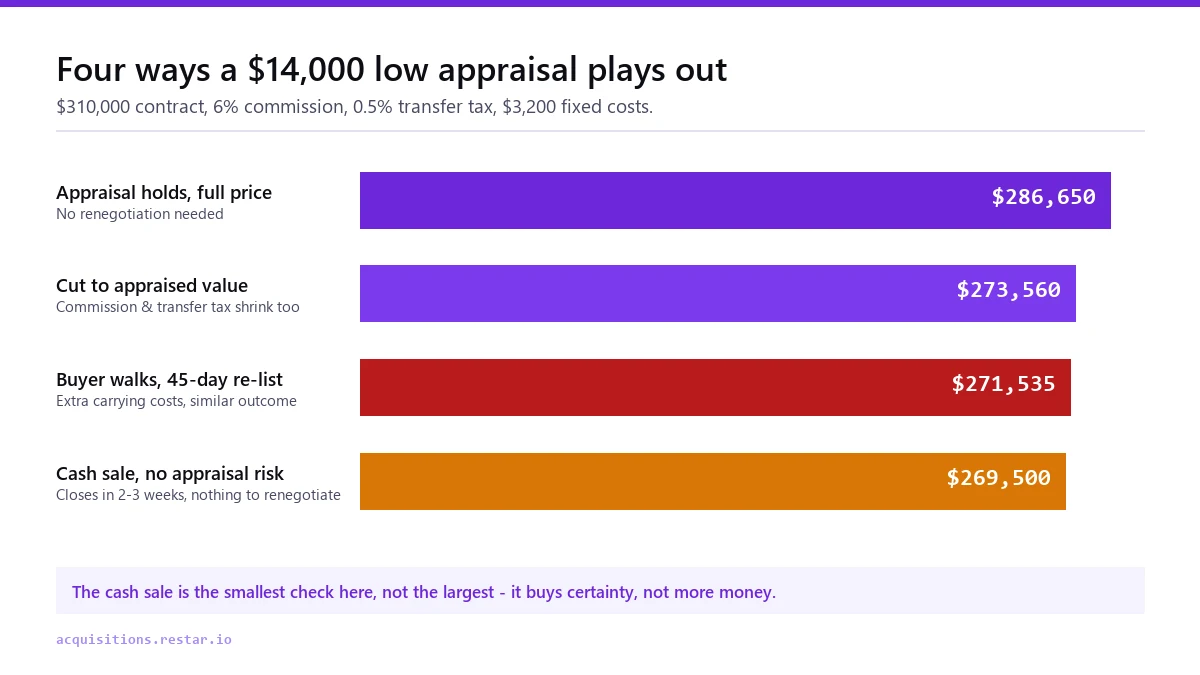
Listed, appraisal holds, full price
$286,650
Listed, cut to match a low appraisal
$273,560
Listed, buyer walks, 45-day re-list
$271,535
Cash sale, no appraisal risk, 2–3 weeks
$269,500
Four ways a $14,000 low appraisal plays outRestar Acquisitions · worked example from this page
A worked illustration on one hypothetical property. Not a quote, not a prediction about your house, and not a fixed formula we apply.
Line up the numbers honestly and the cash sale is the smallest check in this example, not the largest — even after a low appraisal cuts into the financed path. What it buys instead is certainty: no second appraisal that can also come in short, no financing contingency, and a closing date measured in weeks instead of a re-listing gamble. That's the real cost of an appraisal gap measured against every option, not just the one that already fell through.
Common questions
What is an appraisal gap?
It's the difference between the price a buyer agreed to pay and the value a lender's appraiser assigns to the house. Since most loans are capped at a percentage of the lower of the two numbers, a gap forces the buyer to either bring more cash, renegotiate the price, or walk away.
Can a seller just refuse to lower the price after a low appraisal?
Yes, a seller can hold firm on price, but if the buyer's contract includes an appraisal contingency, they can then cancel and get their earnest money back, leaving the seller back on the market.
Does a cash offer skip the appraisal entirely?
A cash purchase has no lender involved, so there's no lender-required appraisal and nothing for a gap to form around. Some cash buyers still order their own valuation for their own decision-making, but it doesn't create a contractual gap the way a lender's appraisal does.
How often do appraisals actually come in low?
It varies by market conditions and how competitively a house is priced; low appraisals are more common in fast-moving markets where contract prices outpace recent comparable sales. There's no single national rate reliable enough to plan around — treat it as a real possibility worth having a plan for, not a rare event.
What is an appraisal gap coverage clause?
It's a buyer's written promise, made when submitting an offer, to cover some or all of the difference in cash if the appraisal comes in below the contract price, up to a stated dollar amount. It shifts risk toward the buyer, but only up to whatever limit they specified.
Can I dispute a low appraisal?
Yes — a formal reconsideration of value (ROV) process lets a borrower flag factual errors, missing comparable sales, or other issues to the lender for the appraiser to review, though it doesn't change the value automatically.
Skip the appraisal risk entirely, if the numbers make sense
A cash sale isn't subject to a lender's appraisal at all, which means there's no gap to negotiate and no risk of a second low number if the buyer walks and you re-list. It's not automatically the bigger check — the math below is honest about that — but if you've already been through one collapsed appraisal, send us the address and we'll show you the real comparison for your specific numbers.
Every offer on this site is underwritten by a person, not a form. If the
numbers do not work for you, say so and I will tell you what would.
Also from Restar
Want the data behind all of this?
Restar Acquisitions is the acquisitions arm of Restar — a housing-market analytics
platform tracking 180+ metrics across every U.S. market, with composite scores and 12-month
price forecasts. The numbers on this page come from the same work.