Every market page publishes the numbers behind its offer. See the math
Home › Guides › The Real Cost of a Rent-Back Agreement After Closing
Guide
The Real Cost of a Rent-Back Agreement After Closing
A rent-back agreement — also called a post-closing occupancy agreement or a use-and-occupancy agreement — lets a seller stay in the house for an agreed number of days after the sale closes, paying the new owner rent for the privilege. It solves a real timing problem: your sale closes on the date the buyer needs, but your next place isn't ready for another two or three weeks. The part that gets skipped in most explanations is the actual arithmetic — what it costs, what it's capped at, and who owes tax on the money changing hands.
Takes about two minutes. Or call
(313) 710-6129 — we answer.
Educational only. This explains how these situations generally work. It is not legal, tax or financial advice, and the rules differ by state — talk to an attorney or CPA about your own situation before you act on any of it.
The cost of a rent-back agreement: the short answer
A seller rent-back after closing typically costs the seller 1/30th of the buyer's daily mortgage, tax and insurance payment for each day they stay, plus a security deposit held in escrow. On a median-priced house that runs roughly $60 to $150 a day. Most owner-occupant loans cap the arrangement near 60 days before the buyer's financing is affected.
This is educational information, not legal, tax or insurance advice. A rent-back creates a real landlord-tenant relationship for the days it covers — talk to your closing attorney or title company before signing one, and to a tax preparer about how the payments are reported.
What a rent-back agreement actually is
Once you close, the house legally belongs to the buyer — not you. A rent-back is a short, separate agreement, typically drafted by the closing attorney or built into the purchase contract, that lets the seller remain in the home as a paying occupant for a fixed number of days afterward. The buyer becomes, on paper, the seller's landlord for that window, and depending on the state, the arrangement can function as a short-term lease or something closer to a tenancy at will if the agreement doesn't spell out a firm end date — which is exactly why the end date needs to be firm. The title or escrow company commonly holds a security deposit out of the seller's proceeds and disburses or withholds it based on whether the seller moves out on time and leaves the house in the agreed condition.
How the per-diem rent is actually calculated
The standard convention buyers and their agents use is to charge the seller a daily rate equal to 1/30th of the buyer's monthly PITI — principal, interest, taxes and insurance — plus any HOA dues, for every day of the rent-back. Here's a worked example on a $265,000 house with a $224,000 loan at 6.75%:
This is a worked illustration on one hypothetical property, not a quote or a prediction about your own numbers.
Line
Monthly
Principal & interest
$1,453
Property tax (est.)
$265
Homeowners insurance (est.)
$140
Total PITI
$1,858
Per diem (PITI ÷ 30)
$62/day
For a 21-day rent-back, that's $1,302 in rent, plus a security deposit — commonly around one month's PITI, so roughly $1,850 here — held by the title company and refunded (minus any damage or overstay charge) once the seller actually moves out.
Is it worth it? Compare it to the alternative
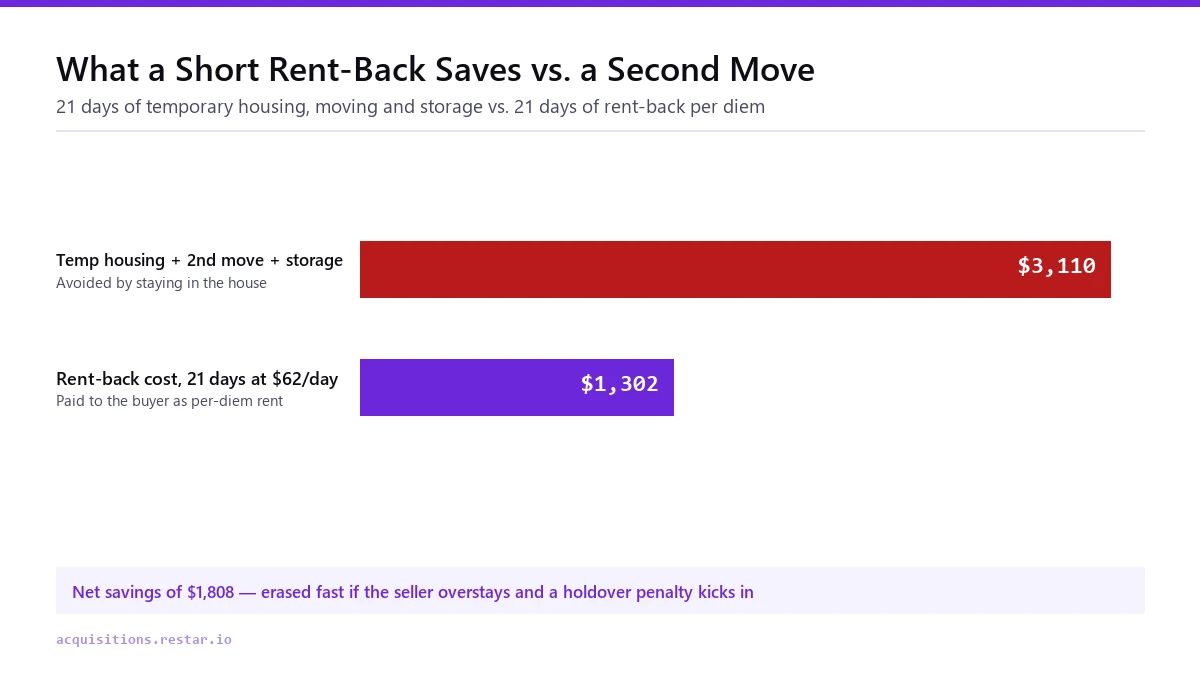
The honest comparison isn't the rent-back against nothing — it's the rent-back against what those 21 days would otherwise cost: short-term housing, a second move, and storage for anything that doesn't fit in a temporary place.
Cost
Amount
Extended-stay housing, 21 nights at $110
$2,310
A second moving day (truck + labor)
$650
Storage unit for 3 weeks
$150
Total avoided by staying put
$3,110
Rent-back cost, 21 days at $62/day
−$1,302
Net savings from the rent-back
$1,808
What a short rent-back saves vs. a second moveRestar Acquisitions · worked example from this page
That's a real, if modest, savings — as long as the seller actually moves out on the agreed date. Most rent-back agreements carry a holdover penalty on top of the normal per diem if the seller overstays, commonly reported in the $150 to $300 a day range. Ten days late at $200 a day is $2,000 — more than the entire savings this example produced. A rent-back is a good deal exactly as long as it's short and the move-out date is firm, and a bad one the moment it isn't.
The hard ceiling: the buyer's loan sets the limit
If the buyer financed the purchase as their primary residence, their loan documents generally commit them to occupying the home within a limited window — commonly cited as 60 days — under the occupancy classification framework Fannie Mae's Selling Guide uses to distinguish a principal residence from an investment property. Run the rent-back past that point, and the buyer's loan can effectively no longer match what they certified at closing — a problem for them, not you, but one that will kill the rent-back request from their side well before it becomes a real issue.
This is also where a cash sale changes the math. A cash buyer with no owner-occupancy loan to answer to has no equivalent clock — if you genuinely need more time than a 60-day ceiling allows, negotiating a later closing date or a longer occupancy period with a cash buyer avoids the constraint entirely, rather than trying to stretch a financed buyer's rent-back past what their lender will tolerate.
Who owes tax on the rent — and it isn't necessarily who you'd assume
Once the sale closes, the buyer owns the house. The IRS treats payments received for the use or occupation of a property as rental income to whoever owns the property when the payment is received — the framework laid out in IRS Topic 414, Rental income and expenses. That means the per-diem “rent” a seller pays during a rent-back is generally the buyer's reportable rental income, not the seller's — a detail that surprises plenty of first-time buyers who didn't realize a short rent-back turned them into a landlord for tax purposes, even briefly. Sellers should still confirm with their own tax preparer that a short post-sale occupancy doesn't affect anything on their own return; it typically doesn't change the tax treatment of the home sale itself, but “typically” isn't the same as “always.”
The honest tradeoff: rent-back vs. the alternatives
A rent-back isn't the only way to solve a timing gap, and it isn't always the simplest one:
Negotiate a later closing date instead. No landlord-tenant relationship is created, no per-diem math, no security deposit — just a later date on the contract. The tradeoff is it ties up the buyer's rate lock and earnest money longer, which not every buyer will agree to.
Use short-term housing and accept the cost if the numbers in your specific case favor it — a rent-back only wins when the per diem is meaningfully cheaper than the alternative, and that isn't automatic on every house.
Ask family or friends for a short bridge, which avoids both the cost and the paperwork entirely.
Sell to a buyer who isn't racing a lender's occupancy clock. A cash sale removes the 60-day ceiling and the need for a formal rent-back structure at all, since there's no owner-occupant financing to protect.
What to get in writing before you sign one
The exact move-out date, the per-diem rate, and the holdover penalty if that date slips.
Who pays utilities and who insures the home during the rent-back — a standard homeowners policy generally ends the day you no longer own the house, so ask about short-term liability coverage for the days you're staying as a tenant.
Confirmation from the buyer's lender that the specific number of days doesn't create a problem with their loan.
Who is responsible for any damage that occurs during the rent-back period, and how the security deposit is actually released.
Common questions
What is a rent-back agreement?
A short agreement that lets a seller remain in a house as a paying occupant for a set number of days after closing, once the buyer legally owns the property. It's also called a post-closing occupancy or use-and-occupancy agreement.
How is rent-back per diem calculated?
The common convention is 1/30th of the buyer's monthly PITI (principal, interest, taxes and insurance), plus any HOA dues, charged for each day of the rent-back. A security deposit, often around one month's PITI, is typically held in escrow.
How long can a seller rent back after closing?
It depends on the buyer's financing. Owner-occupant loans generally require the buyer to move in within a limited window — commonly cited as 60 days — under Fannie Mae's occupancy-type framework, which caps how long a financed buyer can realistically agree to. A cash buyer has no equivalent lender-imposed ceiling.
Who pays tax on rent-back payments?
Generally the buyer, not the seller. Once the sale closes, the buyer owns the property, and the IRS treats payments for occupying a property as rental income belonging to whoever owns it when the payment is received.
What happens if the seller doesn't move out on time?
Most rent-back agreements include a holdover penalty on top of the normal per-diem rent, commonly reported in the $150 to $300-a-day range, and can allow the buyer to pursue eviction under state landlord-tenant law if the seller doesn't leave.
Because we aren't financing the purchase with an owner-occupant loan, we don't run into the 60-day ceiling a retail buyer's lender does. If you need real time after closing, we can often build that into the closing date itself rather than layering a formal rent-back agreement on top of it. Send us the address and tell us the timeline you actually need.
If a short rent-back with a financed buyer nets you more in your specific situation, that can be the better math — our worked example below shows honestly when a rent-back is worth it and when the holdover risk outweighs the savings.
Every offer on this site is underwritten by a person, not a form. If the
numbers do not work for you, say so and I will tell you what would.
Also from Restar
Want the data behind all of this?
Restar Acquisitions is the acquisitions arm of Restar — a housing-market analytics
platform tracking 180+ metrics across every U.S. market, with composite scores and 12-month
price forecasts. The numbers on this page come from the same work.