Every market page publishes the numbers behind its offer. See the math
Home › Guides › Cash for Keys Cost: Eviction and Selling Occupied, Compared
Guide
Cash for Keys Cost: Eviction and Selling Occupied, Compared
If you're a landlord who wants a tenant out before you sell, a cash-for-keys agreement is one of three real paths in front of you — the other two are filing for eviction, or selling the house with the tenant still living in it. Cash for keys typically costs somewhere between a half month's rent and two months' rent in most markets, roughly $500 to $5,000, though it runs much higher in tenant-protective cities. None of the three paths is automatically the cheapest — here's the actual math for each, worked on a real number.
Takes about two minutes. Or call
(313) 710-6129 — we answer.
Educational only. This explains how these situations generally work. It is not legal, tax or financial advice, and the rules differ by state — talk to an attorney or CPA about your own situation before you act on any of it.
What a Cash-for-Keys Agreement Actually Is
A cash-for-keys agreement is a written agreement between a landlord and a tenant: the landlord pays the tenant a set amount of money, and the tenant agrees to move out voluntarily by a specific date, leaving the unit in agreed-upon condition. In exchange, the landlord agrees not to file for eviction as long as the tenant holds up their end.
It should always be in writing, and it should specify, at minimum:
The dollar amount and how/when it's paid (commonly split — partial at signing, remainder at move-out with keys and a clean unit)
The exact move-out date
The condition the unit must be left in
A statement that no eviction will be filed if the terms are met
What happens to the security deposit
It is not a legal document that overrides the lease or state eviction procedure on its own — it's a settlement both sides agree to instead of going to court. If the tenant doesn't leave, the landlord's only lawful recourse is still the court system, not self-help.
What Cash-for-Keys Payments Typically Cost
There's no fixed fee schedule for this — it's negotiated, and it varies by market, by how motivated the tenant is, and by how much leverage each side has. Property-management sources report a fairly wide range:
iPropertyManagement's landlord guide puts a typical offer at half of one month's rent up to a full month's rent, plus the remainder of the tenant's security deposit, absent major damage.
Other industry guides cite a broader working range of roughly $500 to $5,000 in most standard markets — sometimes described as one to two months' rent.
In tenant-protective jurisdictions — cities like Los Angeles, San Francisco, and New York, where local ordinances give tenants more leverage and sometimes mandate relocation payments for no-fault terminations — reported figures climb much higher, into the $5,000–$25,000+ range.
Treat all of these as scoped ranges, not a quote. What a specific tenant will actually accept depends on your local market, the tenant's situation, and how quickly they can find another place. If you're negotiating one, it's reasonable to research your specific city's landlord-tenant rules first, since some cities set minimums or require relocation assistance regardless of whether you call it "cash for keys."
What a Formal Eviction Actually Costs
Eviction is a real legal process with real fees at every step, and it is slower and more expensive than most landlords expect going in. It's also common: Princeton's Eviction Lab recorded 3.6 million eviction filings nationwide in 2018 alone, so the costs below apply to millions of landlords a year, not an edge case.
Court filing fees generally run $50 to $500, depending on the state and county and the amount in dispute.
Attorney fees, if you use one, run roughly $300–$1,000 as a flat fee for a straightforward, uncontested case, or $150–$400 an hour if the tenant contests it — which can push total legal costs well past $2,000–$5,000 on a contested case.
Lost rent is usually the biggest line item and the one landlords underestimate most. Industry data puts average lost rent during a typical eviction process at around $2,500, and total eviction costs — legal fees, lost rent, property damage, and turnover — averaging $3,500, with a realistic range of $500 on the low end for a simple, uncontested case up to $10,000 or more for a contested one.
Timeline varies enormously by jurisdiction. An uncontested eviction can move in as little as three to six weeks in landlord-favorable states. A contested case, or a filing in a state or city with strong tenant protections, commonly runs two to six months, and courts in busy urban areas can be backlogged well beyond that. None of this includes the risk of property damage from a tenant who knows they're being forced out.
One more thing to flag clearly: landlords generally cannot evict a tenant simply because they want to sell the house. Eviction requires a legal ground — nonpayment of rent, a real lease violation, and so on. Some states and cities do allow a landlord to end a tenancy for an "owner's intent to sell," but this varies significantly by location, and a growing number of cities require "just cause" for any termination and mandate relocation assistance for no-fault terminations, including sale of the property. Seattle's Just Cause Eviction Ordinance, for example, allows an owner's intent to sell a single-family home as valid grounds, but requires 90 days' notice — and other cities attach relocation-payment requirements to similar no-fault terminations. Check your specific city and state before assuming "I want to sell" is grounds for eviction where you are.
The Risk of Skipping the Paperwork
The reason a written agreement matters isn't a formality — it's what protects both sides if things don't go as planned.
Without something in writing, a tenant can take a cash payment and simply not leave, and you're back to square one with no eviction filed and less cash in hand. Without a written agreement (or once you have one but the tenant breaches it), the landlord's only lawful option is still to go through the court eviction process — not to force the issue directly.
"Self-help" eviction — changing the locks, shutting off utilities, removing a tenant's belongings, or otherwise trying to force someone out without a court order — is illegal in every state, even when the landlord has a completely valid reason to want the tenant gone. It exposes the landlord to civil liability, statutory penalties in many states, and potentially a lawsuit that costs far more than the eviction would have.
This is educational only — talk to an attorney about your specific situation and local landlord-tenant law.
The Honest Price Tradeoff: Three Paths on a $150,000 Rental
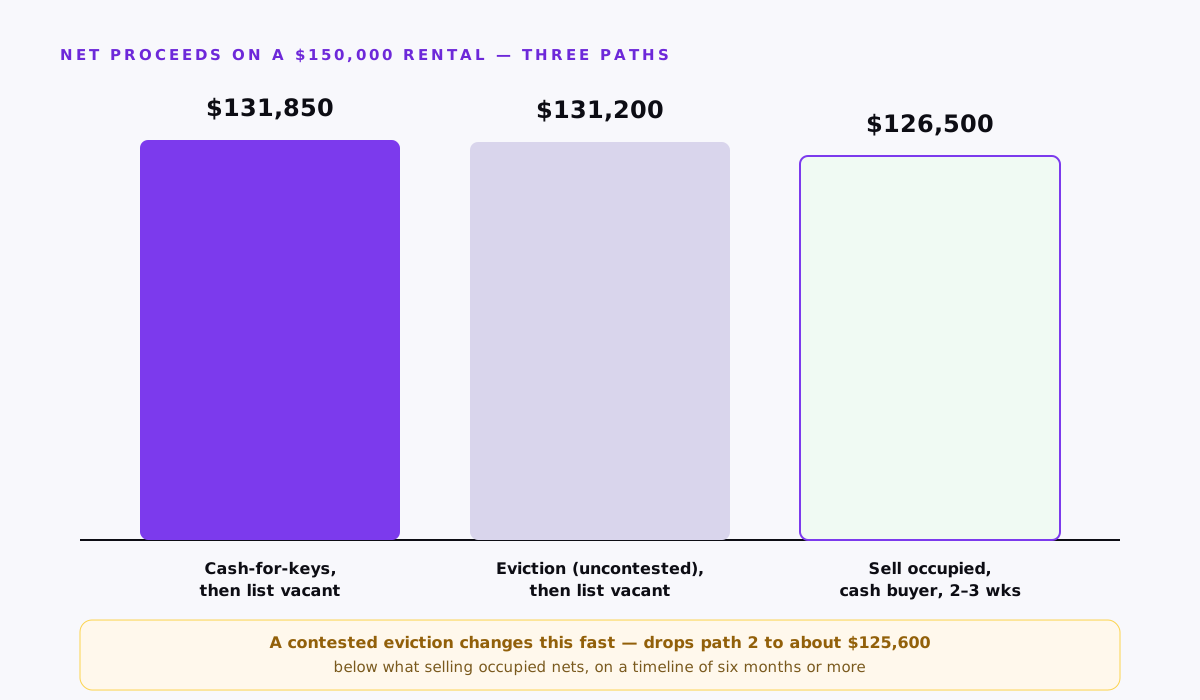
A contested eviction changes the math fastRestar Acquisitions · worked example from this page
Here's the same rental property — worth $150,000 vacant, currently rented for $1,300 a month — run through all three paths. Use your own numbers for your own property; these are illustrative, not a quote.
Path 1 — pay cash-for-keys, then sell vacant at retail with an agent.
Retail sale price
$150,000
Cash-for-keys payment (2 months' rent)
−$2,600
Lost rent during move-out/prep (1 month)
−$1,300
Cleanup and light repairs before listing
−$3,000
Agent commission (6%)
−$9,000
Seller closing costs (~1.5%)
−$2,250
Net to you
$131,850
Time
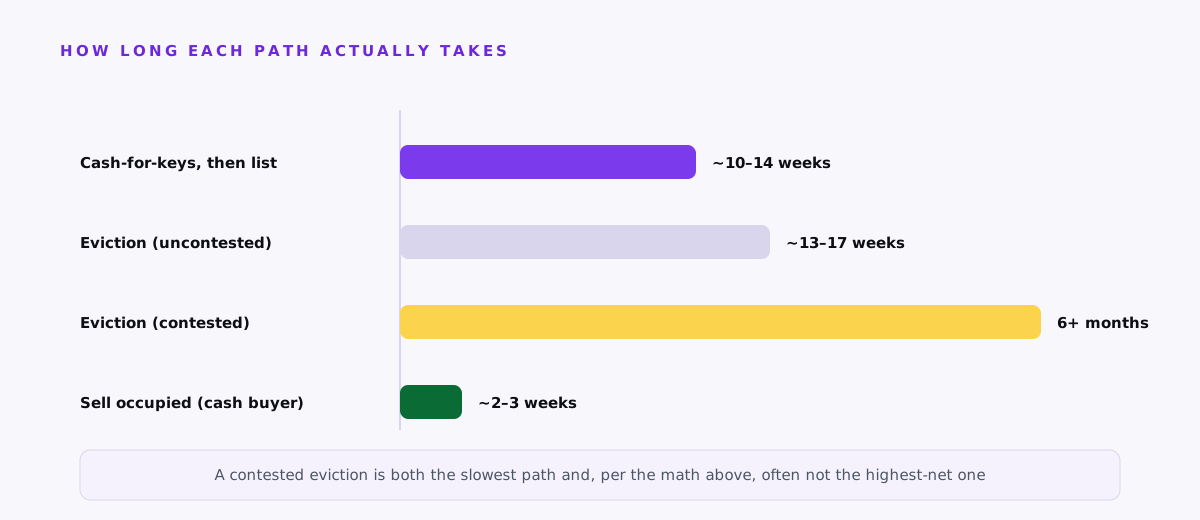
~10–14 weeks
Path 2 — file for eviction, then sell vacant at retail.
Retail sale price
$150,000
Court filing fee
−$200
Attorney fee (uncontested, flat)
−$750
Lost rent during eviction (~2 months)
−$2,600
Cleanup and repairs (often higher after a forced move-out)
−$4,000
Agent commission (6%)
−$9,000
Seller closing costs (~1.5%)
−$2,250
Net to you
$131,200
Time
~3–4 months, if uncontested
If that eviction gets contested — which happens — the math changes fast: a contested attorney bill closer to $3,500–$4,000, four-plus months of lost rent instead of two, and a longer, higher-risk process pushes net proceeds down toward $125,000–$126,000, on a timeline of six months or more.
Path 3 — sell to a cash buyer with the tenant still in place.
Cash offer (discounted for lease/holdover risk, no repairs needed)
$126,500
Agent commission
$0
Closing costs
$0 — buyer covers standard costs
Cleanup/repairs
$0
Buyout or eviction cost
$0
Net to you
$126,500
Time
~2–3 weeks
Path
Net proceeds
Time
What it requires from you
1 — Pay to leave, then list
$131,850
~3 months
Tenant cooperation, $3,000+ for prep, commission, patience
2 — Eviction (uncontested), then list
$131,200
~3–4 months
Court process, commission, a tenant who doesn't contest
2 — Eviction (contested)
~$125,600
6+ months
All of the above, plus a real risk it costs more than it's worth
3 — Sell occupied, cash buyer
$126,500
2–3 weeks
Nothing — no vacancy, no repairs, no court
On this example, Path 1 nets the most if the tenant cooperates, you can front the commission and prep costs, and you're not in a hurry. But it beats a direct occupied sale by only about $5,350 — and that gap disappears, or reverses, the moment an eviction gets contested or your court has a backlog. Which path actually nets you more is genuinely case-by-case. Don't assume either extreme — "cash-for-keys always pays for itself" or "a cash sale always beats the hassle" — without running your own numbers.
A contested eviction is the slowest path and often not the highest-net oneRestar Acquisitions · timeline for the same example
Your Other Options
Cash-for-keys and eviction aren't the only two roads. Depending on your situation, consider:
Selling with the tenant and lease in place. Many buyers — investors especially — will purchase a property with an existing tenant and lease intact. You avoid the vacancy and the buyout entirely, though the buyer will price in the lease terms and the risk of taking over a tenancy they didn't screen.
Waiting out the lease term, then listing vacant. If the lease is close to ending anyway, this avoids paying anyone to leave early or filing anything — you just wait, then list once the unit is naturally vacant.
A negotiated buyout, covered above — pay the tenant to move the date up voluntarily.
Formal eviction, covered above — only available where you have a real legal ground (nonpayment, lease violation, or a local ordinance that permits ending a tenancy for sale, with whatever notice and relocation rules apply where you are).
Buyout, then sell retail
Eviction, then sell retail
Sell occupied, cash buyer
Typical cost to you
$500–$5,000+ payment
$500–$10,000+ (fees, lost rent, damage)
$0 out of pocket
Timeline
Weeks to prep, then a normal listing
Weeks to 6+ months, then a normal listing
Typically days to a few weeks
Requires vacant possession
Yes
Yes
No
Requires repairs/prep/commission
Usually
Usually
No
Outcome certainty
High, if tenant cooperates
Lower — court dependent
High
Common questions
How much does a cash-for-keys agreement typically cost?
Reported ranges run from about half a month's rent up to two months' rent in most markets — roughly $500 to $5,000 — and considerably higher, into five figures, in tenant-protective cities like Los Angeles, San Francisco, and New York. It's negotiated, not fixed, and varies with your market and the tenant's situation.
Is cash-for-keys legally binding?
It's a settlement agreement, not a substitute for the eviction process itself. Put it in writing with a move-out date, the payment terms, and a statement that no eviction will be filed if the tenant meets the terms. If the tenant doesn't follow through, your lawful recourse is still the court system — not changing locks or shutting off utilities, which is illegal everywhere.
Can I just evict my tenant because I want to sell the house?
Not on its own, in most places. Eviction generally requires a legal ground like nonpayment or a lease violation. Some states and cities allow ending a tenancy for an owner's intent to sell, sometimes with required notice periods or relocation assistance, but this varies significantly by state and city. Check your local law before assuming it applies to you.
What happens if I try to force a tenant out without a written agreement or a court order?
That's a self-help eviction — changing locks, shutting off utilities, removing belongings — and it's illegal in every state, regardless of how valid your reason for wanting them out is. It can expose you to civil liability, statutory penalties, and a lawsuit that costs far more than either lawful route would have.
Does selling a house with a tenant in it always mean a lower price?
Often, yes, somewhat — the buyer pool shrinks to investors and cash buyers who are comfortable taking on the lease and holdover risk, and any offer will typically be discounted to reflect that. But it also removes the buyout, the vacancy, the repairs, and the court timeline entirely, so the net gap is often smaller than the headline price difference suggests. Run the actual numbers on your property rather than assuming.
Which option is cheapest — cash-for-keys, eviction, or selling occupied?
It depends on your tenant, your local court's timeline, and whether an eviction stays uncontested. On the worked example above, cash-for-keys then a retail sale narrowly nets the most if everything goes smoothly, but a contested eviction can end up costing more than simply selling with the tenant in place. There's no universal answer — that's the whole point of running the math on your specific property. This is educational only — talk to an attorney about your specific situation and local landlord-tenant law.
Want to compare these paths on your actual property?
We're happy to look at the numbers with you — including a straight cash offer with the tenant still in place, if that's a path worth comparing. Send us the address and we'll get back to you with a written offer within 24 hours. No pressure either way.
Every offer on this site is underwritten by a person, not a form. If the
numbers do not work for you, say so and I will tell you what would.
Also from Restar
Want the data behind all of this?
Restar Acquisitions is the acquisitions arm of Restar — a housing-market analytics
platform tracking 180+ metrics across every U.S. market, with composite scores and 12-month
price forecasts. The numbers on this page come from the same work.