Every market page publishes the numbers behind its offer. See the math
Home › Guides › Selling a Rental Property With a Section 8 Tenant
Guide
Selling a Rental Property With a Section 8 Tenant
Selling a rental property with a Section 8 tenant works like any other tenant-occupied sale, with one extra layer. Our general guide to selling a rental property with tenants covers what happens to a lease when you sell. A housing choice voucher tenancy adds a second contract on top of it — the Housing Assistance Payments (HAP) contract between you and the local public housing agency — and that second contract does not simply follow the property the way a lease does. Here is what actually happens to each piece.
Takes about two minutes. Or call
(313) 710-6129 — we answer.
Educational only. This explains how these situations generally work. It is not legal, tax or financial advice, and the rules differ by state — talk to an attorney or CPA about your own situation before you act on any of it.
Selling a rental property with a Section 8 tenant: the short answer
The tenant's lease generally survives the sale, but the HAP contract does not — it's between you and the public housing agency, and a new owner must apply and be approved to assume it. If nobody does, the tenant keeps the voucher and can use it elsewhere; the buyer just doesn't inherit the subsidy automatically.
This is educational information, not legal advice. Housing Choice Voucher administration is run locally by hundreds of public housing agencies operating under HUD regulations, and procedures, forms and timelines vary by agency. Confirm your PHA's specific process before you sign a purchase agreement.
Two contracts, not one
This is the piece almost everyone selling a voucher-tenant property misses at first, because a normal rental sale only has to deal with a lease.
The lease is between you and the tenant. Under the HUD tenancy addendum incorporated into every Housing Choice Voucher lease, the tenant's rights are the same as any other tenant's under state and local law — including, in most states, the rule that a change of ownership does not terminate a fixed-term lease. The buyer steps into your role as landlord for the remainder of the term.
The HAP contract is a separate agreement between you, the owner, and the local public housing agency (PHA), under which the PHA pays its share of the rent directly to you. Federal regulation (24 CFR Part 982, Subpart J) establishes this as a contract between the PHA and the owner, matched to the lease term — it is not automatically assigned to whoever happens to own the property. When ownership changes, the existing HAP contract does not simply carry over to the new owner by default; the new owner has to be approved and step into it, or a new HAP contract has to be executed, before PHA payments will go to them.
Confuse the two and you get the two most common mistakes: sellers who assume the voucher money “comes with the house” for a buyer who never applied for it, and buyers who assume the lease ends because “the Section 8 contract ended.”
What has to happen for the new owner to keep receiving the subsidy
If your buyer intends to keep the unit as a Section 8 rental — the common case when you sell to another investor rather than an owner-occupant — the practical sequence runs roughly like this, though the exact forms and timeline are set by your local PHA:
Notify the PHA of the pending sale before closing, ideally as soon as you have a contract. Most agencies want this in writing with the anticipated closing date.
The new owner applies to assume the HAP contract. This typically means completing paperwork the PHA provides — commonly an assumption or change-of-ownership form plus a W-9 for tax reporting — and going through the PHA's standard owner approval, which can include a background and program-compliance check.
The unit may need a new Housing Quality Standards inspection, or the PHA may accept the existing one depending on its timing and your agency's policy. Ask specifically; this is one of the more common sources of delay.
Direct deposit and payment setup take time. Expect the PHA's own processing, separate from your closing, to take several weeks once the paperwork is complete — plan on this running in parallel with, not faster than, a typical closing timeline.
Until the new owner's paperwork is approved, PHA subsidy payments do not go to them. If the closing happens before that approval clears, there can be a gap where the new owner is owed the subsidy portion retroactively once approved, or in some agencies' practice is not able to collect for that gap at all — a detail worth confirming with your specific PHA in writing before you close, not after.
If the new owner does not want to keep it as a Section 8 rental
The voucher belongs to the tenant, not the unit, which is the piece that should reassure both you and your tenant. If the HAP contract lapses because nobody assumes it, the tenant does not lose their voucher — they can use it to lease a different unit, a right generally referred to as portability, subject to the notice and process their PHA requires. What they cannot be forced to do is leave before their lease term ends and any required notice period runs, exactly as with any other tenant, covered in more detail in our general tenants guide. A new owner who wants the unit vacant still has to wait out the lease and follow ordinary notice and eviction procedure for nonpayment or lease violations — there is no shortcut created by the tenant's voucher status, and treating a voucher holder differently in the removal process than any other tenant can itself raise fair housing issues in states and cities that protect source of income.
Why this shrinks your buyer pool the same way any lease does
Exactly as with a standard tenant-occupied sale: an owner-occupant buyer generally cannot move in while the lease runs, and FHA and VA financing carry owner-occupancy requirements that rule out that buyer entirely during the lease term. Your realistic buyer pool for a Section 8-occupied property is other landlords and cash buyers — which is not a bad thing if the rent is reliable and the PHA has been paying on time, since that stability is exactly what a buy-and-hold investor is looking for, but it is a narrower and often slower-moving pool than an open owner-occupant market.
The honest math
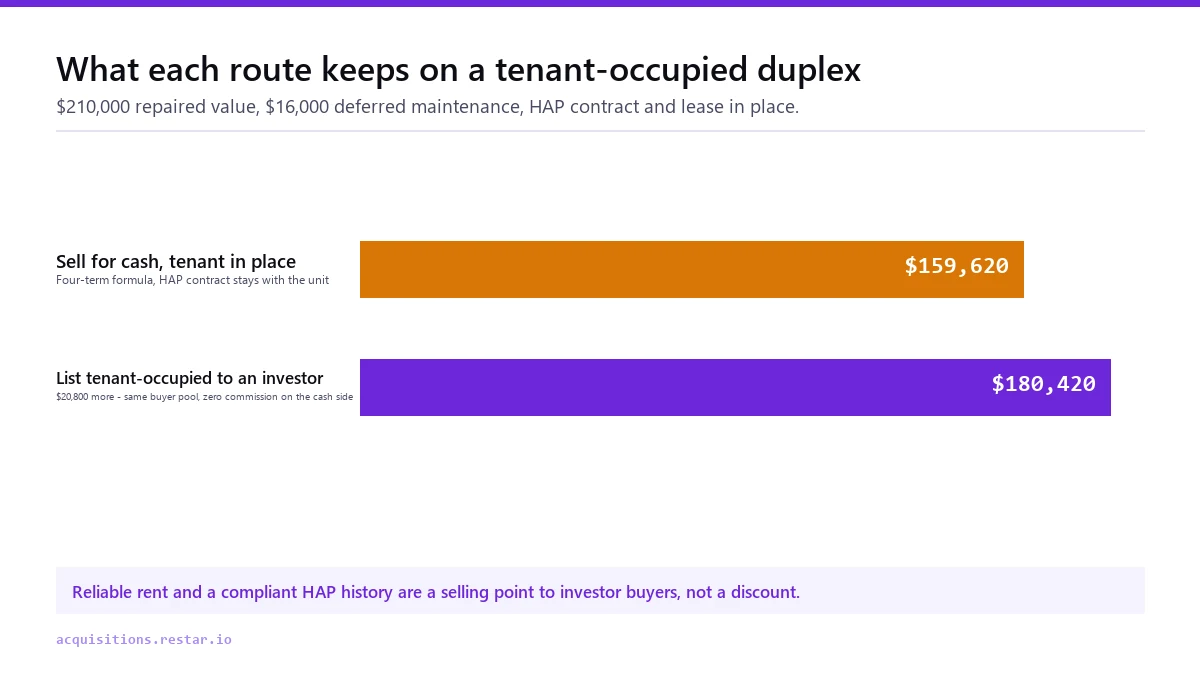
Take a duplex worth $210,000 fully repaired and rented, with a Section 8 tenant paying a combined rent of $1,650 a month ($1,050 PHA portion, $600 tenant portion), a lease with eight months remaining, and $16,000 of deferred maintenance.
List it as-is, tenant-occupied, to an investor buyer. Investor buyers price tenant-occupied property on the income it produces as much as on comparable sales, and a below-market or at-market lease with a reliable subsidized portion is often a selling point rather than a discount. Pricing the deferred maintenance straight into the sale price: $210,000 − $16,000 = $194,000 list price. After a 5.5% commission ($10,670) and 1.5% seller closing costs ($2,910): $194,000 − $10,670 − $2,910 = $180,420 net.
Sell for cash, tenant in place, using the four-term formula: after-repair value $210,000, repairs $16,000, resale and holding costs $14,500 (built to a buyer who intends to keep the tenant and the HAP contract, so holding time is short), margin $19,880. $210,000 − $16,000 − $14,500 − $19,880 = $159,620.
What each route keeps on a tenant-occupied duplexRestar Acquisitions · worked example from this page
A worked illustration on one hypothetical property. Not a quote, not a prediction about your house, and not a fixed formula we apply.
Listing nets $20,800 more in this example, which is the same pattern seen across most tenant-occupied properties on this site: the discount for the work is real either way, but the commission on a cash sale is zero and the listing route reaches the same investor buyers a cash sale does. The gap narrows or reverses if the deferred maintenance is heavier, the lease has little time left, or the HAP contract has any compliance history that makes the PHA approval of a new owner slower or less certain — ask us for the as-is figure and compare it against your own listing quote before deciding.
Alternatives
List it tenant-occupied with an agent experienced in investment sales — usually the best net result, per the math above, provided the lease and HAP history are in order.
Wait out the lease and sell vacant — opens the owner-occupant buyer pool, but costs months of carrying costs and lost rent, with no certainty the tenant leaves cleanly on schedule.
Sell to us with the tenant and HAP contract in place — we buy tenant-occupied property as-is and will tell you plainly if the numbers favor listing instead, the way they do in the example above.
Common questions
Does the HAP contract transfer automatically when I sell?
No. The lease generally survives a sale like any other lease, but the HAP contract is a separate agreement between the owner and the local public housing agency. A new owner has to apply and be approved by the PHA to start receiving the subsidy payments — it is not automatic.
Does my Section 8 tenant lose their voucher if I sell and the new owner doesn't want the HAP contract?
No. The voucher belongs to the tenant, not the property. If the HAP contract on your unit lapses, the tenant can use the voucher to lease a different unit, subject to their PHA's notice and portability process. What ends is the subsidy arrangement on your specific address, not the tenant's voucher itself.
Can a new owner refuse to keep the property in the Section 8 program?
Generally yes, once any existing lease term ends — an owner is not required to participate in the voucher program going forward. But they cannot remove a tenant before the lease ends and required notice runs just because the tenant uses a voucher; ordinary lease and eviction rules still apply, and some states and cities separately prohibit refusing tenants based on source of income.
Will my buyer's lender have a problem with a tenant-occupied Section 8 property?
The bigger issue is usually occupancy type, not the voucher itself — most owner-occupant loan programs require the buyer to move in, which they cannot do while your tenant's lease runs. Investor and cash buyers do not have that restriction, which is why they are the realistic buyer pool for a property sold mid-lease.
How long does PHA approval of a new owner actually take?
It varies by housing agency, but plan for it to take several weeks after the paperwork is submitted, and confirm with your specific PHA whether a new Housing Quality Standards inspection is required — that is one of the more common causes of delay.
Do I have to disclose that the tenant is on Section 8 when I sell?
Most seller disclosure forms do not ask about a tenant's payment source specifically, but they do ask about existing leases, and a buyer needs the lease terms and rent structure regardless to evaluate the purchase. Disclose the lease and HAP status plainly — it affects financing and the buyer pool either way, so there's nothing to gain by leaving it out.
If your tenant's voucher and your lease are both in good standing, that is worth more to a buyer than most sellers assume — say so up front rather than treating the Section 8 status as a complication to hide. We buy tenant-occupied houses, HAP contract and all, and do not need the property vacant, empty or repaired.
Written offer within 24 hours — and if waiting out the lease and listing would net you more, which our worked example below usually shows, we will tell you that instead. Send us the property here.
Every offer on this site is underwritten by a person, not a form. If the
numbers do not work for you, say so and I will tell you what would.
Also from Restar
Want the data behind all of this?
Restar Acquisitions is the acquisitions arm of Restar — a housing-market analytics
platform tracking 180+ metrics across every U.S. market, with composite scores and 12-month
price forecasts. The numbers on this page come from the same work.