Every market page publishes the numbers behind its offer. See the math
Home › Guides › Selling a House With a Rent-to-Own Tenant
Guide
Selling a House With a Rent-to-Own Tenant
A rent-to-own tenant isn't a normal renter. Depending on how the contract is written, they may hold an equitable interest in the house — a real claim, short of ownership, that comes from paying an option fee and crediting part of their rent toward a future purchase. If that deal has stalled, the option has expired, or the tenant-buyer has stopped paying, you can't just treat it like an ordinary lease ending: the option fee and rent credits may or may not be owed back depending on the contract and your state, and in a few states a long-running rent-to-own arrangement can be legally treated like an installment land contract, with foreclosure-style protections instead of a routine eviction.
Stuck with a rent-to-own deal that's not moving forward?
Tell us about the property and where things stand with the tenant-buyer. We'll talk through your options honestly, including whether listing or working out the option terms might net you more.
Takes about two minutes. Or call
(313) 710-6129 — we answer.
Educational only. This explains how these situations generally work. It is not legal, tax or financial advice, and the rules differ by state — talk to an attorney or CPA about your own situation before you act on any of it.
Selling a house with a rent-to-own tenant: the short answer
Selling a house with a rent-to-own tenant means dealing with more than a lease. Depending on the contract, your tenant-buyer may hold an equitable interest in the property, and the option fee and rent credits may need to be returned, forfeited, or negotiated before you can convey clear, sellable title.
This is educational information, not legal advice. Whether your rent-to-own tenant holds an equitable interest, what happens to their option fee and rent credits, and whether you can evict them or need a slower foreclosure-style process all depend on your specific contract and state law — confirm your situation with a real estate attorney before you act.
This is a different situation than selling a house with an ordinary renter in it. A rent-to-own or lease-option tenant signed up for a shot at buying the house, put money down for that right, and may have been crediting part of their rent toward a future purchase for months or years. When that deal stalls — financing never comes through, the option expires, payments stop, or both sides just want out — untangling it correctly matters more than it would with a standard lease.
Lease Option vs. Lease Purchase: What a Rent-to-Own Tenant Actually Owns
A lease option gives the tenant-buyer the right, but not the obligation, to purchase the house by a set date, usually at a price agreed on upfront or set by a formula. In exchange, they typically pay an upfront option fee (sometimes called option consideration) that secures that right. If they never exercise it — financing doesn't come through, they change their mind, or the deadline just passes — most lease-option contracts are written so no purchase happens and no sale ever needs to close.
A lease purchase (sometimes structured as a contract-for-deed style or installment arrangement) is a different animal: the tenant-buyer is obligated to complete the purchase, not just entitled to attempt it. Payments are often applied toward the price over time, and the tenant-buyer may take on responsibilities that look more like ownership — paying property taxes, insurance, or maintenance directly. That structure functions much closer to an installment land contract than a lease, and some states regulate it as one no matter what the paperwork is titled.
Either version can give the tenant-buyer an equitable interest in the property — a real, if limited, claim recognized by courts, separate from the legal title you keep until closing. How much that equitable interest actually protects them, and how much it restricts what you can do as the seller, depends on the specific contract terms and on your state's law.
Option Money and Rent Credits: What Happens If the Tenant-Buyer Doesn't Buy
If the tenant-buyer simply lets the option expire — they never exercise it, and the deadline passes — most lease-option contracts are written so the option fee is non-refundable and forfeited, and any accumulated rent credits go with it, since those credits generally only convert into real value if the purchase actually closes. Courts have generally enforced that forfeiture as written, as long as the arrangement was a genuine option the buyer was never obligated to exercise.
If the tenant-buyer breaches instead — stops paying rent, damages the property, or otherwise defaults before the option question is even reached — many contracts let the seller keep the option fee and credits on top of pursuing the normal remedies for unpaid rent. Again, that assumes the document is actually structured, and functions in practice, as an option rather than an obligation to buy.
Don't assume your contract's forfeiture language is automatically the last word. A handful of states have layered statutory protections on top of whatever the contract says. Illinois' Installment Sales Contract Act (765 ILCS 67) gives buyers under a covered installment contract a 90-day cure period before they can lose their rights over a missed payment, and applies once a seller enters more than three such contracts in a 12-month period (see Illinois Attorney General: Installment Sales Contract Act notice). Texas goes further still — see the next section.
Read your actual contract before you assume the option fee and rent credits are simply yours to keep. If your state has a statute like Illinois', or if a court would look at how the deal actually operated rather than what it's titled, the forfeiture clause you're relying on may not hold up exactly as written.
How to Actually End a Stalled Rent-to-Own Deal
If your arrangement is a genuine lease option — the tenant-buyer never exercised, never built meaningful equity beyond ordinary rent, and simply remained a tenant — ending it generally works like ending any other lease. Once the option period lapses, or if the tenant-buyer stops paying rent, you give proper notice and, if they don't leave, proceed through your state's standard eviction process, the same one used for any nonpaying tenant. Our guide to selling a rental property with tenants covers how a sale generally works around an occupied lease.
Texas takes this further than most states by statute. Under Texas Property Code Chapter 5, Subchapter D, a lease with an option to purchase is specifically defined as an executory contract once its term runs longer than 180 days, the buyer uses the property as a residence, and the parties aren't close relatives. That designation pulls the deal into a framework built for contracts-for-deed generally — seller disclosures, recording requirements, and, in some circumstances, a buyer's right to foreclosure-style protection rather than a simple eviction (see Texas Law Help: executory contracts and lease-to-own real estate). A Texas seller who assumes “it's just a lease, I can evict tomorrow” can be wrong about that.
Outside Texas, the same underlying idea shows up through case law rather than a dedicated statute in some states: the more a tenant-buyer has paid toward the price, and the more their arrangement functioned like ownership rather than renting, the more reluctant courts are to let a seller reclaim the house through a fast eviction instead of a slower, court-supervised process. Regulators are paying closer attention to this pattern generally — the CFPB's own review found some contract-for-deed-style sellers structuring deals specifically to route around buyer protections (see CFPB: contract-for-deed investors setting borrowers up to fail).
Before you file anything, reread the actual contract, add up what the tenant-buyer has actually paid toward the purchase versus the total price, and get a landlord-tenant or real estate attorney in your state to confirm whether a standard eviction or a slower foreclosure-style process applies. Filing the wrong one can get the case thrown out and cost you more time than starting correctly the first time.
The Honest Tradeoff: What Getting Out Fast Actually Costs
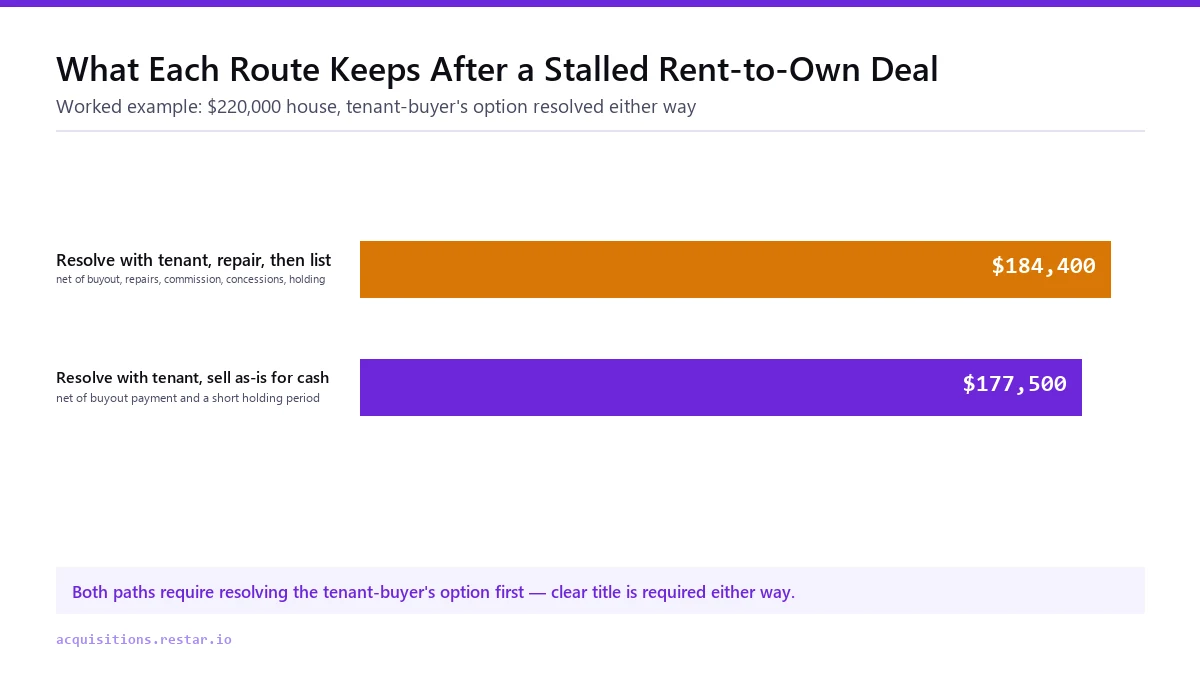
A cash, as-is sale is genuinely faster and more certain than untangling a stalled rent-to-own deal and then listing on the open market — but it also nets less than a fully repaired retail sale. Here's the arithmetic on one hypothetical $220,000 house, illustrative only, not a quote.
Line
Resolve with tenant, repair, then list
Resolve with tenant, sell as-is for cash
Sale price
$220,000
$181,000
Buyout/release payment to tenant-buyer
−$3,000
−$3,000
Repairs after deferred maintenance
−$9,000
$0
Agent commission (5.5%)
−$12,100
$0
Seller closing costs (1.5%)
−$3,300
$0 — we cover standard closing costs
Buyer concessions (1%)
−$2,200
$0
Holding, ~4 months vs. ~2 weeks
−$6,000
−$500
Net kept, before any existing mortgage
$184,400
$177,500
Both columns start with the same unavoidable step: resolving the tenant-buyer's option through a buyout or release, since neither a retail buyer nor a cash buyer can close on a house with a live equitable-interest claim attached. From there, listing wins by $6,900 in this example — the price of the repair budget, commission, concessions, and months of holding time it takes to fund and market a retail sale. See cash offer vs. listing net proceeds for the general version of this math, and how cash home buyers calculate offers for how a cash number gets built.
What each route keeps after a stalled rent-to-own dealRestar Acquisitions · worked example from this page
Whether that $6,900 gap is worth the repair funding and the months of uncertainty is a real question, not a rhetorical one. If you have the cash to fund repairs, the time to carry the holding costs, and a buyer's market that supports it, listing can be the right call. So can simply working out new terms with the tenant-buyer instead of ending the deal at all.
Alternatives Worth Considering Before You Evict Anyone
Negotiate a buyout of the option. Offer the tenant-buyer a lump sum to sign a mutual release and vacate — often faster and cheaper than a contested eviction or a foreclosure-style process, and it clears the title cloud without a court date.
Let the option lapse naturally. If the tenant-buyer is unlikely to exercise and hasn't built meaningful equity, sometimes the simplest path is waiting for the option period to run out, then proceeding like any lease ending.
Sign a mutual cancellation agreement. Even without a payment changing hands, both sides can agree in writing to void the option and rent-credit terms — cleaner than relying on a forfeiture clause you're not certain will hold up.
Consult a landlord-tenant or real estate attorney before attempting any eviction. Given how much the correct process depends on your specific contract and state, confirming which one applies before you file is worth the cost of the consultation.
Work out new terms with the tenant-buyer instead of ending the deal. If they still want to buy and just need more time or a revised price, extending or renegotiating the option can be the better outcome for both sides — selling isn't always the right call, and neither is walking away from a deal that could still close.
List with an agent, or sell to a cash buyer, once the option is genuinely resolved. Either route needs clear, marketable title first.
Common questions
Can I sell a house that has a rent-to-own tenant in it?
Not until the tenant-buyer's option or purchase agreement is resolved — released, expired unexercised, or otherwise legally cleared. A buyer, cash or financed, needs marketable title, and an active option or executory contract is a cloud on that title.
Does a lease-option tenant have any legal claim to my house?
Potentially, yes. Depending on the contract and how much they've paid in, a rent-to-own or lease-option tenant can hold an equitable interest in the property — a real claim recognized by courts, separate from your legal title. How much it limits what you can do depends on your specific contract and state law.
What happens to the option fee and rent credits if the tenant-buyer doesn't buy?
In most straightforward lease-option contracts, the option fee and any accumulated rent credits are forfeited if the tenant-buyer doesn't exercise by the deadline. That forfeiture is generally enforceable if the arrangement was a genuine option — but a few states, including Illinois for certain installment contracts, place statutory limits on it. Confirm with an attorney before assuming the money is simply yours to keep.
Can I just evict a rent-to-own tenant who stopped paying?
Sometimes. If the arrangement was a genuine lease option and the tenant-buyer never built meaningful equity, a standard eviction generally applies. But if the deal functioned more like an installment sale — especially in states like Texas that regulate certain lease-options as executory contracts — you may need a slower, foreclosure-style process instead. Confirm which one applies before filing.
What's the difference between a lease option and a lease purchase?
A lease option gives the tenant-buyer the right, but not the obligation, to buy the house by a set date. A lease purchase obligates them to complete the purchase, with payments typically applied toward the price over time — a structure that functions more like an installment land contract than a simple lease.
Once the tenant-buyer's interest is resolved, we can make a cash offer
We buy real property with clear, marketable title — not a house still encumbered by an active option to purchase or an unresolved rent-to-own agreement. Once you and the tenant-buyer have signed a mutual cancellation, the option has genuinely expired unexercised, or your attorney has confirmed the interest is resolved, send us the address. We'll send a written cash offer within 24 hours, as-is, no repairs and no commissions, and you pick the closing date.
We buy in 30 markets across Alabama, Arizona, Florida, Georgia, Indiana, Maryland, Michigan, New York, North Carolina, Ohio, and Texas.
Every offer on this site is underwritten by a person, not a form. If the
numbers do not work for you, say so and I will tell you what would.
Also from Restar
Want the data behind all of this?
Restar Acquisitions is the acquisitions arm of Restar — a housing-market analytics
platform tracking 180+ metrics across every U.S. market, with composite scores and 12-month
price forecasts. The numbers on this page come from the same work.