Every market page publishes the numbers behind its offer. See the math
Home › Guides › Selling a House After Your Spouse Dies
Guide
Selling a House After Your Spouse Dies
Losing a spouse is hard enough without also having to figure out who legally owns the house now, whether the mortgage is suddenly due, and whether you owe taxes if you sell. The answer to almost all of it comes down to one document you probably haven't looked at in years — the deed — and a set of federal protections most people don't know exist.
Tell us how the house was titled and what's happening with the mortgage. We'll tell you honestly whether you can sell now, what probate would involve, and how the numbers compare to keeping the house.
Takes about two minutes. Or call
(313) 710-6129 — we answer.
Educational only. This explains how these situations generally work. It is not legal, tax or financial advice, and the rules differ by state — talk to an attorney or CPA about your own situation before you act on any of it.
Selling a house after your spouse dies: the short answer
If you owned the house as joint tenants, tenants by the entirety, or community property, it's usually already yours — no probate needed — once you record the death certificate. If your spouse was the sole owner, probate is generally required first, which can take a couple of months to well over a year, depending on your state.
This is educational information, not legal or tax advice. Title rules, step-up-in-basis treatment, and probate procedure vary by state — confirm your specific situation with an estate attorney or CPA before you make decisions based on this page.
How the title was held decides everything
The single biggest factor in how fast you can sell is a piece of paper you probably haven't looked at in years: the deed.
Joint tenancy with right of survivorship (JTWROS) — ownership passes to you automatically the moment your spouse dies. No probate needed for this asset. You record a certified death certificate and, in most states, an affidavit of death of joint tenant, and the county recorder updates title.
Tenancy by the entirety (TBE) — the same automatic survivorship as JTWROS, available only to married couples, recognized in roughly half the states (including Florida, Michigan, New York, North Carolina, Maryland, and Ohio for deeds recorded 1972–1985). No probate needed.
Community property with right of survivorship — recognized in Arizona and Texas among this company's footprint states, plus other community-property states. Also passes outside probate when the survivorship option was elected on the deed.
Sole ownership, or tenancy in common with no survivorship language — this is the case that requires probate (or a state's simplified small-estate process, if the estate qualifies) before clear title passes to you or to other heirs.
If you're not sure which of these applies, the deed itself will say — a title company or an estate attorney can read it in minutes.
What the IRS resets, and what it doesn't
When a spouse dies, the tax basis of jointly owned property gets a "step-up" to fair market value as of the date of death — this is what determines your capital gain if you later sell.
In community-property states, which include two of the ten states this company buys in — Arizona and Texas — IRS Publication 551 explains that the entire property, including the half you already owned, generally gets stepped up to full fair market value at death. That's often called a full or "double" step-up. In common-law states, only your spouse's half of a jointly held house gets stepped up; your own half keeps its original cost basis. IRS Publication 559 covers the general rule for property received from a decedent.
This difference can matter for your tax bill if the house has appreciated significantly, and it's exactly the kind of number a CPA should confirm on your specific return — this page can tell you the mechanism, not your number.
The mortgage doesn't go away, but you may not need to refinance it
A common and expensive mistake: assuming you have to refinance the mortgage into your own name to keep making payments, or that a servicer can force the loan due immediately because the borrower died. Two federal protections usually prevent that.
The Garn-St. Germain Depository Institutions Act of 1982 blocks a lender from enforcing a due-on-sale clause when a home transfers to a surviving spouse who intends to live there — the existing loan can continue. Under the CFPB's mortgage servicing rules (Regulation X, 12 CFR § 1024.31), a surviving spouse who inherits the property is treated as a "successor in interest." Once you confirm your identity and ownership with the servicer, they're required to give you access to loan information, payoff statements, and the same loss-mitigation options a borrower would have — without making you qualify as a new borrower just to keep paying on the existing loan.
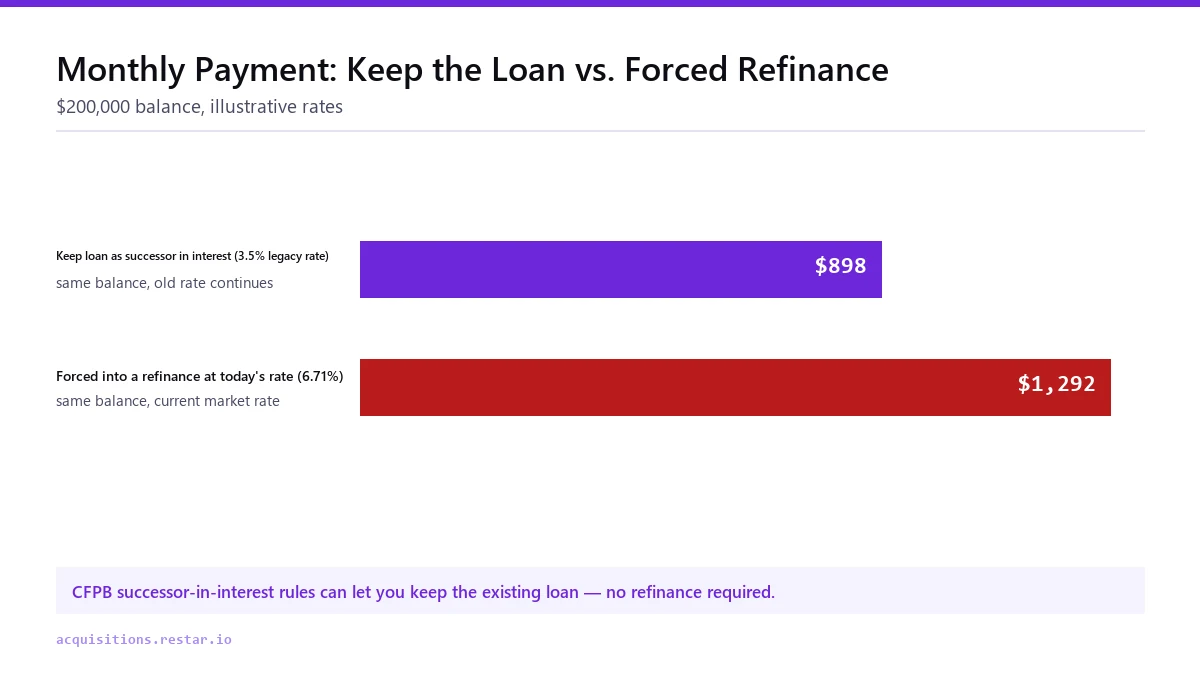
The CFPB has documented the problem this protects against: a December 2024 report found servicers sometimes push grieving spouses toward a new, higher-rate refinance instead of simply recognizing them as successors in interest on the existing loan. If mortgage rates have moved since your original loan closed, that difference is real money.
Keeping the loan vs. a forced refinanceRestar Acquisitions · illustrative amortization, not a quote.
If you don't intend to keep the house, none of this changes your ability to sell — you can list and close with the existing loan paid off at settlement either way. The successor-in-interest protections matter most if you want to keep living in the home and keep the existing rate rather than being talked into an unnecessary refinance.
If probate is required
If the house was solely in your late spouse's name, or held as tenants in common, someone has to be appointed by the probate court — usually the surviving spouse, if there's a will naming you as executor — before that person has legal authority to sell.
Full probate commonly runs anywhere from about six months to well over a year, longer if there's no will or if anyone contests it. But most states also offer a simplified process for smaller estates that skips most of that: California's small-estate affidavit, for example, is available for estates under a set dollar threshold and can close in roughly two months rather than a year-plus. Ask a probate attorney or your county's self-help court resources whether your estate qualifies before assuming you're in for the long process.
What this looks like at closing, either way
How title was held
Probate needed?
Basis step-up
Typical time before you can list
Joint tenancy w/ right of survivorship
No
Half (common-law states) or full (community-property states)
Days to a few weeks
Tenancy by the entirety
No
Half (most TBE states are common-law)
Days to a few weeks
Community property w/ survivorship
No
Full
Days to a few weeks
Sole ownership / tenancy in common, no survivorship
Yes, unless a small-estate exception applies
Full (FMV at death)
~2 months (small estate) to 12+ months (full probate)
The honest tradeoff: sell now, sell later, or keep it
None of this changes the basic math of selling. A cash offer closes faster and skips repairs, but it's priced below what a fully prepared, agent-listed sale can bring once you subtract commission, closing costs, and the months a listing can sit on the market. If you're not under financial pressure to sell quickly, and the house doesn't need major repairs, listing with an agent may put more in your pocket even after those costs. If the estate needs cash quickly, if the house needs work you can't fund, or if you simply don't want to manage a listing while grieving, a cash sale trades some of that upside for speed and certainty. There's also a third option worth naming plainly: keep the house, especially if the mortgage terms are still favorable once you're confirmed as a successor in interest — selling isn't the only path forward.
A HUD-approved housing counselor or an estate attorney can help you weigh this without a sales agenda attached to the advice.
Common questions
Do I have to go through probate to sell the house?
Only if your spouse was the sole owner, or if you held title as tenants in common without survivorship rights. If you owned the home as joint tenants, tenants by the entirety, or community property with survivorship, the house is already yours and probate generally isn't required for that asset.
Do I have to refinance the mortgage into my own name?
Not automatically. Under CFPB rules, a surviving spouse who inherits the home is a "successor in interest" and can generally keep making payments on the existing loan once the servicer confirms your ownership — you don't have to qualify as a new borrower or take on a new rate unless you choose to.
What is a step-up in basis, and does it apply to my whole house?
It resets the property's cost basis to fair market value as of the date of death, which reduces your taxable gain if you sell. In community-property states, the entire home can qualify for this reset; in common-law states, generally only your late spouse's half does. Confirm your specific figures with a CPA.
How long does probate take if it is required?
Full probate commonly takes six months to well over a year, and longer without a will or if it's contested. Many states offer a faster small-estate process for estates under a certain value — check your state's threshold before assuming the long timeline applies to you.
Can I sell the house before probate is finished?
Often yes, once a personal representative has been formally appointed, though some states require court approval of the sale terms. This varies by state and by whether the will grants the executor an explicit power of sale.
Is a cash offer or a listing better after a spouse's death?
It depends on your timeline and the house's condition. A cash sale is faster and skips repairs but nets less than a well-prepared listing. If you're not under time pressure and the home is in reasonable shape, listing may put more in your pocket; if you need speed or can't fund repairs, a cash offer trades some proceeds for certainty.
If you'd rather not manage a listing right now, we can make this simple
Selling isn't the only option, and it isn't always the right one — but if you decide it is, we can give you a plain cash offer and close on your timeline, without you needing to fix anything first. Send us the address and we'll tell you honestly how the numbers compare to listing.
If keeping the house and staying on as a successor in interest makes more sense for you, that's worth knowing too — we'll say so.
Every offer on this site is underwritten by a person, not a form. If the
numbers do not work for you, say so and I will tell you what would.
Also from Restar
Want the data behind all of this?
Restar Acquisitions is the acquisitions arm of Restar — a housing-market analytics
platform tracking 180+ metrics across every U.S. market, with composite scores and 12-month
price forecasts. The numbers on this page come from the same work.